

Wealth Daily
Meta Gains as Mortgage Competition Hits FICO
Today’s Must-Know News
Overnight Markets
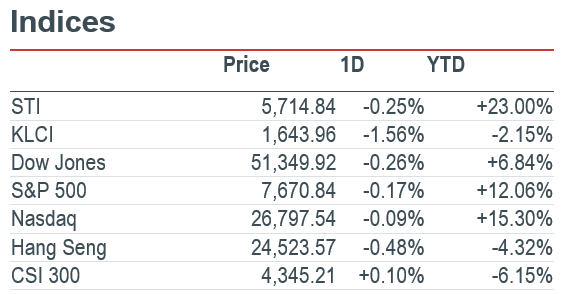

Market Movers: At Tuesday’s US close, the S&P 500 slipped 0.17%. Meta Platforms (META US) gained about 3.2% as it launched Muse for Small Business, linking its AI agent to social accounts, advertising and outside business tools. Oracle (ORCL US) rose about 3.9% alongside its Fusion Claw launch, adding 25 applications to a suite of 75. OpenAI separately introduced Dots, persistent cloud agents connected to more than 4,000 apps, intensifying competition for business workflows. FICO (FICO US) plunged about 26.5% in the first regular session after Rocket Mortgage’s Monday announcement that VantageScore 4.0 would become the preferred model for eligible direct loans in the fourth quarter. Product exclusions limit the immediate reach of the shift, but the move challenges FICO’s mortgage franchise. (Meta / Oracle / OpenAI / Rocket) Meta (META US) is our Core Recommendation.
Macro: China announced new support after Tuesday’s mainland and Hong Kong closes: a 25bp reduction in the one-year pledged supplementary lending rate to 1.50%, plus an annual one-percentage-point interest subsidy for eligible first-home mortgages for up to five years on subsidised principal capped at RMB1mn. Australia raised its cash-rate target by 25bps to 4.60%. US consumer confidence fell to 81.9 from 88.6 in September, highlighting household unease as policy and inflation risks diverge across economies. (PBOC / Xinhua / RBA / Conference Board)
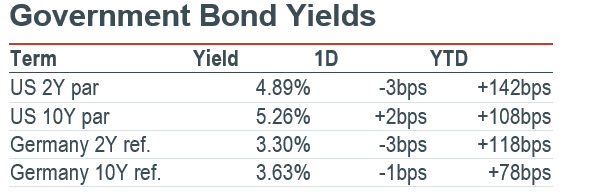
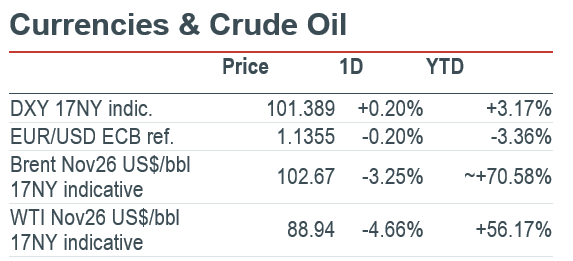
FICC: The US 10Y Treasury par yield rose 2bps to 5.26% on Tuesday. At the 17:00 New York indicative snapshot, November WTI fell 4.66% to US$88.94/bbl against Monday’s same-time level, while December gold rose 1.60% to US$4,215.00/oz. Oil’s decline accompanied reports of restored Saudi pipeline operations and resumed exports from Yanbu, easing immediate supply concerns. (US Treasury / Yahoo / Yahoo / DTN)
AI
Meta pushes Muse into small business workflows. Meta Platforms (META US) launched Muse for Small Business on Tuesday, connecting its AI agent to Shopify, QuickBooks, Stripe and Canva. Shares gained about 3.2% at Tuesday’s U.S. close. Users must approve publishing, sending and spending. The integrations extend Meta into routine business operations, where workflow adoption can broaden its commercial reach beyond existing advertising relationships. (Meta) Meta Platforms (META US) is our Core Recommendation.
OpenAI expands persistent agents and cheaper models. OpenAI launched Dots at Tuesday’s DevDay, offering persistent cloud agents that connect to over 4,000 apps. GPT-6.1 Sol became available in Work, Codex and the API, with standard token prices of US$2 for input and US$10 for output per million. Combining persistent execution with lower model costs broadens business automation, although savings depend on each workload’s usage and reliability. (OpenAI Dots / OpenAI Sol)
Anthropic disclosures expose dependence on cloud partners. Reuters’ fresh review of Anthropic’s IPO prospectus showed 47% of 2025 sales passed through Amazon (AMZN US) and Alphabet’s (GOOGL US) Google marketplaces, versus 32% in 2024. Fees were roughly US$351m on US$2.16bn of channel sales; two customers each supplied 12% of revenue. Distribution benefits therefore come with concentrated exposure to partners’ commercial terms and computing capacity. (Reuters) Amazon (AMZN US) is our Core Recommendation. Alphabet (GOOGL US) is our Trading Buy.
Oracle embeds autonomous execution in enterprise applications. Oracle (ORCL US) introduced Fusion Claw on Tuesday, adding 25 applications to its 75-strong Agentic Applications portfolio. It combines Gemini and OpenAI models with deterministic computation and company-defined approval limits. Shares gained about 3.9% at Tuesday’s U.S. close. Embedding execution within existing business processes strengthens Oracle’s enterprise AI offering, although no incremental sales forecast quantified the launch’s commercial contribution. (Oracle)
Americas
Carnival bookings cushion the impact of fuel. Carnival (CCL US) gained about 13.4% at Tuesday’s U.S. close after reporting third-quarter adjusted EPS of US$1.43 and customer deposits of US$7.6bn, up nearly 7% on flat capacity. More than US$150m of operational improvement in its full-year adjusted profit outlook offsets a US$150m fuel-price hit. Strong bookings support earnings resilience, but energy costs absorb much of the operating upside. (Carnival)
FICO slides as Rocket adopts rival scores. FICO (FICO US) fell about 26.5% at Tuesday’s U.S. close, the first regular session after Rocket Mortgage’s Monday announcement that it will default eligible direct mortgages to VantageScore 4.0 in Q4. FHA, jumbo and other excluded loans retain FICO scores. The shift expands mortgage-scoring competition, pressuring FICO’s pricing power while leaving parts of its existing business intact. (Rocket Mortgage)
UniQure declines after mixed Huntington’s disease results. UniQure (QURE US) fell about 37.3% at Tuesday’s U.S. close after updated AMT-130 Huntington’s results. Among 12 high-dose patients at 48 months, progression on the composite disease scale slowed 44% against matched external controls, without statistical significance (p=0.144). Total Functional Capacity showed 61% slowing (nominal p=0.008). The differing statistical strength leaves durability uncertain despite evidence of benefit on daily functioning. (uniQure)
Iovance lifts guidance as treatment demand strengthens. Iovance (IOVA US) gained about 31.5% at Tuesday’s U.S. close after raising its 2026 revenue outlook to US$410–420m from US$350–370m, a US$55m midpoint increase. Strong U.S. demand for Amtagvi and Proleukin drove the revision. Treatment centers number about 100, with at least 110 targeted by year-end. Greater capacity supports patient access while higher sales can improve absorption of manufacturing costs. (Iovance)
Corning secures multiyear fiber demand from AT&T. Corning (GLW US) gained about 4.7% at Tuesday’s U.S. close after agreeing a multiyear fiber supply contract exceeding US$3bn with AT&T (T US). It supports AT&T’s goal of connecting 60m Americans by end-2030. AT&T reiterated its financial and capital-allocation outlook, already incorporating the deal. The order improves Corning’s demand visibility without implying a fresh increase in AT&T’s spending plans. (AT&T)
CarMax sales recovery comes with margin tradeoffs. CarMax (KMX US) gained about 4.7% at Tuesday’s U.S. close after second-quarter revenue rose 19.5% to US$7.9bn and EPS reached US$1.16 versus US$0.64. Comparable used-unit sales increased 13.0%, but retail gross profit per vehicle fell US$111 to US$2,105. Plans to resume Q3 buybacks signal improving confidence, while thinner vehicle margins show the cost of restoring price competitiveness and sales momentum. (CarMax)
L3Harris expands propulsion output under THAAD award. L3Harris (LHX US) received an undefinitized Lockheed Martin (LMT US) contract exceeding US$6bn over seven years, excluding escalation, to expand THAAD propulsion production. It plans a new booster facility and additional divert-and-attitude-control capacity. The award supports a longer production runway but remains subject to final terms and funding. Consistency with previously announced program expectations limits immediate forecast upside. (L3Harris)
Greater China
Shein’s first results expose freight cost pressure. Shein (0625.HK) fell about 10.7% in the 29 Sep Hong Kong session, the first reaction to Monday’s results. Adjusted second-quarter profit fell 67% to US$228m, while its margin narrowed to 2.1% from 6.2%. Higher jet-fuel and freight costs squeezed earnings, highlighting its cross-border delivery model’s exposure to transport inflation and the limits of European price increases. (Reuters)
Hengrui monetises early obesity pipeline through Novo. Hengrui Pharma (1276.HK) licensed experimental HRS-1596 to Novo Nordisk (NOVO-B.CO) for up to US$2.6bn in total, including US$300m upfront and contingent milestones, plus royalties. The once-weekly oral GLP-1/GIP candidate is ready for phase-one trials; Greater China rights remain with Hengrui. The agreement validates its innovative discovery platform, while most potential proceeds remain dependent on clinical and commercial success. (Hengrui / Reuters)
Mixed debuts reward selective industrial technology exposure. Hong Kong’s 29 Sep debuts produced sharply different outcomes. RoboTechnik (3757.HK) closed at HK$414.40, 4.95% below its HK$436 offer, while circuit-board maker Kinwong (3228.HK) finished at HK$77.05, 10.26% above HK$69.88. Direct Drive (6731.HK) and Red Avenue (9607.HK) also debuted. The dispersion shows that reopening equity funding does not guarantee immediate gains, reinforcing the importance of offer valuation and business differentiation. (HKEX / MT Newswires)
Targeted credit easing supports affordable housing demand. China cut its one-year pledged supplementary lending rate 25bp to 1.50% and announced annual mortgage-interest subsidies of one percentage point for eligible first-home loans. Support lasts up to five years on principal capped at RMB1m, for homes worth no more than RMB1.5m and measuring 120 square metres or less. The package targets affordability rather than unrestricted property stimulus. (PBOC / MOF)
Wangsu pursues exposure to video generation models. Wangsu (300017.SZ) approved a planned RMB300m investment in Sand.ai, targeting a 4.3963% stake after its funding round. Definitive agreements remain unsigned, and completion requires overseas-investment procedures. Sand.ai generated roughly RMB17.4m revenue but lost RMB151.6m in first-half 2026. The proposal broadens Wangsu’s AI exposure, although the target’s losses underline the funding needs and uncertain monetisation of video-generation models. (Wangsu)
Asia ex. China
Samsung broadens AI exposure into infrastructure ownership. Samsung Electronics (005930.KS) and five affiliates committed US$1bn to Helix, backed by KKR (KKR US), with Electronics providing US$500m. Helix combines data centres, power and connectivity, and already had over US$10bn committed at launch. The investment offers opportunities across chips, cooling, construction and batteries, expanding Samsung’s role beyond component supply; commercial benefits still depend on infrastructure deployment and future contracts. (Samsung / KKR)
Toyota’s China weakness offsets Japanese sales recovery. Toyota (7203.T) reported August global Toyota and Lexus sales down 6.4% year-on-year to 790,743 vehicles, with production down 5.9% to 700,860. China sales fell 22.8%, their seventh consecutive monthly contraction, while Japan gained 9.1%. Domestic recovery is therefore insufficient to offset overseas pressure, leaving product competitiveness and demand normalisation central to the group’s volume outlook. (Reuters)
Jinjiang privatisation offers cash or unlisted exposure. Zheneng Jinjiang Environment (BWM.SI) rose about 24.1% in the 29 Sep Singapore session after announcing a privatisation scheme offering S$0.70 cash or one new unlisted offeror share for each existing share. Cash is the default election. Approvals remain outstanding, while investors choosing equity would retain a less liquid holding, making consideration choice important alongside the headline exit price. (Issuer / Business Times)
Singapore funding targets broader equity market liquidity. MAS allocated S$1.45bn to five additional asset managers under its S$6.5bn Equity Market Development Programme, bringing allocations to S$5.4bn. A separate S$20m market-making grant targets roughly 80 smaller stocks and new listings. Together, the measures address investment demand and transaction costs, potentially broadening participation beyond index heavyweights; the test is sustained trading depth as managers deploy capital. (Reuters / The Edge)
EMEA and Others
AstraZeneca buys access to cancer combination opportunities. AstraZeneca (AZN LN) disclosed a US$2bn Summit Therapeutics (SMMT US) investment representing 12% of outstanding shares, alongside trials combining its Sone-Ve antibody-drug conjugate with Summit’s ivonescimab. Gastrointestinal cancers are the initial focus, with each partner retaining commercial rights to its medicine. The structure couples equity exposure with clinical collaboration, widening oncology options while value creation depends on combination efficacy and safety. (AstraZeneca)
Berlin seeks safeguards as UniCredit advances control. Germany expects UniCredit (UCG.MI) to protect jobs, Commerzbank’s (CBK.DE) Frankfurt headquarters, its listing and lending to medium-sized companies, Reuters reported. Berlin owns 13.3% of Commerzbank, while UniCredit has secured nearly half its share capital subject to supervisory clearance. The demands suggest a negotiating path, but conditions protecting domestic autonomy could constrain integration and the cost savings underpinning the transaction. (Reuters)
Lindt’s guidance cut exposes demand sensitivity. Lindt (LISP.SW) fell about 8.7% in the 29 Sep Swiss session after cutting 2026 organic sales-growth guidance to 0–2% from 4–6%. It retained its 20–40bp operating-margin improvement target despite weak seasonal orders in Germany, Switzerland and Austria. Pricing and cost management can cushion margins, but premium confectionery demand is proving less resilient after substantial price increases. (Lindt / Investing.com)
Julius Baer relief retains capital distribution constraints. Julius Baer (BAER.SW) gained about 7.2% in the 29 Sep Swiss session after FINMA concluded enforcement proceedings and relaxed some restrictions. The bank must still hold CHF250m additional capital until specified client exits finish, while shareholder payouts require approval. A buyback request is pending. Regulatory uncertainty has eased, but conditions still govern when excess capital can be returned. (FINMA / Reuters)
Vesuvius bid discussions highlight refractory consolidation potential. Vesuvius (VSVS.L) surged about 24.7% in the 29 Sep London session after disclosing advanced discussions over RHI Magnesita’s (RHIM.L) indicative proposal. Consideration of 470p cash plus 0.028 RHI shares valued each share at 549p using the previous close. The August proposal remains non-binding. Consolidation could reshape refractory supply to steelmakers, but execution and eventual terms remain uncertain. (RHI Magnesita / Reuters)
Close Brothers recovery faces redress capital constraints. Close Brothers (CBG.L) jumped about 15.5% in the 29 Sep London session as results showed accelerated cost savings. Adjusted operating profit fell 17% to £120.3m, but management projected 5–10% underlying loan growth for 2027. Its 14.1% CET1 ratio supports expansion; however, roughly £320m of motor-finance provisions and no final dividend keep redress uncertainty central to shareholder returns. (Close Brothers)
Traders’ corner
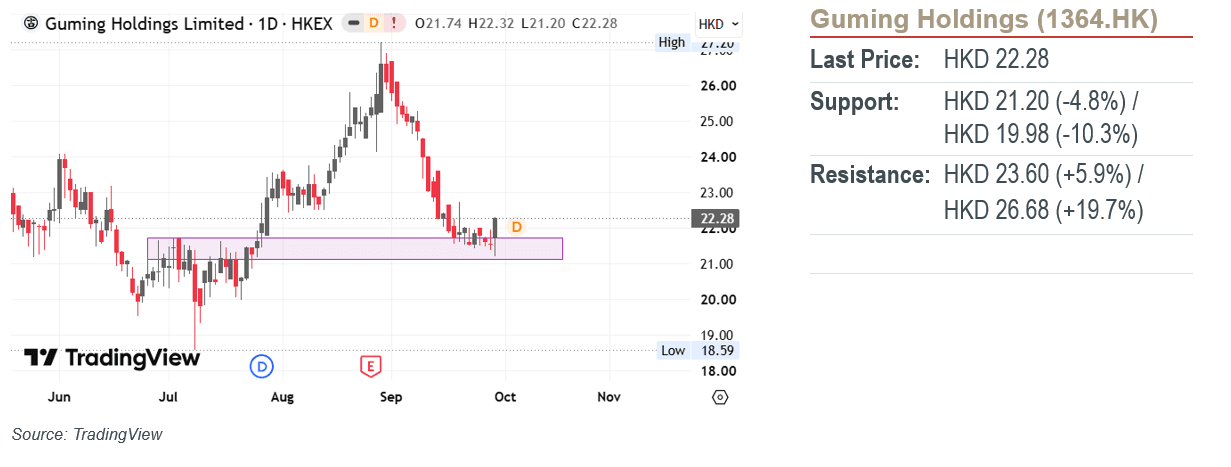
Our Technical View
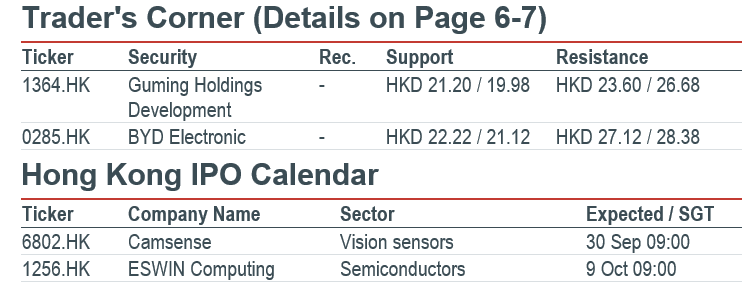
Price rebounded from its resistance-turned-support zone.
The RSI is turning upward directly out of deep oversold territory, signaling extreme momentum exhaustion among sellers and a sharp reacceleration of buy-side momentum.
With price strictly supported above this converted anchor, we could see a sustained bullish expansion toward the prior swing high resistance.
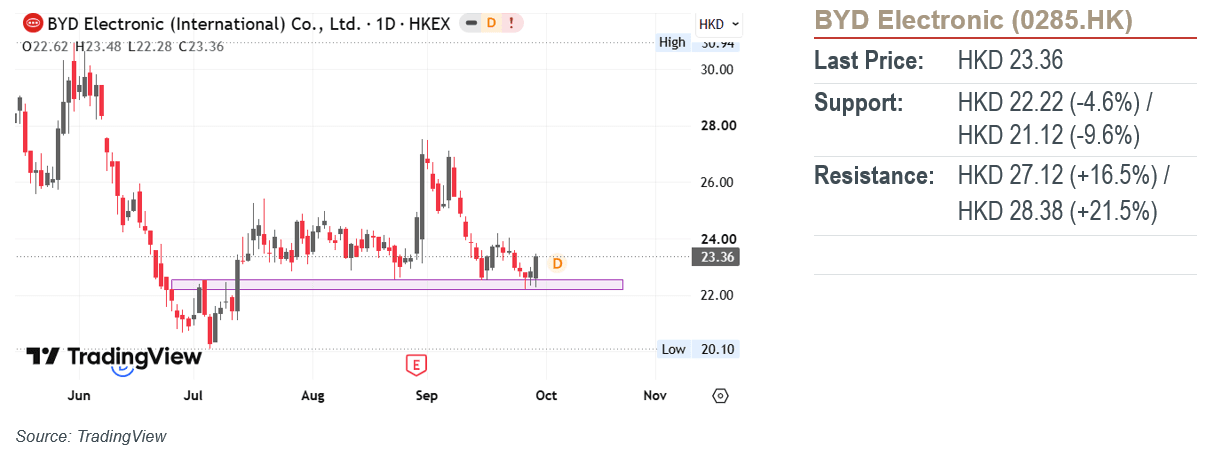
Our Technical View
Price rebounded from its resistance-turned-support zone.
The RSI remains below its neutral 50-midline, its upward turn signals decaying downside momentum and the early stages of a momentum reacceleration.
As long as price remains supported above this converted anchor, we see a sustained bullish expansion toward higher supply targets.
Market Movers: At Tuesday’s US close, the S&P 500 slipped 0.17%. Meta Platforms (META US) gained about 3.2% as it launched Muse for Small Business, linking its AI agent to social accounts, advertising and outside business tools. Oracle (ORCL US) rose about 3.9% alongside its Fusion Claw launch, adding 25 applications to a suite of 75. OpenAI separately introduced Dots, persistent cloud agents connected to more than 4,000 apps, intensifying competition for business workflows. FICO (FICO US) plunged about 26.5% in the first regular session after Rocket Mortgage’s Monday announcement that VantageScore 4.0 would become the preferred model for eligible direct loans in the fourth quarter. Product exclusions limit the immediate reach of the shift, but the move challenges FICO’s mortgage franchise. (Meta / Oracle / OpenAI / Rocket) Meta (META US) is our Core Recommendation.
Macro: China announced new support after Tuesday’s mainland and Hong Kong closes: a 25bp reduction in the one-year pledged supplementary lending rate to 1.50%, plus an annual one-percentage-point interest subsidy for eligible first-home mortgages for up to five years on subsidised principal capped at RMB1mn. Australia raised its cash-rate target by 25bps to 4.60%. US consumer confidence fell to 81.9 from 88.6 in September, highlighting household unease as policy and inflation risks diverge across economies. (PBOC / Xinhua / RBA / Conference Board)
FICC: The US 10Y Treasury par yield rose 2bps to 5.26% on Tuesday. At the 17:00 New York indicative snapshot, November WTI fell 4.66% to US$88.94/bbl against Monday’s same-time level, while December gold rose 1.60% to US$4,215.00/oz. Oil’s decline accompanied reports of restored Saudi pipeline operations and resumed exports from Yanbu, easing immediate supply concerns. (US Treasury / Yahoo / Yahoo / DTN)
AI
Meta pushes Muse into small business workflows. Meta Platforms (META US) launched Muse for Small Business on Tuesday, connecting its AI agent to Shopify, QuickBooks, Stripe and Canva. Shares gained about 3.2% at Tuesday’s U.S. close. Users must approve publishing, sending and spending. The integrations extend Meta into routine business operations, where workflow adoption can broaden its commercial reach beyond existing advertising relationships. (Meta) Meta Platforms (META US) is our Core Recommendation.
OpenAI expands persistent agents and cheaper models. OpenAI launched Dots at Tuesday’s DevDay, offering persistent cloud agents that connect to over 4,000 apps. GPT-6.1 Sol became available in Work, Codex and the API, with standard token prices of US$2 for input and US$10 for output per million. Combining persistent execution with lower model costs broadens business automation, although savings depend on each workload’s usage and reliability. (OpenAI Dots / OpenAI Sol)
Anthropic disclosures expose dependence on cloud partners. Reuters’ fresh review of Anthropic’s IPO prospectus showed 47% of 2025 sales passed through Amazon (AMZN US) and Alphabet’s (GOOGL US) Google marketplaces, versus 32% in 2024. Fees were roughly US$351m on US$2.16bn of channel sales; two customers each supplied 12% of revenue. Distribution benefits therefore come with concentrated exposure to partners’ commercial terms and computing capacity. (Reuters) Amazon (AMZN US) is our Core Recommendation. Alphabet (GOOGL US) is our Trading Buy.
Oracle embeds autonomous execution in enterprise applications. Oracle (ORCL US) introduced Fusion Claw on Tuesday, adding 25 applications to its 75-strong Agentic Applications portfolio. It combines Gemini and OpenAI models with deterministic computation and company-defined approval limits. Shares gained about 3.9% at Tuesday’s U.S. close. Embedding execution within existing business processes strengthens Oracle’s enterprise AI offering, although no incremental sales forecast quantified the launch’s commercial contribution. (Oracle)
Americas
Carnival bookings cushion the impact of fuel. Carnival (CCL US) gained about 13.4% at Tuesday’s U.S. close after reporting third-quarter adjusted EPS of US$1.43 and customer deposits of US$7.6bn, up nearly 7% on flat capacity. More than US$150m of operational improvement in its full-year adjusted profit outlook offsets a US$150m fuel-price hit. Strong bookings support earnings resilience, but energy costs absorb much of the operating upside. (Carnival)
FICO slides as Rocket adopts rival scores. FICO (FICO US) fell about 26.5% at Tuesday’s U.S. close, the first regular session after Rocket Mortgage’s Monday announcement that it will default eligible direct mortgages to VantageScore 4.0 in Q4. FHA, jumbo and other excluded loans retain FICO scores. The shift expands mortgage-scoring competition, pressuring FICO’s pricing power while leaving parts of its existing business intact. (Rocket Mortgage)
UniQure declines after mixed Huntington’s disease results. UniQure (QURE US) fell about 37.3% at Tuesday’s U.S. close after updated AMT-130 Huntington’s results. Among 12 high-dose patients at 48 months, progression on the composite disease scale slowed 44% against matched external controls, without statistical significance (p=0.144). Total Functional Capacity showed 61% slowing (nominal p=0.008). The differing statistical strength leaves durability uncertain despite evidence of benefit on daily functioning. (uniQure)
Iovance lifts guidance as treatment demand strengthens. Iovance (IOVA US) gained about 31.5% at Tuesday’s U.S. close after raising its 2026 revenue outlook to US$410–420m from US$350–370m, a US$55m midpoint increase. Strong U.S. demand for Amtagvi and Proleukin drove the revision. Treatment centers number about 100, with at least 110 targeted by year-end. Greater capacity supports patient access while higher sales can improve absorption of manufacturing costs. (Iovance)
Corning secures multiyear fiber demand from AT&T. Corning (GLW US) gained about 4.7% at Tuesday’s U.S. close after agreeing a multiyear fiber supply contract exceeding US$3bn with AT&T (T US). It supports AT&T’s goal of connecting 60m Americans by end-2030. AT&T reiterated its financial and capital-allocation outlook, already incorporating the deal. The order improves Corning’s demand visibility without implying a fresh increase in AT&T’s spending plans. (AT&T)
CarMax sales recovery comes with margin tradeoffs. CarMax (KMX US) gained about 4.7% at Tuesday’s U.S. close after second-quarter revenue rose 19.5% to US$7.9bn and EPS reached US$1.16 versus US$0.64. Comparable used-unit sales increased 13.0%, but retail gross profit per vehicle fell US$111 to US$2,105. Plans to resume Q3 buybacks signal improving confidence, while thinner vehicle margins show the cost of restoring price competitiveness and sales momentum. (CarMax)
L3Harris expands propulsion output under THAAD award. L3Harris (LHX US) received an undefinitized Lockheed Martin (LMT US) contract exceeding US$6bn over seven years, excluding escalation, to expand THAAD propulsion production. It plans a new booster facility and additional divert-and-attitude-control capacity. The award supports a longer production runway but remains subject to final terms and funding. Consistency with previously announced program expectations limits immediate forecast upside. (L3Harris)
Greater China
Shein’s first results expose freight cost pressure. Shein (0625.HK) fell about 10.7% in the 29 Sep Hong Kong session, the first reaction to Monday’s results. Adjusted second-quarter profit fell 67% to US$228m, while its margin narrowed to 2.1% from 6.2%. Higher jet-fuel and freight costs squeezed earnings, highlighting its cross-border delivery model’s exposure to transport inflation and the limits of European price increases. (Reuters)
Hengrui monetises early obesity pipeline through Novo. Hengrui Pharma (1276.HK) licensed experimental HRS-1596 to Novo Nordisk (NOVO-B.CO) for up to US$2.6bn in total, including US$300m upfront and contingent milestones, plus royalties. The once-weekly oral GLP-1/GIP candidate is ready for phase-one trials; Greater China rights remain with Hengrui. The agreement validates its innovative discovery platform, while most potential proceeds remain dependent on clinical and commercial success. (Hengrui / Reuters)
Mixed debuts reward selective industrial technology exposure. Hong Kong’s 29 Sep debuts produced sharply different outcomes. RoboTechnik (3757.HK) closed at HK$414.40, 4.95% below its HK$436 offer, while circuit-board maker Kinwong (3228.HK) finished at HK$77.05, 10.26% above HK$69.88. Direct Drive (6731.HK) and Red Avenue (9607.HK) also debuted. The dispersion shows that reopening equity funding does not guarantee immediate gains, reinforcing the importance of offer valuation and business differentiation. (HKEX / MT Newswires)
Targeted credit easing supports affordable housing demand. China cut its one-year pledged supplementary lending rate 25bp to 1.50% and announced annual mortgage-interest subsidies of one percentage point for eligible first-home loans. Support lasts up to five years on principal capped at RMB1m, for homes worth no more than RMB1.5m and measuring 120 square metres or less. The package targets affordability rather than unrestricted property stimulus. (PBOC / MOF)
Wangsu pursues exposure to video generation models. Wangsu (300017.SZ) approved a planned RMB300m investment in Sand.ai, targeting a 4.3963% stake after its funding round. Definitive agreements remain unsigned, and completion requires overseas-investment procedures. Sand.ai generated roughly RMB17.4m revenue but lost RMB151.6m in first-half 2026. The proposal broadens Wangsu’s AI exposure, although the target’s losses underline the funding needs and uncertain monetisation of video-generation models. (Wangsu)
Asia ex. China
Samsung broadens AI exposure into infrastructure ownership. Samsung Electronics (005930.KS) and five affiliates committed US$1bn to Helix, backed by KKR (KKR US), with Electronics providing US$500m. Helix combines data centres, power and connectivity, and already had over US$10bn committed at launch. The investment offers opportunities across chips, cooling, construction and batteries, expanding Samsung’s role beyond component supply; commercial benefits still depend on infrastructure deployment and future contracts. (Samsung / KKR)
Toyota’s China weakness offsets Japanese sales recovery. Toyota (7203.T) reported August global Toyota and Lexus sales down 6.4% year-on-year to 790,743 vehicles, with production down 5.9% to 700,860. China sales fell 22.8%, their seventh consecutive monthly contraction, while Japan gained 9.1%. Domestic recovery is therefore insufficient to offset overseas pressure, leaving product competitiveness and demand normalisation central to the group’s volume outlook. (Reuters)
Jinjiang privatisation offers cash or unlisted exposure. Zheneng Jinjiang Environment (BWM.SI) rose about 24.1% in the 29 Sep Singapore session after announcing a privatisation scheme offering S$0.70 cash or one new unlisted offeror share for each existing share. Cash is the default election. Approvals remain outstanding, while investors choosing equity would retain a less liquid holding, making consideration choice important alongside the headline exit price. (Issuer / Business Times)
Singapore funding targets broader equity market liquidity. MAS allocated S$1.45bn to five additional asset managers under its S$6.5bn Equity Market Development Programme, bringing allocations to S$5.4bn. A separate S$20m market-making grant targets roughly 80 smaller stocks and new listings. Together, the measures address investment demand and transaction costs, potentially broadening participation beyond index heavyweights; the test is sustained trading depth as managers deploy capital. (Reuters / The Edge)
EMEA and Others
AstraZeneca buys access to cancer combination opportunities. AstraZeneca (AZN LN) disclosed a US$2bn Summit Therapeutics (SMMT US) investment representing 12% of outstanding shares, alongside trials combining its Sone-Ve antibody-drug conjugate with Summit’s ivonescimab. Gastrointestinal cancers are the initial focus, with each partner retaining commercial rights to its medicine. The structure couples equity exposure with clinical collaboration, widening oncology options while value creation depends on combination efficacy and safety. (AstraZeneca)
Berlin seeks safeguards as UniCredit advances control. Germany expects UniCredit (UCG.MI) to protect jobs, Commerzbank’s (CBK.DE) Frankfurt headquarters, its listing and lending to medium-sized companies, Reuters reported. Berlin owns 13.3% of Commerzbank, while UniCredit has secured nearly half its share capital subject to supervisory clearance. The demands suggest a negotiating path, but conditions protecting domestic autonomy could constrain integration and the cost savings underpinning the transaction. (Reuters)
Lindt’s guidance cut exposes demand sensitivity. Lindt (LISP.SW) fell about 8.7% in the 29 Sep Swiss session after cutting 2026 organic sales-growth guidance to 0–2% from 4–6%. It retained its 20–40bp operating-margin improvement target despite weak seasonal orders in Germany, Switzerland and Austria. Pricing and cost management can cushion margins, but premium confectionery demand is proving less resilient after substantial price increases. (Lindt / Investing.com)
Julius Baer relief retains capital distribution constraints. Julius Baer (BAER.SW) gained about 7.2% in the 29 Sep Swiss session after FINMA concluded enforcement proceedings and relaxed some restrictions. The bank must still hold CHF250m additional capital until specified client exits finish, while shareholder payouts require approval. A buyback request is pending. Regulatory uncertainty has eased, but conditions still govern when excess capital can be returned. (FINMA / Reuters)
Vesuvius bid discussions highlight refractory consolidation potential. Vesuvius (VSVS.L) surged about 24.7% in the 29 Sep London session after disclosing advanced discussions over RHI Magnesita’s (RHIM.L) indicative proposal. Consideration of 470p cash plus 0.028 RHI shares valued each share at 549p using the previous close. The August proposal remains non-binding. Consolidation could reshape refractory supply to steelmakers, but execution and eventual terms remain uncertain. (RHI Magnesita / Reuters)
Close Brothers recovery faces redress capital constraints. Close Brothers (CBG.L) jumped about 15.5% in the 29 Sep London session as results showed accelerated cost savings. Adjusted operating profit fell 17% to £120.3m, but management projected 5–10% underlying loan growth for 2027. Its 14.1% CET1 ratio supports expansion; however, roughly £320m of motor-finance provisions and no final dividend keep redress uncertainty central to shareholder returns. (Close Brothers)
Traders’ corner
Our Technical View
Price rebounded from its resistance-turned-support zone.
The RSI is turning upward directly out of deep oversold territory, signaling extreme momentum exhaustion among sellers and a sharp reacceleration of buy-side momentum.
With price strictly supported above this converted anchor, we could see a sustained bullish expansion toward the prior swing high resistance.
Our Technical View
Price rebounded from its resistance-turned-support zone.
The RSI remains below its neutral 50-midline, its upward turn signals decaying downside momentum and the early stages of a momentum reacceleration.
As long as price remains supported above this converted anchor, we see a sustained bullish expansion toward higher supply targets.
Disclosures and disclaimers
This report is provided subject to, and must be read together with, the full Disclosures / Disclaimers available at this link, which are incorporated by reference into this report. In particular, this report is intended for general circulation and informational purposes only and does not constitute personal investment advice or a recommendation to buy or sell any investment product or security. You should independently evaluate the information and, where necessary, seek advice from a qualified financial adviser regarding the suitability of any investment. Analyst certifications required under applicable regulations, including SEC Regulation AC (where relevant), are included in this report. By accessing, receiving or using this report, you acknowledge that you have read, understood and agreed to be bound by the Disclosures / Disclaimers, as may be amended, supplemented or updated from time to time.


