

Wealth Daily
Tech Rebounds As Central-Bank Paths Diverge
Today’s Must-Know News
Overnight Markets
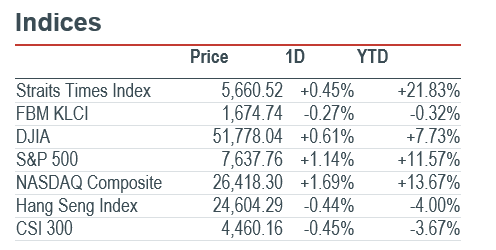
Market Movers: The S&P 500 rose 1.14% in the completed 17 September US session as technology stocks rebounded. Generac (GNRC US) gained about 18.3% in its first regular-session reaction to the Amazon generator contract, whose initial deliveries are expected to total US$2.4bn. Nvidia (NVDA US) rose about 2.5%; its newly disclosed US$2bn contribution to a Brookfield AI fund adds detail to an earlier investment announcement. MiniMax (0100 HK) gained about 7.1% at the 17 September Hong Kong close on SkillsFuture subscription exposure in Singapore. (WPR / Bloomberg / Reuters / AAStocks / StockAnalysis)
Macro: The Bank of England held Bank Rate at 3.75% in a 6–3 vote, warned inflation could exceed 4% in early 2027 and paused gilt sales pending its operational review. The Bank of Japan is expected to raise rates from 1.00% to 1.25% today, a 31-year high; the decision remains ahead of the cutoff. The pace of subsequent tightening and the yen response are key watchpoints. (Bank of England / Reuters)
Geopolitical: Trump said on Thursday he was weighing renewed large-scale attacks on Iran; no decision was announced. Escalation would threaten energy supply and shipping, keeping the geopolitical risk premium sensitive to fresh policy signals. (Axios)
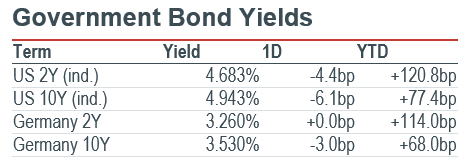
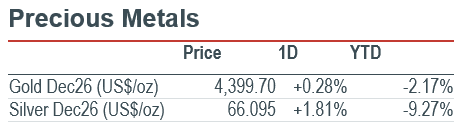
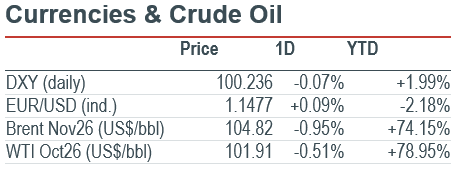
FICC: Brent November futures settled at US$104.82/bbl on 17 September, down 0.95%, as Saudi supply concerns eased; WTI October fell 0.51% to US$101.91/bbl. December gold settled at US$4,399.70/oz, up 0.28%. December silver gained about 1.8% to US$66.095/oz, outperforming gold. The indicative US 10-year yield reported at 03:03 SGT was 4.943%, down 6.1bp from the prior close. (Reuters / AP / Reuters) Nvidia (NVDA US) and Amazon (AMZN US) are our Core Recommendations.
AI
Nvidia's disclosed Brookfield commitment deepens its financing footprint. Investor documents reported by Bloomberg put Nvidia's previously announced Brookfield AI fund commitment at US$2bn. The fund seeks US$10bn; the disclosure establishes investment size rather than a new agreement. Nvidia (NVDA US) rose approximately 2.5% in the 17 September U.S. session. Customer financing can support chip demand, while deepening exposure to AI infrastructure economics. (Bloomberg / StockAnalysis) Nvidia (NVDA US) is our Core Recommendation.
Generac's Amazon contract delivers a sharp first-session rerating. Generac (GNRC US) gained approximately 18.3% in the 17 September U.S. session, the first regular session after its Amazon supply disclosure. Expected backup-generator deliveries total US$2.4bn in 2027–28, while Amazon receives warrants over nearly 1.7mn shares. The agreement improves long-term data-centre revenue visibility, but manufacturing execution and potential dilution remain key risks. (WPR / StockAnalysis) Amazon (AMZN US) is our Core Recommendation.
CoreWeave's capital raising highlights the cost of scaling AI capacity. CoreWeave (CRWV US) fell approximately 4.2% in the 17 September U.S. session after proposing US$3bn of convertible debt, with a US$500mn buyer option, and a programme for up to 35mn shares. Contracted power reached approximately 4.2GW from 3.7GW at end-June. Capacity expansion supports revenue potential, but substantial financing requirements keep leverage and dilution in focus. (Reuters / StockAnalysis)
Nebius lifts cloud prices as computing demand absorbs capacity. Nebius (NBIS US) announced its second price increase in three months: selected Nvidia GPU rates rise 17–21%, some CPU instances 25% and memory approximately 41%. Four customer contracts averaged over US$1bn each. Large, multimonth reservations can receive discounts. Higher on-demand pricing supports revenue per unit of capacity, but may differ from longer-term contracted economics. (Reuters) Nvidia (NVDA US) is our Core Recommendation.
Americas
Applied Materials commits US$5bn to India's chip ecosystem. Applied Materials (AMAT US) announced a decade-long Indian programme covering research, supply chains and workforce development. The government expects chip consumption to reach US$110bn by 2030, from US$45–50bn in 2025. The commitment broadens access to a developing manufacturing base, although delays to India's first large fabrication projects suggest equipment demand will build gradually. (Reuters)
Marvell secures more optical-connectivity capacity from GlobalFoundries. Marvell (MRVL US) and GlobalFoundries (GFS US) expanded their multiyear agreement for silicon-germanium capacity in Burlington, Vermont. The technology supports 200G-per-lane connectivity and optics packaged alongside computing chips. Financial terms were undisclosed. The agreement addresses growing demand to move data between AI accelerators, extending spending beyond processors; revenue will depend on deployment schedules and utilisation. (Company)
The SEC opens a conditional route to tokenized stock trading. The regulator granted five-year relief from exchange and dealer requirements for qualifying tokenized-stock platforms and liquidity providers. Issuers can object, synthetic exposures are excluded, and holders retain dividend and voting rights. Circle (CRCL US) rose approximately 5.8% in the 17 September U.S. session. The framework could widen broker competition, although issuer consent constrains expansion. (Reuters / StockAnalysis)
ExxonMobil's outlook exposes the gap between transition forecasts and climate pathways. ExxonMobil (XOM US) projects energy-related emissions of approximately 30bn tonnes in 2050, around 20% below current levels. That compares with roughly 11bn tonnes in the average IPCC pathway for likely below 2°C warming. Its new outlook requires substantial carbon-capture, hydrogen and biofuel expansion, reinforcing low-carbon projects' dependence on policy support and commercially viable deployment. (Company)
Fluence's production bottlenecks trigger a sharp earnings reset. Fluence Energy (FLNC US) fell approximately 15.4% in the 17 September U.S. session following the previous evening's forecast cut. Fiscal 2026 revenue is now expected at US$2.4bn, versus US$2.9–3.1bn, with an adjusted EBITDA loss near US$200mn. Houston manufacturing and labour problems delayed deliveries and added costs, shifting attention toward execution, cash conversion and project completion. (Energy-Storage.news / Reuters / StockAnalysis)
GFL's competing bidders put takeover expectations into the share price. GFL Environmental (GFL US) gained approximately 5.3% in the 17 September U.S. session following Bloomberg's takeover-bid report. KKR, Energy Capital Partners and Blackstone are competing against Brookfield and IFM Investors. A decision could come within weeks. Competitive bidding may support valuation, but no agreed transaction was disclosed, leaving financing and completion risks unresolved. (Bloomberg / StockAnalysis)
Intuit reiterates its growth outlook as AI reshapes financial software. At its 17 September Investor Day, Intuit (INTU US) reaffirmed fiscal 2027 revenue guidance of US$23.28–23.51bn, or 9–10% growth, and GAAP earnings per share of US$20.12–20.36. Business-platform growth of 13–14% exceeds the consumer platform's 4–6%. Management's emphasis on AI and customer acquisition leaves investors assessing whether product investment can expand adoption while sustaining pricing. (Company)
Xenon's psychiatric trials face a safety-related interruption. Xenon Pharmaceuticals (XENE US) paused new azetukalner enrolment for major depression and bipolar disorder following mental and nervous-system side effects. Enrolled patients can continue while the company considers dose adjustments with safety monitors. The epilepsy programme remains unaffected and its focal-seizures FDA application was submitted. The distinction preserves epilepsy prospects while increasing uncertainty around psychiatric expansion. (Reuters)
Greater China
Hong Kong banks hold prime rates steady. HSBC and Bank of China Hong Kong retained prime lending rates at 5.0%, while Standard Chartered held at 5.25%, despite the HKMA’s 25 bp base-rate increase to 4.25%. All three also left Hong Kong-dollar savings rates unchanged. The decisions cushion borrowers from an immediate repricing; funding costs and deposit competition nevertheless remain important for lending margins. (Reuters / HSBC) HSBC Holdings (0005 HK) is our Core Recommendation.
Huawei flags a domestic computing shortage. Rotating chairman Eric Xu said on Thursday that Huawei cannot produce enough AI computing equipment to meet domestic demand. He also argued that Chinese model developers need to advance further before encountering the frontier risks seen by leading US systems. Our view is that demand remains supportive for the domestic semiconductor chain, while equipment availability remains a constraint on deployment. (Reuters)
MiniMax rises on Singapore distribution exposure. The shares gained about 7.1% at the 17 September Hong Kong close as investors responded to the inclusion of MiniMax Agent, Hailuo AI and MiniMax Audio in Singapore’s SkillsFuture AI subscription programme through Singtel AI Pass. Eligible learners receive six months of access. The programme offers a route to overseas user adoption; conversion from subsidised access into recurring paid usage will be the more meaningful commercial test. (AAStocks / Yicai / StockAnalysis)
Nexperia broadens its supply chain through India. Nexperia agreed a partnership with Tata Electronics covering wafer fabrication, assembly and testing, following its separation from Chinese parent Wingtech’s control. Planned MOSFET production would use Tata’s 300 mm Dholera fab, with discrete-chip packaging at Jagiroad. The two Indian facilities represent US$14bn of Tata investment. The agreement illustrates geographic diversification in mature chips, with manufacturing readiness and customer qualification still crucial. (Nexperia / Reuters)
Asia ex. China
Singapore electronics exports accelerate sharply. August non-oil domestic exports rose 46.2% from a year earlier, exceeding the 35.3% Reuters forecast, as electronics shipments jumped 131.8%; non-electronics grew 12.0%. The release reinforces the strength of AI-related hardware demand and supports the outlook for regional component suppliers. The gap between the two categories also shows that the export surge remains concentrated, leaving broader industrial demand less uniformly strong. (Enterprise Singapore / Reuters)
Brookfield backs ACME’s green-fuels expansion. Brookfield agreed to invest up to US$600m in ACME Cleantech’s green-fuels business, supporting green-ammonia and green-methanol projects in India and Oman. The funding adds institutional backing to a capital-intensive part of the energy transition, with ACME having secured supply agreements with Yara, IHI and Mitsubishi Gas Chemical. Our focus would be on project execution and contracted demand as capacity is developed. (Reuters)
Banyan expands its African hotel footprint. Banyan Group announced a majority investment in Newmark Hotels & Reserves, with phased progression to full ownership. The transaction adds 26 hotels, lodges and reserves across seven African countries, taking the group towards 130 properties, 14 brands and 28 countries. Retaining Newmark’s brand and local operating teams should support continuity while giving Banyan a broader distribution platform in Africa’s leisure markets. (Banyan Group)
EMEA and Others
Next lifts profits despite a softer UK outlook. First-half underlying pretax profit rose 10.5% to £569m, and Next raised its full-year forecast by £12m to £1.255bn, helped by sales and warehousing efficiencies. However, it cut expected second-half UK sales growth to 2.0% from 2.8%. Overseas expansion provides support, but the divergence highlights pressure on domestic discretionary spending from inflation, mortgage costs and a weaker employment market. (Next / Reuters)
Helvetia Baloise accelerates merger savings. The insurer reported first-half underlying earnings of CHF631.6m and a 92.0% non-life combined ratio. It raised its year-end expectation for secured synergies to around 60% of the CHF650m annual target, from around 50%. Faster integration supports the merger case, while August Swiss hailstorms are expected to add CHF120–140m of second-half claims, net of reinsurance and before tax. (Helvetia Baloise)
Softcat buys into US infrastructure demand. Softcat agreed to acquire GDT at a US$1.05bn enterprise value, expanding its US networking, data-centre and AI infrastructure capabilities. Cash, new debt and an equity placing will finance the transaction, which management expects to lift underlying earnings per share in its first full fiscal year. Separately, the company raised FY2026 underlying operating-profit growth expectations to high teens from mid teens. (Softcat RNS / Reuters)
Allegro raises its growth outlook. The Polish e-commerce group lifted 2026 domestic adjusted EBITDA growth guidance to 11–14%, from 7–10%, and now expects group gross merchandise value to increase 13–15%. Management pointed to stronger third-quarter momentum, while international marketplace GMV growth approached 100% in the first ten weeks. The upgrade supports the earnings outlook, although converting rapid overseas expansion into sustained profitability remains the key test. (Allegro / Reuters)
Drax upgrades earnings after stronger operations. Drax now expects 2026 adjusted EBITDA around the top of the £680–711m analyst range, citing strong summer operations and the contribution from its recently acquired Bluefield Solar portfolio. Capital expenditure guidance remains £210–250m. The improved outlook strengthens near-term cash generation, although acquisition funding will keep net debt above its roughly two-times adjusted EBITDA target this year, with a return targeted by end-2027. (Drax)
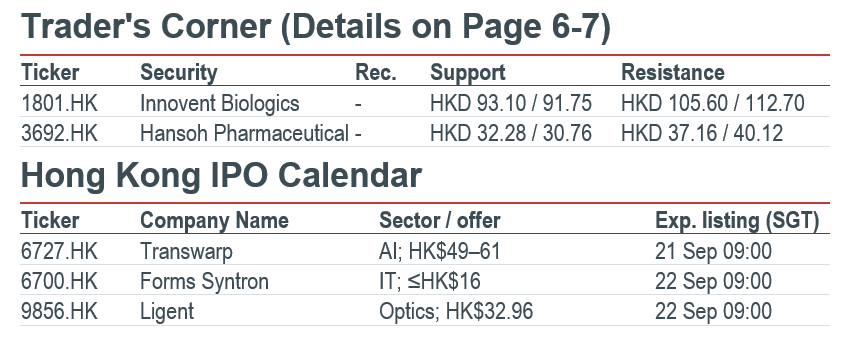
Traders’ corner
Our Technical View
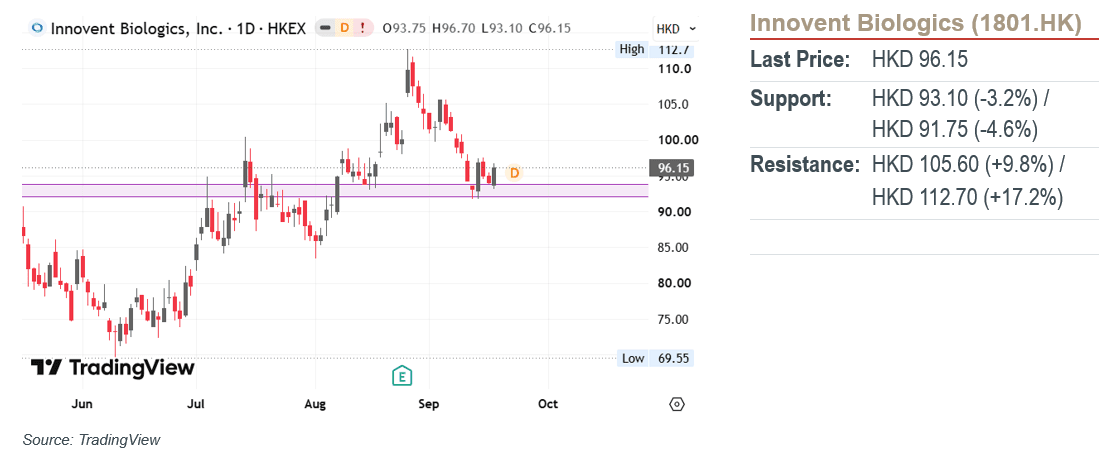
Price successfully defended its resistance-turned-support zone, confirming a successful structural polarity flip.
The ability to hold above this newly converted structural anchor points to the formation of a potential higher low, keeping the bullish sequence intact.
The RSI is turning upward toward its neutral 50-midline.
- As long as price maintains integrity above this support anchor, we could see a sustained rebound toward higher expansion targets.
Our Technical View
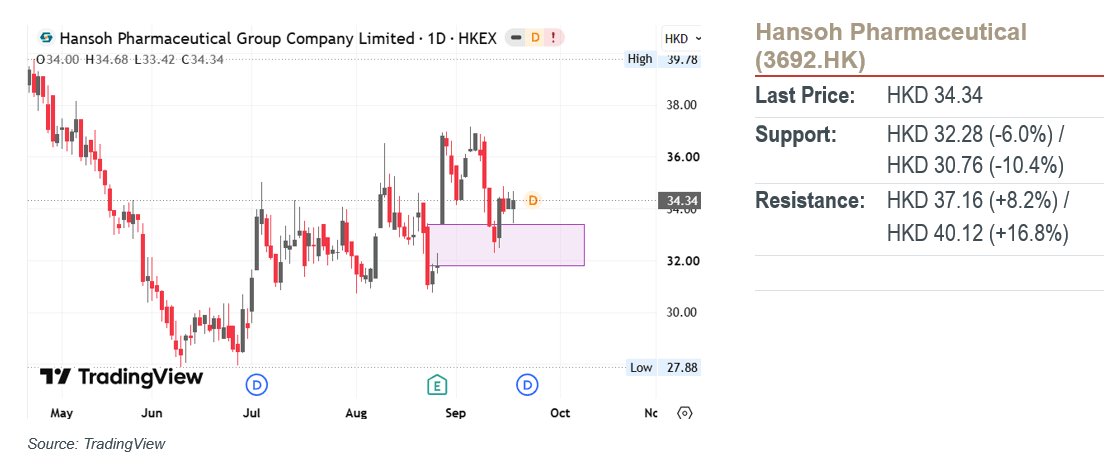
Price successfully maintained above its gap support zone, re-establishing the gap floor as a primary demand anchor.
The RSI has turned bullish and is sloping upward, signaling accelerating trend velocity and renewed buyer control.
As long as price holds above this gap support, path-of-least-resistance dynamics favours a sustained upward movement toward higher expansion targets.
Market Movers: The S&P 500 rose 1.14% in the completed 17 September US session as technology stocks rebounded. Generac (GNRC US) gained about 18.3% in its first regular-session reaction to the Amazon generator contract, whose initial deliveries are expected to total US$2.4bn. Nvidia (NVDA US) rose about 2.5%; its newly disclosed US$2bn contribution to a Brookfield AI fund adds detail to an earlier investment announcement. MiniMax (0100 HK) gained about 7.1% at the 17 September Hong Kong close on SkillsFuture subscription exposure in Singapore. (WPR / Bloomberg / Reuters / AAStocks / StockAnalysis)
Macro: The Bank of England held Bank Rate at 3.75% in a 6–3 vote, warned inflation could exceed 4% in early 2027 and paused gilt sales pending its operational review. The Bank of Japan is expected to raise rates from 1.00% to 1.25% today, a 31-year high; the decision remains ahead of the cutoff. The pace of subsequent tightening and the yen response are key watchpoints. (Bank of England / Reuters)
Geopolitical: Trump said on Thursday he was weighing renewed large-scale attacks on Iran; no decision was announced. Escalation would threaten energy supply and shipping, keeping the geopolitical risk premium sensitive to fresh policy signals. (Axios)
FICC: Brent November futures settled at US$104.82/bbl on 17 September, down 0.95%, as Saudi supply concerns eased; WTI October fell 0.51% to US$101.91/bbl. December gold settled at US$4,399.70/oz, up 0.28%. December silver gained about 1.8% to US$66.095/oz, outperforming gold. The indicative US 10-year yield reported at 03:03 SGT was 4.943%, down 6.1bp from the prior close. (Reuters / AP / Reuters) Nvidia (NVDA US) and Amazon (AMZN US) are our Core Recommendations.
AI
Nvidia's disclosed Brookfield commitment deepens its financing footprint. Investor documents reported by Bloomberg put Nvidia's previously announced Brookfield AI fund commitment at US$2bn. The fund seeks US$10bn; the disclosure establishes investment size rather than a new agreement. Nvidia (NVDA US) rose approximately 2.5% in the 17 September U.S. session. Customer financing can support chip demand, while deepening exposure to AI infrastructure economics. (Bloomberg / StockAnalysis) Nvidia (NVDA US) is our Core Recommendation.
Generac's Amazon contract delivers a sharp first-session rerating. Generac (GNRC US) gained approximately 18.3% in the 17 September U.S. session, the first regular session after its Amazon supply disclosure. Expected backup-generator deliveries total US$2.4bn in 2027–28, while Amazon receives warrants over nearly 1.7mn shares. The agreement improves long-term data-centre revenue visibility, but manufacturing execution and potential dilution remain key risks. (WPR / StockAnalysis) Amazon (AMZN US) is our Core Recommendation.
CoreWeave's capital raising highlights the cost of scaling AI capacity. CoreWeave (CRWV US) fell approximately 4.2% in the 17 September U.S. session after proposing US$3bn of convertible debt, with a US$500mn buyer option, and a programme for up to 35mn shares. Contracted power reached approximately 4.2GW from 3.7GW at end-June. Capacity expansion supports revenue potential, but substantial financing requirements keep leverage and dilution in focus. (Reuters / StockAnalysis)
Nebius lifts cloud prices as computing demand absorbs capacity. Nebius (NBIS US) announced its second price increase in three months: selected Nvidia GPU rates rise 17–21%, some CPU instances 25% and memory approximately 41%. Four customer contracts averaged over US$1bn each. Large, multimonth reservations can receive discounts. Higher on-demand pricing supports revenue per unit of capacity, but may differ from longer-term contracted economics. (Reuters) Nvidia (NVDA US) is our Core Recommendation.
Americas
Applied Materials commits US$5bn to India's chip ecosystem. Applied Materials (AMAT US) announced a decade-long Indian programme covering research, supply chains and workforce development. The government expects chip consumption to reach US$110bn by 2030, from US$45–50bn in 2025. The commitment broadens access to a developing manufacturing base, although delays to India's first large fabrication projects suggest equipment demand will build gradually. (Reuters)
Marvell secures more optical-connectivity capacity from GlobalFoundries. Marvell (MRVL US) and GlobalFoundries (GFS US) expanded their multiyear agreement for silicon-germanium capacity in Burlington, Vermont. The technology supports 200G-per-lane connectivity and optics packaged alongside computing chips. Financial terms were undisclosed. The agreement addresses growing demand to move data between AI accelerators, extending spending beyond processors; revenue will depend on deployment schedules and utilisation. (Company)
The SEC opens a conditional route to tokenized stock trading. The regulator granted five-year relief from exchange and dealer requirements for qualifying tokenized-stock platforms and liquidity providers. Issuers can object, synthetic exposures are excluded, and holders retain dividend and voting rights. Circle (CRCL US) rose approximately 5.8% in the 17 September U.S. session. The framework could widen broker competition, although issuer consent constrains expansion. (Reuters / StockAnalysis)
ExxonMobil's outlook exposes the gap between transition forecasts and climate pathways. ExxonMobil (XOM US) projects energy-related emissions of approximately 30bn tonnes in 2050, around 20% below current levels. That compares with roughly 11bn tonnes in the average IPCC pathway for likely below 2°C warming. Its new outlook requires substantial carbon-capture, hydrogen and biofuel expansion, reinforcing low-carbon projects' dependence on policy support and commercially viable deployment. (Company)
Fluence's production bottlenecks trigger a sharp earnings reset. Fluence Energy (FLNC US) fell approximately 15.4% in the 17 September U.S. session following the previous evening's forecast cut. Fiscal 2026 revenue is now expected at US$2.4bn, versus US$2.9–3.1bn, with an adjusted EBITDA loss near US$200mn. Houston manufacturing and labour problems delayed deliveries and added costs, shifting attention toward execution, cash conversion and project completion. (Energy-Storage.news / Reuters / StockAnalysis)
GFL's competing bidders put takeover expectations into the share price. GFL Environmental (GFL US) gained approximately 5.3% in the 17 September U.S. session following Bloomberg's takeover-bid report. KKR, Energy Capital Partners and Blackstone are competing against Brookfield and IFM Investors. A decision could come within weeks. Competitive bidding may support valuation, but no agreed transaction was disclosed, leaving financing and completion risks unresolved. (Bloomberg / StockAnalysis)
Intuit reiterates its growth outlook as AI reshapes financial software. At its 17 September Investor Day, Intuit (INTU US) reaffirmed fiscal 2027 revenue guidance of US$23.28–23.51bn, or 9–10% growth, and GAAP earnings per share of US$20.12–20.36. Business-platform growth of 13–14% exceeds the consumer platform's 4–6%. Management's emphasis on AI and customer acquisition leaves investors assessing whether product investment can expand adoption while sustaining pricing. (Company)
Xenon's psychiatric trials face a safety-related interruption. Xenon Pharmaceuticals (XENE US) paused new azetukalner enrolment for major depression and bipolar disorder following mental and nervous-system side effects. Enrolled patients can continue while the company considers dose adjustments with safety monitors. The epilepsy programme remains unaffected and its focal-seizures FDA application was submitted. The distinction preserves epilepsy prospects while increasing uncertainty around psychiatric expansion. (Reuters)
Greater China
Hong Kong banks hold prime rates steady. HSBC and Bank of China Hong Kong retained prime lending rates at 5.0%, while Standard Chartered held at 5.25%, despite the HKMA’s 25 bp base-rate increase to 4.25%. All three also left Hong Kong-dollar savings rates unchanged. The decisions cushion borrowers from an immediate repricing; funding costs and deposit competition nevertheless remain important for lending margins. (Reuters / HSBC) HSBC Holdings (0005 HK) is our Core Recommendation.
Huawei flags a domestic computing shortage. Rotating chairman Eric Xu said on Thursday that Huawei cannot produce enough AI computing equipment to meet domestic demand. He also argued that Chinese model developers need to advance further before encountering the frontier risks seen by leading US systems. Our view is that demand remains supportive for the domestic semiconductor chain, while equipment availability remains a constraint on deployment. (Reuters)
MiniMax rises on Singapore distribution exposure. The shares gained about 7.1% at the 17 September Hong Kong close as investors responded to the inclusion of MiniMax Agent, Hailuo AI and MiniMax Audio in Singapore’s SkillsFuture AI subscription programme through Singtel AI Pass. Eligible learners receive six months of access. The programme offers a route to overseas user adoption; conversion from subsidised access into recurring paid usage will be the more meaningful commercial test. (AAStocks / Yicai / StockAnalysis)
Nexperia broadens its supply chain through India. Nexperia agreed a partnership with Tata Electronics covering wafer fabrication, assembly and testing, following its separation from Chinese parent Wingtech’s control. Planned MOSFET production would use Tata’s 300 mm Dholera fab, with discrete-chip packaging at Jagiroad. The two Indian facilities represent US$14bn of Tata investment. The agreement illustrates geographic diversification in mature chips, with manufacturing readiness and customer qualification still crucial. (Nexperia / Reuters)
Asia ex. China
Singapore electronics exports accelerate sharply. August non-oil domestic exports rose 46.2% from a year earlier, exceeding the 35.3% Reuters forecast, as electronics shipments jumped 131.8%; non-electronics grew 12.0%. The release reinforces the strength of AI-related hardware demand and supports the outlook for regional component suppliers. The gap between the two categories also shows that the export surge remains concentrated, leaving broader industrial demand less uniformly strong. (Enterprise Singapore / Reuters)
Brookfield backs ACME’s green-fuels expansion. Brookfield agreed to invest up to US$600m in ACME Cleantech’s green-fuels business, supporting green-ammonia and green-methanol projects in India and Oman. The funding adds institutional backing to a capital-intensive part of the energy transition, with ACME having secured supply agreements with Yara, IHI and Mitsubishi Gas Chemical. Our focus would be on project execution and contracted demand as capacity is developed. (Reuters)
Banyan expands its African hotel footprint. Banyan Group announced a majority investment in Newmark Hotels & Reserves, with phased progression to full ownership. The transaction adds 26 hotels, lodges and reserves across seven African countries, taking the group towards 130 properties, 14 brands and 28 countries. Retaining Newmark’s brand and local operating teams should support continuity while giving Banyan a broader distribution platform in Africa’s leisure markets. (Banyan Group)
EMEA and Others
Next lifts profits despite a softer UK outlook. First-half underlying pretax profit rose 10.5% to £569m, and Next raised its full-year forecast by £12m to £1.255bn, helped by sales and warehousing efficiencies. However, it cut expected second-half UK sales growth to 2.0% from 2.8%. Overseas expansion provides support, but the divergence highlights pressure on domestic discretionary spending from inflation, mortgage costs and a weaker employment market. (Next / Reuters)
Helvetia Baloise accelerates merger savings. The insurer reported first-half underlying earnings of CHF631.6m and a 92.0% non-life combined ratio. It raised its year-end expectation for secured synergies to around 60% of the CHF650m annual target, from around 50%. Faster integration supports the merger case, while August Swiss hailstorms are expected to add CHF120–140m of second-half claims, net of reinsurance and before tax. (Helvetia Baloise)
Softcat buys into US infrastructure demand. Softcat agreed to acquire GDT at a US$1.05bn enterprise value, expanding its US networking, data-centre and AI infrastructure capabilities. Cash, new debt and an equity placing will finance the transaction, which management expects to lift underlying earnings per share in its first full fiscal year. Separately, the company raised FY2026 underlying operating-profit growth expectations to high teens from mid teens. (Softcat RNS / Reuters)
Allegro raises its growth outlook. The Polish e-commerce group lifted 2026 domestic adjusted EBITDA growth guidance to 11–14%, from 7–10%, and now expects group gross merchandise value to increase 13–15%. Management pointed to stronger third-quarter momentum, while international marketplace GMV growth approached 100% in the first ten weeks. The upgrade supports the earnings outlook, although converting rapid overseas expansion into sustained profitability remains the key test. (Allegro / Reuters)
Drax upgrades earnings after stronger operations. Drax now expects 2026 adjusted EBITDA around the top of the £680–711m analyst range, citing strong summer operations and the contribution from its recently acquired Bluefield Solar portfolio. Capital expenditure guidance remains £210–250m. The improved outlook strengthens near-term cash generation, although acquisition funding will keep net debt above its roughly two-times adjusted EBITDA target this year, with a return targeted by end-2027. (Drax)
Traders’ corner
Our Technical View
Price successfully defended its resistance-turned-support zone, confirming a successful structural polarity flip.
The ability to hold above this newly converted structural anchor points to the formation of a potential higher low, keeping the bullish sequence intact.
The RSI is turning upward toward its neutral 50-midline.
- As long as price maintains integrity above this support anchor, we could see a sustained rebound toward higher expansion targets.
Our Technical View
Price successfully maintained above its gap support zone, re-establishing the gap floor as a primary demand anchor.
The RSI has turned bullish and is sloping upward, signaling accelerating trend velocity and renewed buyer control.
As long as price holds above this gap support, path-of-least-resistance dynamics favours a sustained upward movement toward higher expansion targets.
Disclosures and disclaimers
This report is provided subject to, and must be read together with, the full Disclosures / Disclaimers available at this link, which are incorporated by reference into this report. In particular, this report is intended for general circulation and informational purposes only and does not constitute personal investment advice or a recommendation to buy or sell any investment product or security. You should independently evaluate the information and, where necessary, seek advice from a qualified financial adviser regarding the suitability of any investment. Analyst certifications required under applicable regulations, including SEC Regulation AC (where relevant), are included in this report. By accessing, receiving or using this report, you acknowledge that you have read, understood and agreed to be bound by the Disclosures / Disclaimers, as may be amended, supplemented or updated from time to time.


