

Wealth Flash
The Knowledge Share
China Export Shock 2.0: AI Expansion Revisited
Three months ago, we wrote about China’s AI token exports, followed by a series of reports on China Export Shock 2.0. But the story doesn’t end there. Read on to learn how Chinese AI exports are growing beyond models and tokens, and how this may tilt the balance in the US-China AI Race.
CIO Summary
- China’s AI export surge. The Middle Kingdom is rapidly scaling AI service exports, from robotaxis to cloud and chatbots, doubling service exports to USD 510 bn over the past decade and establishing early global presence far ahead of US rivals.
- Domestic dynamics push + global markets pull. Weak profitability at home and lubricative overseas price arbitrage are accelerating Chinese AI firms’ expansion abroad, where labor shortages and municipal demand make adoption easier and politically smoother.
- Strategic standard‑setting opportunity. If China’s AI export momentum continues, Beijing could eventually set the global standards for robotaxis and physical‑AI platforms – something China has already achieved in 5G, EV batteries, and solar.
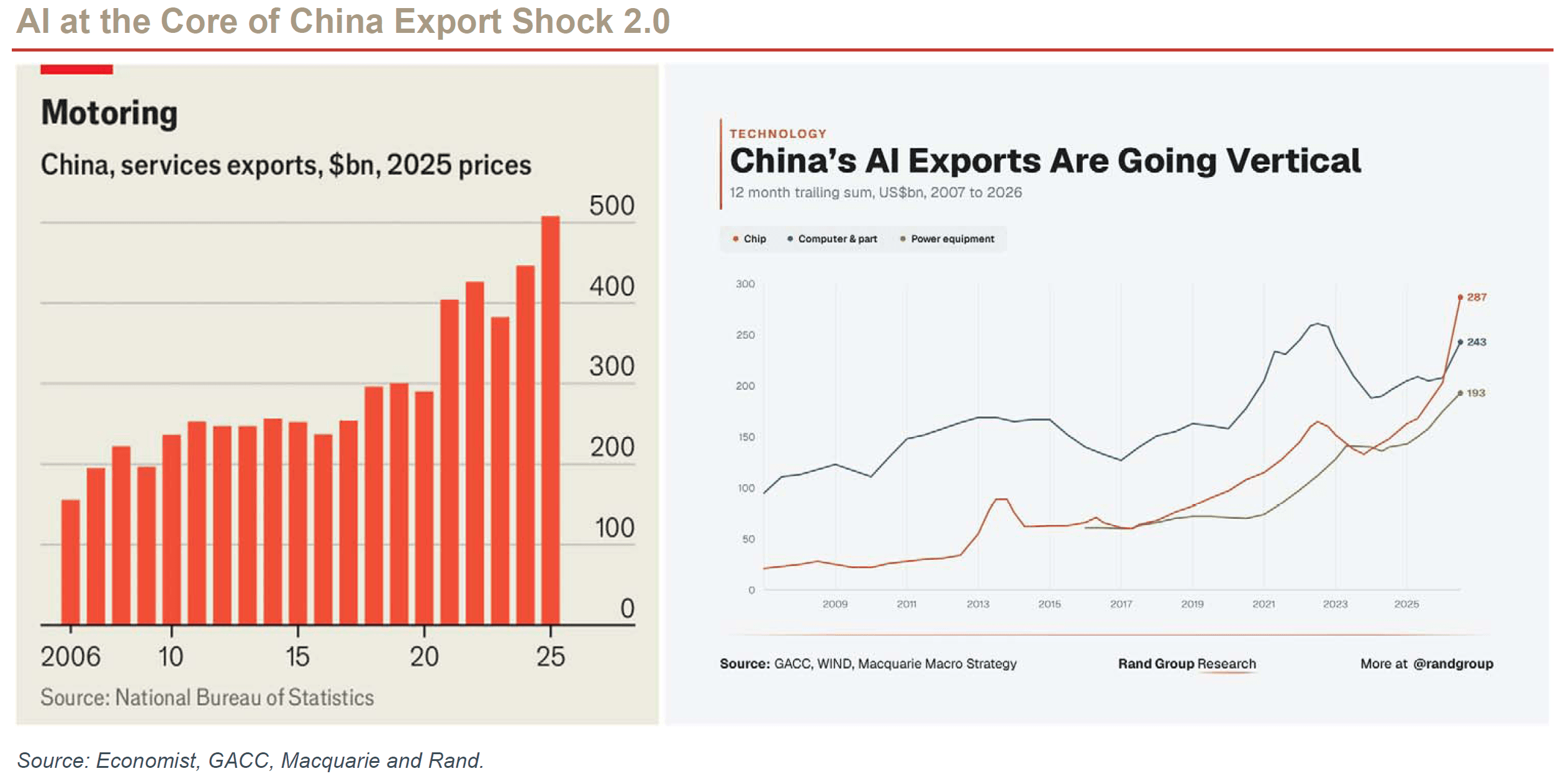
The Economist recently featured an article titled Can China dominate AI exports, too?, echoing a series of similar analyses on China’s AI ambition and progress. It also fits neatly with our China Export Shock 2.0, China Maxxing and the US-China AI Race theme (a top prediction for 2026). We’d like to share a few key takeaways from the above report. Hope you find them useful.
- China’s service exports doubled to USD 510 bn (2015–2025), driven by AI as a growing share of the expansion. This includes robotaxis, cloud computing, and chatbots, a new generation of gadgets.
- Robotaxis are leading the rapid “physical AI” growth overseas. Over 70 Chinese physical AI firms are already operating abroad and ~20 more are preparing to do so, far ahead of American rivals. Baidu’s Apollo Go are supplying driverless taxis to Switzerland, Singapore, Slovakia, and Saudi Arabia, leaving US rivals like Waymo in the dust.
- Weak domestic economics push Chinese firms abroad: low fares, oversupply of cab drivers, and consumers unwilling to pay for AI services make profitability difficult at home. The overseas “price arbitrage” seems very lucrative: a 10-kilometer robotaxi ride in China costs RMB 23 yuan (USD 3.40), whereas a comparable ride in Switzerland commands a lucrative CHF 44 (USD 54).
- Western labor gaps mitigate resistance: While Beijing faces domestic friction over potential AI-driven job displacement, Western markets differ significantly. Many suffer from structural shortages of native transport workers, meaning Chinese autonomous vehicle services may face minimal local resistance and could even be welcomed by municipalities looking to plug labor gaps (rather than triggering political backlash).
- Apart from the economic/financial benefits, there is a strategic angle. China is exporting technological standards along with its competitive AI services, becoming the de-facto rule‑setter in markets where its robotaxis arrive first.
Our Take
- The story offers clear evidence for our China Export Shock 2.0, where a combination of weak domestic demand, manufacturing advantage and technology innovation is driving a new generation of high-end, globally competitive exports. This shock should have profound implications to China’s economic model, as well as global trade and supply chains.
- The story offers clear evidence for our China Maxxing theme, where Chinese products are services are helping to solve real-world pain points in the West, thus creating a more positive image and increasing soft power for China. For those interested, please check out a related story on how Chinese portable air conditioners are taking Europe by storm, offering affordable cooling to the masses amid record-high temperatures.
- The story means China could gain an upper hand in the US-China AI Race, provided that its AI export momentum continues – allowing China to set key standards in global markets. This is no wishful thinking. By the same logic, China has already defined global standards in industries such as 5G networks, EV batteries and solar panels.
Three months ago, we wrote about China’s AI token exports, followed by a series of reports on China Export Shock 2.0. But the story doesn’t end there. Read on to learn how Chinese AI exports are growing beyond models and tokens, and how this may tilt the balance in the US-China AI Race.
CIO Summary
- China’s AI export surge. The Middle Kingdom is rapidly scaling AI service exports, from robotaxis to cloud and chatbots, doubling service exports to USD 510 bn over the past decade and establishing early global presence far ahead of US rivals.
- Domestic dynamics push + global markets pull. Weak profitability at home and lubricative overseas price arbitrage are accelerating Chinese AI firms’ expansion abroad, where labor shortages and municipal demand make adoption easier and politically smoother.
- Strategic standard‑setting opportunity. If China’s AI export momentum continues, Beijing could eventually set the global standards for robotaxis and physical‑AI platforms – something China has already achieved in 5G, EV batteries, and solar.
The Economist recently featured an article titled Can China dominate AI exports, too?, echoing a series of similar analyses on China’s AI ambition and progress. It also fits neatly with our China Export Shock 2.0, China Maxxing and the US-China AI Race theme (a top prediction for 2026). We’d like to share a few key takeaways from the above report. Hope you find them useful.
- China’s service exports doubled to USD 510 bn (2015–2025), driven by AI as a growing share of the expansion. This includes robotaxis, cloud computing, and chatbots, a new generation of gadgets.
- Robotaxis are leading the rapid “physical AI” growth overseas. Over 70 Chinese physical AI firms are already operating abroad and ~20 more are preparing to do so, far ahead of American rivals. Baidu’s Apollo Go are supplying driverless taxis to Switzerland, Singapore, Slovakia, and Saudi Arabia, leaving US rivals like Waymo in the dust.
- Weak domestic economics push Chinese firms abroad: low fares, oversupply of cab drivers, and consumers unwilling to pay for AI services make profitability difficult at home. The overseas “price arbitrage” seems very lucrative: a 10-kilometer robotaxi ride in China costs RMB 23 yuan (USD 3.40), whereas a comparable ride in Switzerland commands a lucrative CHF 44 (USD 54).
- Western labor gaps mitigate resistance: While Beijing faces domestic friction over potential AI-driven job displacement, Western markets differ significantly. Many suffer from structural shortages of native transport workers, meaning Chinese autonomous vehicle services may face minimal local resistance and could even be welcomed by municipalities looking to plug labor gaps (rather than triggering political backlash).
- Apart from the economic/financial benefits, there is a strategic angle. China is exporting technological standards along with its competitive AI services, becoming the de-facto rule‑setter in markets where its robotaxis arrive first.
Our Take
- The story offers clear evidence for our China Export Shock 2.0, where a combination of weak domestic demand, manufacturing advantage and technology innovation is driving a new generation of high-end, globally competitive exports. This shock should have profound implications to China’s economic model, as well as global trade and supply chains.
- The story offers clear evidence for our China Maxxing theme, where Chinese products are services are helping to solve real-world pain points in the West, thus creating a more positive image and increasing soft power for China. For those interested, please check out a related story on how Chinese portable air conditioners are taking Europe by storm, offering affordable cooling to the masses amid record-high temperatures.
- The story means China could gain an upper hand in the US-China AI Race, provided that its AI export momentum continues – allowing China to set key standards in global markets. This is no wishful thinking. By the same logic, China has already defined global standards in industries such as 5G networks, EV batteries and solar panels.
Disclosures and disclaimers
This report is provided subject to, and must be read together with, the full Disclosures / Disclaimers available at the following link: https://research-api.uobkayhian.com/assets/disclaimer/b2112181-0bf2-4c07-af37-3d7129735e61, which are incorporated by reference into this report. In particular, this report is intended for general circulation and informational purposes only and does not constitute personal investment advice or a recommendation to buy or sell any investment product or security. You should independently evaluate the information and, where necessary, seek advice from a qualified financial adviser regarding the suitability of any investment. Analyst certifications required under applicable regulations, including SEC Regulation AC (where relevant), are included in this report. By accessing, receiving or using this report, you acknowledge that you have read, understood and agreed to be bound by the Disclosures / Disclaimers, as may be amended, supplemented or updated from time to time.


