

Wealth Flash
The Knowledge Share
Treasury Politicization and Intervention Could Accelerate De‑Dollarization
The recent Treasury intervention in the U.S. bond market is highly controversial. The drama may just begin to unfold. Regardless, it confirms that the root cause of de‑dollarization lies in fundamental erosion of US fiscal credibility – one of our key long-term themes.
CIO Summary
- Increasing politicization of the US bond market. Ahead of the midterms, the Treasury has stepped in to cap surging long-term yields via aggressive bond and FX interventions. This politicization not only creates friction with the Fed, but also invites pushback from investors.
- The structural problem remains supply. The US deficit (6% of GDP) and debt load (>130% of GDP) mean long‑end stress is fundamentally a supply problem, not a demand issue. Treasury operations are merely band-aids, not long-term fixes relative to the sheer scale of issuance.
- Stay short, stay high-quality. We reiterate our preference for short-duration (< 3 years), top-rated investment-grade bonds, while maintaining our cautious stance on long-duration assets. Gold remains a top beneficiary and a portfolio hedge against de-dollarization, which is reinforced by these recent developments.
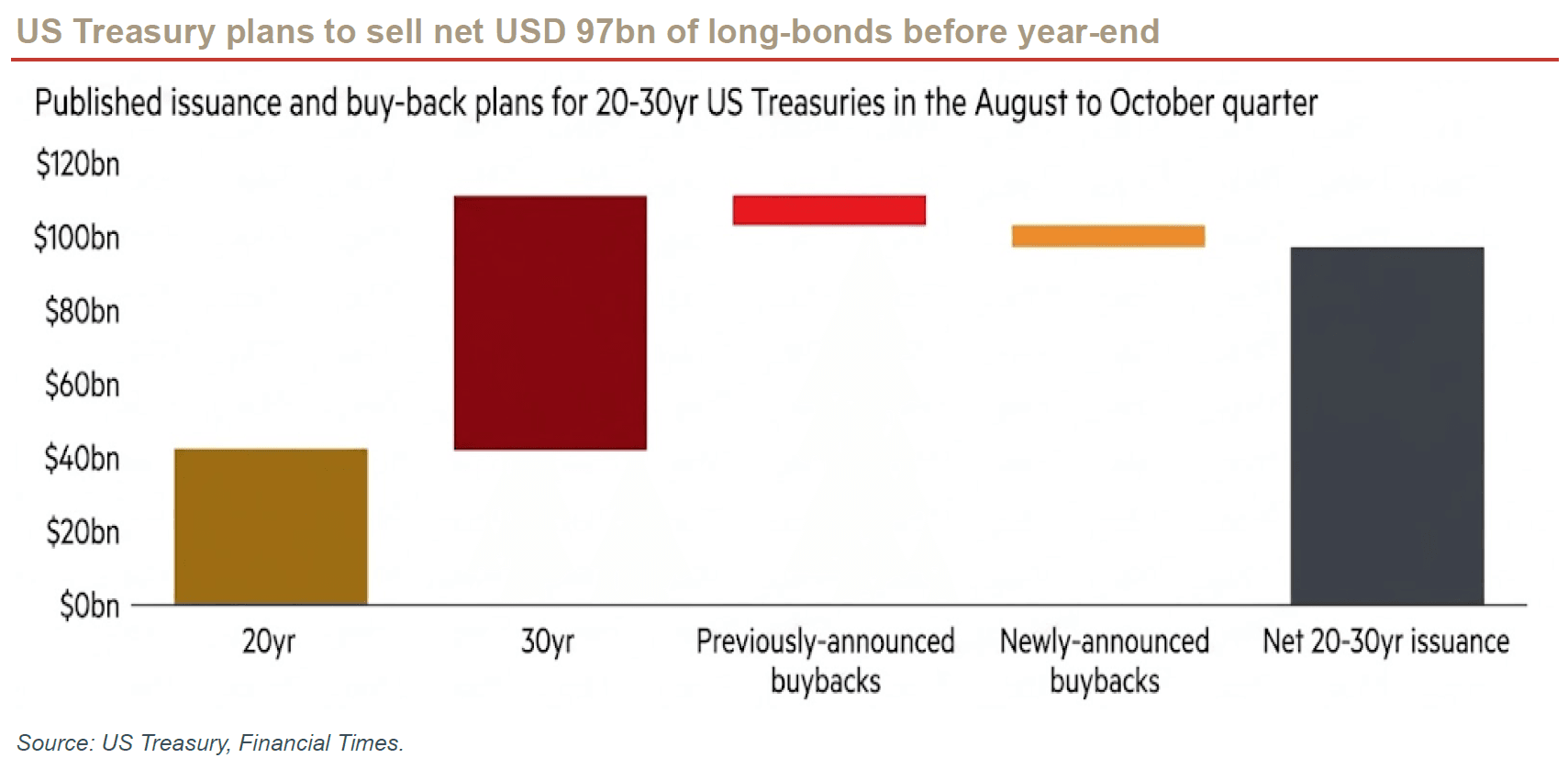
Financial media has recently featured several articles on the US Treasury intervention to cap long-bond yields, including “Is Scott Bessent the Fed chair Donald Trump always wanted” by The Economist, “It Didn't Take Long for the White House to Undermine the Fed” by Bloomberg, and “How Bessent Is Establishing A New Monetary Order” from Capital Flow. We’d like to share a few key takeaways from these pieces. Hope you will find them useful.
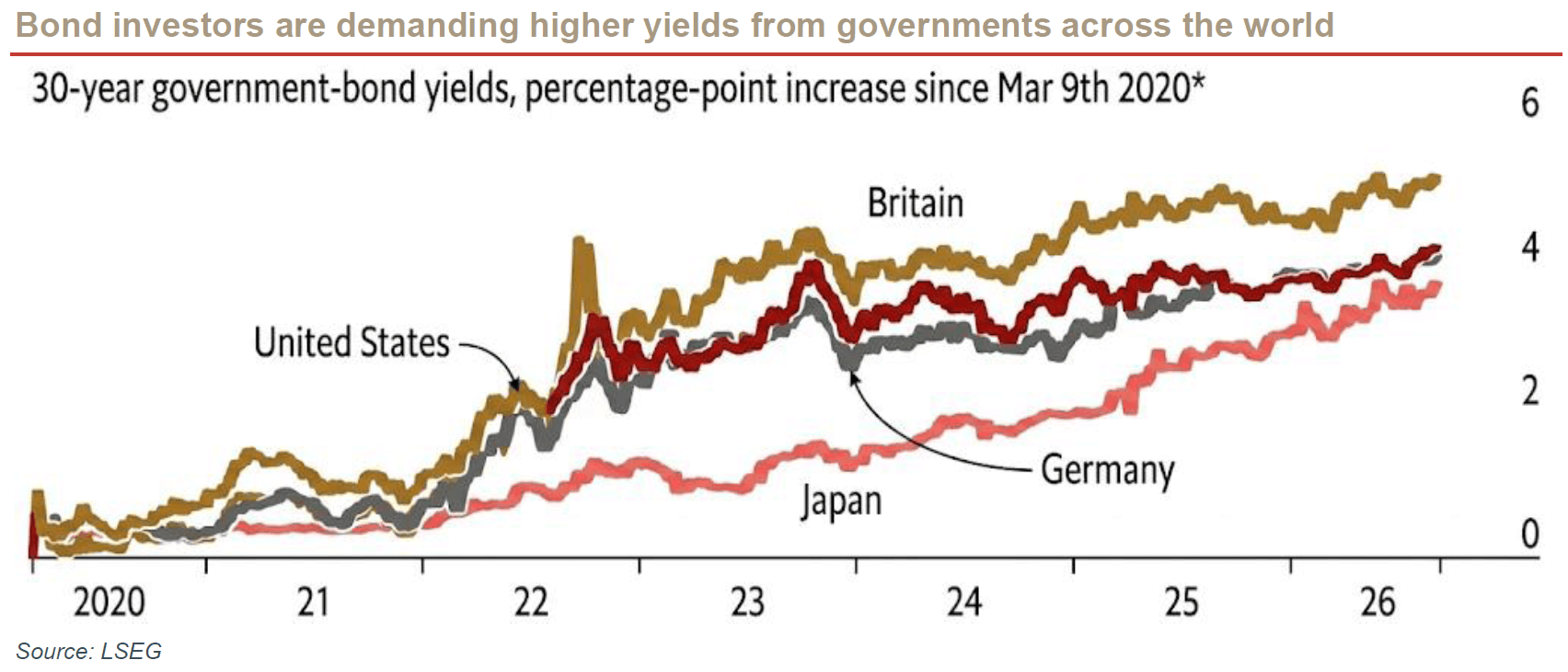
- America’s new bond salesman-in-chief. With the US midterm elections just two months away, and the federal debt burden becoming increasingly unwieldy, Treasury Secretary Scott Bessent is now acting as America’s "top bond salesman” and an explicit manager of long-term yields. The Treasury is actively trying to suppress long-term yields by buying back its own bonds, as 30Y yields climb to a 2-decade high of 5.2% (see chart above).
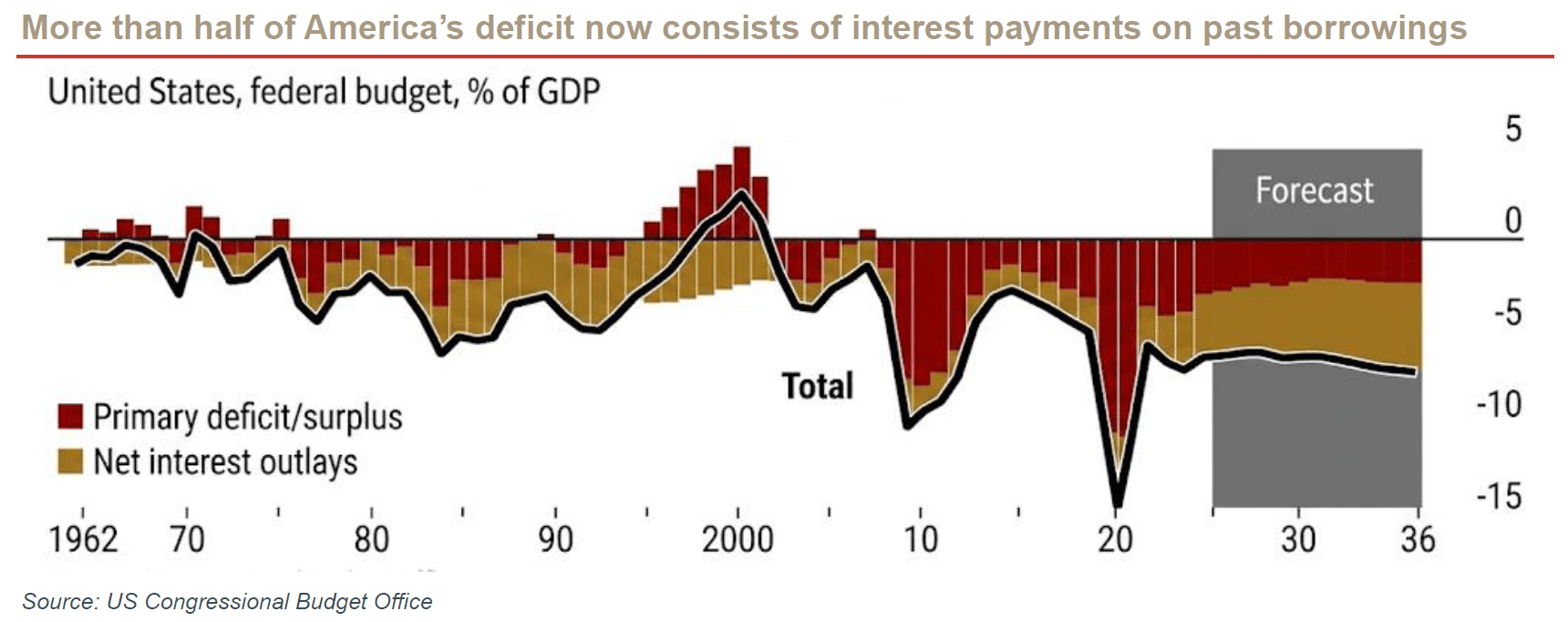
- Band-aids, not a cure for the US debt burden. These buybacks do not reduce the total US debt meaningfully, as the amounts are relatively small. The US deficit still stands at 6% of GDP, with federal debt past 130% of GDP. More importantly, half of that deficit consists of interest payments (see chart below). The structural fiscal imbalance remains intact as long as the government keeps issuing long-term bonds at the current pace.
- Treasury’s market intervention undermines the Fed. Lower yields plus a weaker dollar equal to easing, at a time when markets expect the Fed to hike in 2026. Chair Warsh stated that he "will not waver" on returning inflation to 2% after a five-year overshoot. The Treasury's aggressive buyback effectively works against the Fed's tightening stance. It also runs counter to Warsh’s disavowal of QE and aversion to heavy market footprints, which we discussed in our recent Wealth Flash.
- A silent monetary pact? Despite apparent public friction, Capital Flows argues that Bessent, Warsh, and Trump are executing an unspoken pact: Warsh anchors the short-end to fight inflation and attract global capital, while Bessent manipulates the long-end and FX markets to fund the AI supercycle and secure the US dominance. As a result, they are building a new monetary order through a coordinated “division of labor” – a possible silver lining in an otherwise chaotic policy landscape.
- Markets push back against Treasury politicization. Regardless, we are facing the most brazen politicization of the Treasury market in recent history. The irony is palpable, given Bessent once criticized Yellen for doing exactly this. Markets are voting with their feet: the dollar tumbled and gold surged on the Treasury buyback announcement, signalling growing investor scepticism toward the strategy. As someone who helped break Britain's currency peg in 1992, Bessent knows better than most that markets eventually overpower governments that try to defy fundamentals.
Our Take
- It's about supply, not just demand. Based on our view of “higher for longer”, as well as Stan Druckenmiller’s warning, the core issue with long-term treasuries ultimately comes down to supply. Yes, Secretary Bessent has showcased multiple weapons in the Treasury toolbox within a month (TGA buybacks, duration tilts, FX intervention), with more still in the arsenal to deploy. However, these are aimed at near-term sentiment support ahead of the midterm elections, not at solving the long-term debt problem. As long as the US government continues to issue bonds at a staggering pace, the structural supply-demand imbalance in Treasuries will remain intact.
- Confirming our de-dollarization theme. The politicization of the Treasury market and the stealth monetization of debt threaten the US dollar's credibility. As fiscal dominance erodes institutional trust and fuels de-dollarization narratives, investors will likely demand higher returns on US bonds and also diversify away from the dollar, reinforcing gold as a key beneficiary.
Below are our calls to action amid mounting US debt and accelerating de-dollarization.
Asset Class | Call to Action |
Fixed Income | Stay short, stay high-quality. The structural supply glut at the long end of the curve—exacerbated by US deficits and the "AI Credit Supercycle"—can’t be solved by Treasury buybacks. We reiterate our Core Recommendation of short-duration (< 3 years), top-rated investment-grade bonds for the best balance of yield, carry and resilience. |
Equities | Maintain Barbell Strategy, avoid duration traps. High rates create a hostile environment for capital-intensive, cash-burning and high-leverage businesses. Exercise caution with long-duration, loss-making companies, such as unprofitable SMID-cap equities. Balance exposure between high-momentum AI leaders (which have cash flows to self-fund) and high-quality “True Defensive” stocks. |
Commodities | Gold as a top beneficiary and a portfolio hedge. Treasury's market interventions and the resulting tug-of-war with the Fed risk undermining the US dollar's stability and its reserve status. Gold remains a critical hedge against fiat debasement and fiscal stress. |
The recent Treasury intervention in the U.S. bond market is highly controversial. The drama may just begin to unfold. Regardless, it confirms that the root cause of de‑dollarization lies in fundamental erosion of US fiscal credibility – one of our key long-term themes.
CIO Summary
- Increasing politicization of the US bond market. Ahead of the midterms, the Treasury has stepped in to cap surging long-term yields via aggressive bond and FX interventions. This politicization not only creates friction with the Fed, but also invites pushback from investors.
- The structural problem remains supply. The US deficit (6% of GDP) and debt load (>130% of GDP) mean long‑end stress is fundamentally a supply problem, not a demand issue. Treasury operations are merely band-aids, not long-term fixes relative to the sheer scale of issuance.
- Stay short, stay high-quality. We reiterate our preference for short-duration (< 3 years), top-rated investment-grade bonds, while maintaining our cautious stance on long-duration assets. Gold remains a top beneficiary and a portfolio hedge against de-dollarization, which is reinforced by these recent developments.
Financial media has recently featured several articles on the US Treasury intervention to cap long-bond yields, including “Is Scott Bessent the Fed chair Donald Trump always wanted” by The Economist, “It Didn't Take Long for the White House to Undermine the Fed” by Bloomberg, and “How Bessent Is Establishing A New Monetary Order” from Capital Flow. We’d like to share a few key takeaways from these pieces. Hope you will find them useful.
- America’s new bond salesman-in-chief. With the US midterm elections just two months away, and the federal debt burden becoming increasingly unwieldy, Treasury Secretary Scott Bessent is now acting as America’s "top bond salesman” and an explicit manager of long-term yields. The Treasury is actively trying to suppress long-term yields by buying back its own bonds, as 30Y yields climb to a 2-decade high of 5.2% (see chart above).
- Band-aids, not a cure for the US debt burden. These buybacks do not reduce the total US debt meaningfully, as the amounts are relatively small. The US deficit still stands at 6% of GDP, with federal debt past 130% of GDP. More importantly, half of that deficit consists of interest payments (see chart below). The structural fiscal imbalance remains intact as long as the government keeps issuing long-term bonds at the current pace.
- Treasury’s market intervention undermines the Fed. Lower yields plus a weaker dollar equal to easing, at a time when markets expect the Fed to hike in 2026. Chair Warsh stated that he "will not waver" on returning inflation to 2% after a five-year overshoot. The Treasury's aggressive buyback effectively works against the Fed's tightening stance. It also runs counter to Warsh’s disavowal of QE and aversion to heavy market footprints, which we discussed in our recent Wealth Flash.
- A silent monetary pact? Despite apparent public friction, Capital Flows argues that Bessent, Warsh, and Trump are executing an unspoken pact: Warsh anchors the short-end to fight inflation and attract global capital, while Bessent manipulates the long-end and FX markets to fund the AI supercycle and secure the US dominance. As a result, they are building a new monetary order through a coordinated “division of labor” – a possible silver lining in an otherwise chaotic policy landscape.
- Markets push back against Treasury politicization. Regardless, we are facing the most brazen politicization of the Treasury market in recent history. The irony is palpable, given Bessent once criticized Yellen for doing exactly this. Markets are voting with their feet: the dollar tumbled and gold surged on the Treasury buyback announcement, signalling growing investor scepticism toward the strategy. As someone who helped break Britain's currency peg in 1992, Bessent knows better than most that markets eventually overpower governments that try to defy fundamentals.
Our Take
- It's about supply, not just demand. Based on our view of “higher for longer”, as well as Stan Druckenmiller’s warning, the core issue with long-term treasuries ultimately comes down to supply. Yes, Secretary Bessent has showcased multiple weapons in the Treasury toolbox within a month (TGA buybacks, duration tilts, FX intervention), with more still in the arsenal to deploy. However, these are aimed at near-term sentiment support ahead of the midterm elections, not at solving the long-term debt problem. As long as the US government continues to issue bonds at a staggering pace, the structural supply-demand imbalance in Treasuries will remain intact.
- Confirming our de-dollarization theme. The politicization of the Treasury market and the stealth monetization of debt threaten the US dollar's credibility. As fiscal dominance erodes institutional trust and fuels de-dollarization narratives, investors will likely demand higher returns on US bonds and also diversify away from the dollar, reinforcing gold as a key beneficiary.
Below are our calls to action amid mounting US debt and accelerating de-dollarization.
Asset Class | Call to Action |
Fixed Income | Stay short, stay high-quality. The structural supply glut at the long end of the curve—exacerbated by US deficits and the "AI Credit Supercycle"—can’t be solved by Treasury buybacks. We reiterate our Core Recommendation of short-duration (< 3 years), top-rated investment-grade bonds for the best balance of yield, carry and resilience. |
Equities | Maintain Barbell Strategy, avoid duration traps. High rates create a hostile environment for capital-intensive, cash-burning and high-leverage businesses. Exercise caution with long-duration, loss-making companies, such as unprofitable SMID-cap equities. Balance exposure between high-momentum AI leaders (which have cash flows to self-fund) and high-quality “True Defensive” stocks. |
Commodities | Gold as a top beneficiary and a portfolio hedge. Treasury's market interventions and the resulting tug-of-war with the Fed risk undermining the US dollar's stability and its reserve status. Gold remains a critical hedge against fiat debasement and fiscal stress. |
Disclosures and disclaimers
This report is provided subject to, and must be read together with, the full Disclosures / Disclaimers available at this link, which are incorporated by reference into this report. In particular, this report is intended for general circulation and informational purposes only and does not constitute personal investment advice or a recommendation to buy or sell any investment product or security. You should independently evaluate the information and, where necessary, seek advice from a qualified financial adviser regarding the suitability of any investment. Analyst certifications required under applicable regulations, including SEC Regulation AC (where relevant), are included in this report. By accessing, receiving or using this report, you acknowledge that you have read, understood and agreed to be bound by the Disclosures / Disclaimers, as may be amended, supplemented or updated from time to time.


