

Wealth Daily
Nvidia Results Beat Forecasts Amid Market Retreat
Today’s Must-Know News
Overnight Markets
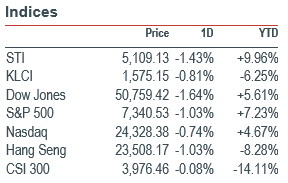
Market Movers: At the 17 November close, the S&P 500 fell 1.03%. Nvidia (NVDA US) slipped 0.44% before post-close results showed 3QFY27 revenue of US$115.8bn, up 103% YoY, and a US$130bn fourth-quarter forecast. The outlook includes an extra week and excludes China data-centre compute sales; guided gross margins of 71–72% temper the growth signal. Microsoft (MSFT US) fell about 2.3% despite launching specialist coding and cybersecurity models. Salesforce (CRM US) dropped about 9.5% amid AI competition concerns, without company-specific news. Cheaper AI tools challenge software pricing power; Reuters separately reported an SEC probe into Nvidia. (Nvidia / Reuters / Yahoo Finance / AP / Reuters / WSJ) Nvidia (NVDA US) is our Core Recommendation; Microsoft (MSFT US) is our Investment Opportunity.
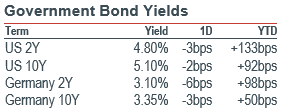
Macro: US October retail sales rose 0.2% MoM and 6.8% YoY to US$748.2bn; control-group sales gained 0.6%, pointing to resilient underlying spending. Manufacturing output increased 0.3% MoM, even as total industrial production fell 0.4% on weaker utilities. The mix argues against treating the headline slowdown as a broad demand contraction. FOMC minutes are due 19 November at 03:00 SGT, with the inflation-growth balance in focus. (Census / Federal Reserve / Reuters)
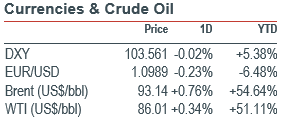
FICC: January Brent settled at US$93.14/bbl, up 0.76%, and December WTI at US$86.01, up 0.34%. Renewed tanker attacks supported crude, while recovering Middle East exports and surplus expectations limited gains. Producers remain exposed to both fresh disruption and a normalisation of supply. (Reuters / eOption)
AI
Nvidia earnings confirm strong demand while its outlook signals lower margins. After the US close, Nvidia (NVDA US) reported third-quarter FY2027 revenue of US$115.8bn, up 103% YoY. Its fourth-quarter forecast of US$130bn, plus or minus 3%, includes an extra week and excludes China data-centre compute sales. Non-GAAP gross margin is forecast at 71–72%, versus 74.9% in the reported quarter. Reuters, citing the Wall Street Journal, separately reported an SEC investigation. Strong demand therefore needs weighing against margin pressure and unresolved governance risk. (Nvidia / Reuters / Reuters / WSJ) Nvidia (NVDA US) is our Core Recommendation.
Microsoft specialist models intensify competition on AI cost and enterprise distribution. Microsoft (MSFT US) unveiled coding and cybersecurity models at Ignite, expanding its in-house AI offering. In company tests using promotional pricing, MAI Code 2 achieved 98% of GPT-6.1 Sol's performance at 40% of its cost across four benchmarks. Availability through GitHub Copilot gives the launch an established distribution channel. Shares closed about 2.3% lower amid the broader technology selloff. The investment test is whether lower inference costs improve product economics without sacrificing reliability. (Microsoft / Reuters / Market data) Microsoft (MSFT US) is our Investment Opportunity.
OpenAI lowers flagship model prices as it launches GPT-6.2 Astra and Sol. OpenAI released GPT-6.2 Astra and Sol across ChatGPT Work, Codex and its API. Standard Astra pricing is US$8 per million input tokens and US$40 per million output tokens, both 20% below GPT-6 Astra. Sol retains pricing of US$2 and US$10 respectively. OpenAI says both models complete demanding work with fewer output tokens. Cheaper task completion could broaden adoption, while sharpening competition among model providers; the revenue benefit still depends on usage growth and customer retention. (OpenAI / 9to5Mac)
Salesforce sharp decline highlights the market's reassessment of software economics. Salesforce (CRM US) closed about 9.5% lower at US$194.52 during a wider software selloff. Contemporaneous reporting highlighted concern that AI agents could pressure established software businesses, while identifying no new Salesforce-specific announcement. The share move is evidence of repricing, rather than proof of an immediate revenue impact. Investors will need evidence that agent products create incremental customer spending and sustainable margins as adoption changes; stronger AI capabilities can also challenge existing seat-based revenue models. (TIKR / Market data)
Americas
JPMorgan planned CFO transition puts capital discipline and continuity in focus. JPMorgan Chase (JPM US) named commercial and investment bank CFO Bregje de Best to succeed Jeremy Barnum after first-quarter 2027 financial reporting. Barnum will become vice chairman and remain until early 2028, supporting the transition. The bank's shares closed about 2.4% lower in the broader market decline; the appointment alone does not establish the cause. Capital returns, expense control and net-interest-income guidance remain useful tests of continuity through the leadership change. (JPMorgan / Reuters / Market data)
Home Depot sales growth contrasts with a softer full-year comparable-sales outlook. Home Depot (HD US) reported third-quarter FY2026 sales of US$43.4bn, up 4.9% YoY, and comparable-sales growth of 2.2%. Adjusted EPS rose to US$3.86 from US$3.74, about 3.2% YoY. It now expects full-year comparable sales to grow about 1.4%, below its previous target of up to 2%. Shares closed about 2.4% lower. Improving reported sales therefore offer limited reassurance about the pace of the broader home-improvement recovery. (Home Depot / Bloomberg / Market data)
Disney earnings growth comes with a calendar boost and higher investment spending. Walt Disney (DIS US) reported fourth-quarter FY2026 revenue of US$25.9bn, up 16% YoY, and adjusted EPS of US$1.77, up 59%. Both benefited from an extra week. It retained double-digit FY2027 adjusted-EPS growth guidance excluding that effect, while planning 9% higher cash content spending. Shares closed about 1.5% lower. Strong engagement supports expansion, but ending separate streaming-profit disclosure makes returns on the increased content investment harder for investors to track. (Disney / Reuters / Market data)
Medtronic expanded Hugo clearance opens a broader US surgical market. Medtronic (MDT US) announced FDA clearance extending its Hugo robotic-assisted surgery system beyond urology into general surgery. The newly covered procedures represent about 3.5 million US surgeries annually, more than half of all soft-tissue procedures, according to the company. Medtronic also expects global Hugo procedures to exceed 50,000 by its fiscal year-end. The approval expands the commercial opportunity, but hospital purchases, surgeon training and utilisation will determine how much of that opportunity becomes recurring revenue. (Medtronic / RTTNews)
Greater China
JD profit recovery leaves retail growth under scrutiny. JD.com (JD US; 9618.HK) closed about 7.7% lower in US trading after third-quarter revenue rose 3.5% YoY to RMB309.6bn. Operating profit recovered to RMB5.2bn from a RMB1.1bn loss, while adjusted net income increased 44% to RMB8.3bn. Retail operating margin nevertheless eased to 5.8% from 5.9%. Narrower new-business losses improve group earnings, but modest sales growth and the retail margin dip leave the durability of that recovery dependent on disciplined spending and competitive execution. (JD / HKEX / Market data)
MINISO mainland momentum masks slower overseas growth. MINISO (MNSO US; 9896.HK) closed about 8.4% higher in US trading after reporting third-quarter revenue of RMB6.63bn, up 14.3% YoY. Mainland MINISO-brand revenue increased 29.6%, but overseas growth slowed to 1.7% and TOP TOY revenue fell 12.5%. Gross margin improved to 45.3% from 44.7%, while selling and distribution expenses rose 18.8%, faster than sales. The figures support the domestic product strategy, yet overseas execution and operating-cost discipline remain necessary to turn stronger sales into sustained earnings growth. (MINISO / Market data)
Tencent Music grows beyond subscriptions, with profit lagging sales. Tencent Music Entertainment (TME US; 1698.HK) gained about 6.6% in US trading as third-quarter revenue increased 5.6% YoY to RMB8.94bn. Membership revenue rose 9.2% to RMB4.99bn, while marketing and consumption services grew 12.1% to RMB2.70bn on merchandise and live performances. Attributable IFRS profit stayed broadly flat at RMB2.15bn. Broader monetisation strengthens the music franchise, but the gap between revenue and profit growth makes cost absorption and acquisition integration the next tests of earnings quality. (Tencent Music / Market data)
Weibo softer sales and higher costs squeeze operating returns. Weibo (WB US; 9898.HK) fell about 4.0% in US trading after third-quarter revenue declined 7% YoY to US$410.2m. Operating profit dropped to US$64.3m from US$117.3m, taking the margin to 16% from 27%. Costs and expenses increased 6%, partly because of higher advertising production costs. The combination leaves earnings more exposed to weak advertising demand; stabilising revenue alone may be insufficient without better production efficiency and tighter control of the operating cost base. (Weibo / Market data)
Asia ex. China
Japan Post Bank completes its capital return allocation. Japan Post Bank (7182 JP) completed the repurchase of 9.44m shares for almost JPY30bn through Tokyo’s off-market ToSTNeT-3 facility. The purchase exhausted the monetary limit approved by the board, so the bank will undertake no additional market purchases under this programme. The execution delivers a concrete improvement in capital efficiency, but removes the prospect of further buying support from this allocation. Future shareholder returns will depend on fresh authorisations and the bank’s capital needs. (Japan Post Bank)
Singapore export surge remains uneven beneath the headline. Singapore’s October non-oil domestic exports jumped 79.8% YoY, accelerating from 68.3% in September. Non-electronics exports grew 81.9%, helped by lumpy ship structures and a 253.1% rise in pharmaceuticals; electronics increased 73.9% on sustained AI-related demand. The breadth supports manufacturing activity, but unusually large shipments and low comparison bases limit the headline’s usefulness as a recurring growth rate. Investors should distinguish durable electronics demand from volatile transport and pharmaceutical contributions when assessing industrial earnings. (AsiaOne / EnterpriseSG)
EMEA and Others
Deutsche Bank disclosure concerns revive a governance discount. Deutsche Bank (DBK GR) closed about 6.0% lower after new media reports based on leaked documents raised questions about historical client dealings. The bank said the reports concerned old incidents and pointed to strengthened controls. The decline outpaced the STOXX Europe 600’s 1.75% fall, illustrating a company-specific confidence shock within a broader sell-off. Investors should watch for substantiated regulatory follow-up; the published allegations do not by themselves establish a new fine or quantified earnings charge. (Reuters / Euronews)
BASF reported concessions target obstacles to an Evonik deal. BASF (BAS GR) reportedly approached regional officials and Evonik’s largest shareholder with commitments on plants, jobs and training, seeking support after an earlier offer above EUR11bn was rejected. Evonik (EVK GR) rose about 4.2%, while BASF fell about 2.8%. Neither company confirmed the latest talks. The reported move may improve stakeholder acceptance, but employment and site assurances could constrain restructuring savings. Deal certainty and achievable synergies remain distinct questions until binding terms emerge. (Reuters / Dow Jones / Market data / Market data)
Imperial cash returns cushion a weaker reported profit result. Imperial Brands (IMB LN) reported adjusted operating profit growth of 3.7% and adjusted EPS growth of 8.8% at constant currency for its financial year. Reported operating profit nevertheless fell 10.2%, reflecting strategic spending and a Delaware settlement. Free cash flow of GBP2.6bn supported a 4% dividend increase and a GBP1.5bn buyback for the new year. Pricing and capital returns support the investment case, while the gap between adjusted and reported performance warrants close scrutiny. (Imperial Brands / RNS)
Elbit backlog supports growth as capacity execution becomes central. Elbit Systems (ESLT US) gained about 5.8% after third-quarter revenue rose 17.2% YoY to US$2.25bn and adjusted EPS increased 30.1% to US$4.36. Its order backlog reached US$33bn, with 74% attributable to customers outside Israel and 35% scheduled for execution through the end of next year. The backlog provides revenue visibility across defence programmes. Converting it into cash and profit will depend on manufacturing capacity, delivery timing and the cost of expanding production. (Elbit Systems / Market data)
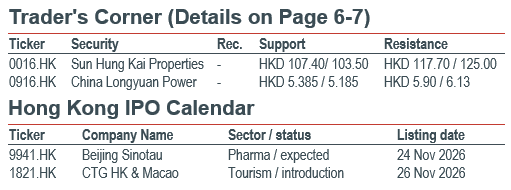
Traders' Corner
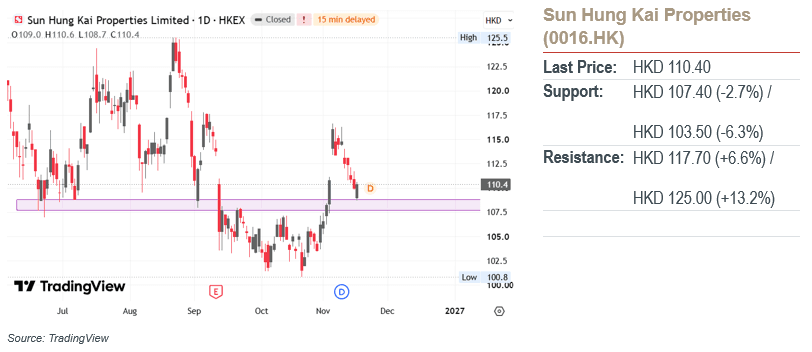
Our Technical View
Price holds above its resistance-turned-support zone during recent pullback testing.
The RSI remains in bullish territory and is turning upward directly from its neutral 50 level.
Provided price remains supported above the converted polarity floor on, we see continued upward progression toward higher overhead resistance targets.
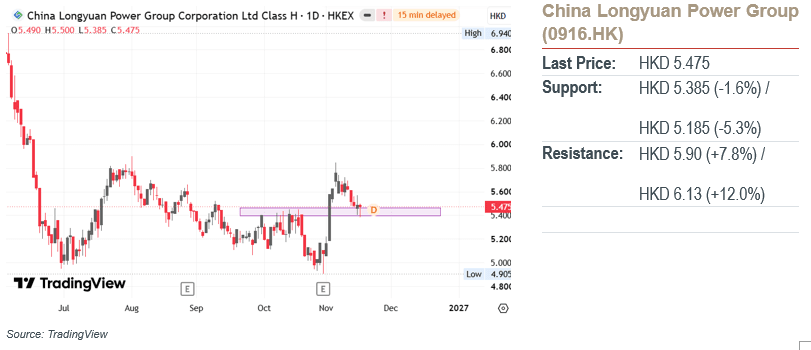
Our Technical View
Price holds at its resistance-turned-support zone, printing a hammer candlestick pattern during recent pullback testing.
The RSI remains solidly in bullish territory.
Provided price remains supported above the hammer low and converted polarity floor, we see continued upward progression toward higher overhead resistance targets.
Market Movers: At the 17 November close, the S&P 500 fell 1.03%. Nvidia (NVDA US) slipped 0.44% before post-close results showed 3QFY27 revenue of US$115.8bn, up 103% YoY, and a US$130bn fourth-quarter forecast. The outlook includes an extra week and excludes China data-centre compute sales; guided gross margins of 71–72% temper the growth signal. Microsoft (MSFT US) fell about 2.3% despite launching specialist coding and cybersecurity models. Salesforce (CRM US) dropped about 9.5% amid AI competition concerns, without company-specific news. Cheaper AI tools challenge software pricing power; Reuters separately reported an SEC probe into Nvidia. (Nvidia / Reuters / Yahoo Finance / AP / Reuters / WSJ) Nvidia (NVDA US) is our Core Recommendation; Microsoft (MSFT US) is our Investment Opportunity.
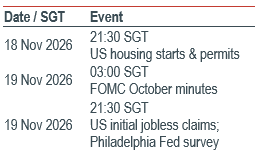
Macro: US October retail sales rose 0.2% MoM and 6.8% YoY to US$748.2bn; control-group sales gained 0.6%, pointing to resilient underlying spending. Manufacturing output increased 0.3% MoM, even as total industrial production fell 0.4% on weaker utilities. The mix argues against treating the headline slowdown as a broad demand contraction. FOMC minutes are due 19 November at 03:00 SGT, with the inflation-growth balance in focus. (Census / Federal Reserve / Reuters)
FICC: January Brent settled at US$93.14/bbl, up 0.76%, and December WTI at US$86.01, up 0.34%. Renewed tanker attacks supported crude, while recovering Middle East exports and surplus expectations limited gains. Producers remain exposed to both fresh disruption and a normalisation of supply. (Reuters / eOption)
AI
Nvidia earnings confirm strong demand while its outlook signals lower margins. After the US close, Nvidia (NVDA US) reported third-quarter FY2027 revenue of US$115.8bn, up 103% YoY. Its fourth-quarter forecast of US$130bn, plus or minus 3%, includes an extra week and excludes China data-centre compute sales. Non-GAAP gross margin is forecast at 71–72%, versus 74.9% in the reported quarter. Reuters, citing the Wall Street Journal, separately reported an SEC investigation. Strong demand therefore needs weighing against margin pressure and unresolved governance risk. (Nvidia / Reuters / Reuters / WSJ) Nvidia (NVDA US) is our Core Recommendation.
Microsoft specialist models intensify competition on AI cost and enterprise distribution. Microsoft (MSFT US) unveiled coding and cybersecurity models at Ignite, expanding its in-house AI offering. In company tests using promotional pricing, MAI Code 2 achieved 98% of GPT-6.1 Sol's performance at 40% of its cost across four benchmarks. Availability through GitHub Copilot gives the launch an established distribution channel. Shares closed about 2.3% lower amid the broader technology selloff. The investment test is whether lower inference costs improve product economics without sacrificing reliability. (Microsoft / Reuters / Market data) Microsoft (MSFT US) is our Investment Opportunity.
OpenAI lowers flagship model prices as it launches GPT-6.2 Astra and Sol. OpenAI released GPT-6.2 Astra and Sol across ChatGPT Work, Codex and its API. Standard Astra pricing is US$8 per million input tokens and US$40 per million output tokens, both 20% below GPT-6 Astra. Sol retains pricing of US$2 and US$10 respectively. OpenAI says both models complete demanding work with fewer output tokens. Cheaper task completion could broaden adoption, while sharpening competition among model providers; the revenue benefit still depends on usage growth and customer retention. (OpenAI / 9to5Mac)
Salesforce sharp decline highlights the market's reassessment of software economics. Salesforce (CRM US) closed about 9.5% lower at US$194.52 during a wider software selloff. Contemporaneous reporting highlighted concern that AI agents could pressure established software businesses, while identifying no new Salesforce-specific announcement. The share move is evidence of repricing, rather than proof of an immediate revenue impact. Investors will need evidence that agent products create incremental customer spending and sustainable margins as adoption changes; stronger AI capabilities can also challenge existing seat-based revenue models. (TIKR / Market data)
Americas
JPMorgan planned CFO transition puts capital discipline and continuity in focus. JPMorgan Chase (JPM US) named commercial and investment bank CFO Bregje de Best to succeed Jeremy Barnum after first-quarter 2027 financial reporting. Barnum will become vice chairman and remain until early 2028, supporting the transition. The bank's shares closed about 2.4% lower in the broader market decline; the appointment alone does not establish the cause. Capital returns, expense control and net-interest-income guidance remain useful tests of continuity through the leadership change. (JPMorgan / Reuters / Market data)
Home Depot sales growth contrasts with a softer full-year comparable-sales outlook. Home Depot (HD US) reported third-quarter FY2026 sales of US$43.4bn, up 4.9% YoY, and comparable-sales growth of 2.2%. Adjusted EPS rose to US$3.86 from US$3.74, about 3.2% YoY. It now expects full-year comparable sales to grow about 1.4%, below its previous target of up to 2%. Shares closed about 2.4% lower. Improving reported sales therefore offer limited reassurance about the pace of the broader home-improvement recovery. (Home Depot / Bloomberg / Market data)
Disney earnings growth comes with a calendar boost and higher investment spending. Walt Disney (DIS US) reported fourth-quarter FY2026 revenue of US$25.9bn, up 16% YoY, and adjusted EPS of US$1.77, up 59%. Both benefited from an extra week. It retained double-digit FY2027 adjusted-EPS growth guidance excluding that effect, while planning 9% higher cash content spending. Shares closed about 1.5% lower. Strong engagement supports expansion, but ending separate streaming-profit disclosure makes returns on the increased content investment harder for investors to track. (Disney / Reuters / Market data)
Medtronic expanded Hugo clearance opens a broader US surgical market. Medtronic (MDT US) announced FDA clearance extending its Hugo robotic-assisted surgery system beyond urology into general surgery. The newly covered procedures represent about 3.5 million US surgeries annually, more than half of all soft-tissue procedures, according to the company. Medtronic also expects global Hugo procedures to exceed 50,000 by its fiscal year-end. The approval expands the commercial opportunity, but hospital purchases, surgeon training and utilisation will determine how much of that opportunity becomes recurring revenue. (Medtronic / RTTNews)
Greater China
JD profit recovery leaves retail growth under scrutiny. JD.com (JD US; 9618.HK) closed about 7.7% lower in US trading after third-quarter revenue rose 3.5% YoY to RMB309.6bn. Operating profit recovered to RMB5.2bn from a RMB1.1bn loss, while adjusted net income increased 44% to RMB8.3bn. Retail operating margin nevertheless eased to 5.8% from 5.9%. Narrower new-business losses improve group earnings, but modest sales growth and the retail margin dip leave the durability of that recovery dependent on disciplined spending and competitive execution. (JD / HKEX / Market data)
MINISO mainland momentum masks slower overseas growth. MINISO (MNSO US; 9896.HK) closed about 8.4% higher in US trading after reporting third-quarter revenue of RMB6.63bn, up 14.3% YoY. Mainland MINISO-brand revenue increased 29.6%, but overseas growth slowed to 1.7% and TOP TOY revenue fell 12.5%. Gross margin improved to 45.3% from 44.7%, while selling and distribution expenses rose 18.8%, faster than sales. The figures support the domestic product strategy, yet overseas execution and operating-cost discipline remain necessary to turn stronger sales into sustained earnings growth. (MINISO / Market data)
Tencent Music grows beyond subscriptions, with profit lagging sales. Tencent Music Entertainment (TME US; 1698.HK) gained about 6.6% in US trading as third-quarter revenue increased 5.6% YoY to RMB8.94bn. Membership revenue rose 9.2% to RMB4.99bn, while marketing and consumption services grew 12.1% to RMB2.70bn on merchandise and live performances. Attributable IFRS profit stayed broadly flat at RMB2.15bn. Broader monetisation strengthens the music franchise, but the gap between revenue and profit growth makes cost absorption and acquisition integration the next tests of earnings quality. (Tencent Music / Market data)
Weibo softer sales and higher costs squeeze operating returns. Weibo (WB US; 9898.HK) fell about 4.0% in US trading after third-quarter revenue declined 7% YoY to US$410.2m. Operating profit dropped to US$64.3m from US$117.3m, taking the margin to 16% from 27%. Costs and expenses increased 6%, partly because of higher advertising production costs. The combination leaves earnings more exposed to weak advertising demand; stabilising revenue alone may be insufficient without better production efficiency and tighter control of the operating cost base. (Weibo / Market data)
Asia ex. China
Japan Post Bank completes its capital return allocation. Japan Post Bank (7182 JP) completed the repurchase of 9.44m shares for almost JPY30bn through Tokyo’s off-market ToSTNeT-3 facility. The purchase exhausted the monetary limit approved by the board, so the bank will undertake no additional market purchases under this programme. The execution delivers a concrete improvement in capital efficiency, but removes the prospect of further buying support from this allocation. Future shareholder returns will depend on fresh authorisations and the bank’s capital needs. (Japan Post Bank)
Singapore export surge remains uneven beneath the headline. Singapore’s October non-oil domestic exports jumped 79.8% YoY, accelerating from 68.3% in September. Non-electronics exports grew 81.9%, helped by lumpy ship structures and a 253.1% rise in pharmaceuticals; electronics increased 73.9% on sustained AI-related demand. The breadth supports manufacturing activity, but unusually large shipments and low comparison bases limit the headline’s usefulness as a recurring growth rate. Investors should distinguish durable electronics demand from volatile transport and pharmaceutical contributions when assessing industrial earnings. (AsiaOne / EnterpriseSG)
EMEA and Others
Deutsche Bank disclosure concerns revive a governance discount. Deutsche Bank (DBK GR) closed about 6.0% lower after new media reports based on leaked documents raised questions about historical client dealings. The bank said the reports concerned old incidents and pointed to strengthened controls. The decline outpaced the STOXX Europe 600’s 1.75% fall, illustrating a company-specific confidence shock within a broader sell-off. Investors should watch for substantiated regulatory follow-up; the published allegations do not by themselves establish a new fine or quantified earnings charge. (Reuters / Euronews)
BASF reported concessions target obstacles to an Evonik deal. BASF (BAS GR) reportedly approached regional officials and Evonik’s largest shareholder with commitments on plants, jobs and training, seeking support after an earlier offer above EUR11bn was rejected. Evonik (EVK GR) rose about 4.2%, while BASF fell about 2.8%. Neither company confirmed the latest talks. The reported move may improve stakeholder acceptance, but employment and site assurances could constrain restructuring savings. Deal certainty and achievable synergies remain distinct questions until binding terms emerge. (Reuters / Dow Jones / Market data / Market data)
Imperial cash returns cushion a weaker reported profit result. Imperial Brands (IMB LN) reported adjusted operating profit growth of 3.7% and adjusted EPS growth of 8.8% at constant currency for its financial year. Reported operating profit nevertheless fell 10.2%, reflecting strategic spending and a Delaware settlement. Free cash flow of GBP2.6bn supported a 4% dividend increase and a GBP1.5bn buyback for the new year. Pricing and capital returns support the investment case, while the gap between adjusted and reported performance warrants close scrutiny. (Imperial Brands / RNS)
Elbit backlog supports growth as capacity execution becomes central. Elbit Systems (ESLT US) gained about 5.8% after third-quarter revenue rose 17.2% YoY to US$2.25bn and adjusted EPS increased 30.1% to US$4.36. Its order backlog reached US$33bn, with 74% attributable to customers outside Israel and 35% scheduled for execution through the end of next year. The backlog provides revenue visibility across defence programmes. Converting it into cash and profit will depend on manufacturing capacity, delivery timing and the cost of expanding production. (Elbit Systems / Market data)
Traders' Corner
Our Technical View
Price holds above its resistance-turned-support zone during recent pullback testing.
The RSI remains in bullish territory and is turning upward directly from its neutral 50 level.
Provided price remains supported above the converted polarity floor on, we see continued upward progression toward higher overhead resistance targets.
Our Technical View
Price holds at its resistance-turned-support zone, printing a hammer candlestick pattern during recent pullback testing.
The RSI remains solidly in bullish territory.
Provided price remains supported above the hammer low and converted polarity floor, we see continued upward progression toward higher overhead resistance targets.
Disclosures and disclaimers
This report is provided subject to, and must be read together with, the full Disclosures / Disclaimers available at this link, which are incorporated by reference into this report. In particular, this report is intended for general circulation and informational purposes only and does not constitute personal investment advice or a recommendation to buy or sell any investment product or security. You should independently evaluate the information and, where necessary, seek advice from a qualified financial adviser regarding the suitability of any investment. Analyst certifications required under applicable regulations, including SEC Regulation AC (where relevant), are included in this report. By accessing, receiving or using this report, you acknowledge that you have read, understood and agreed to be bound by the Disclosures / Disclaimers, as may be amended, supplemented or updated from time to time.


