

Wealth Daily
Nvidia Turmoil Deepens Tech Losses as Oil Slides
Today’s Must-Know News
Overnight Markets
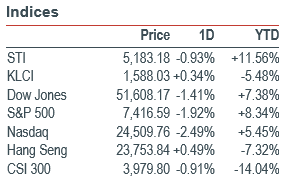
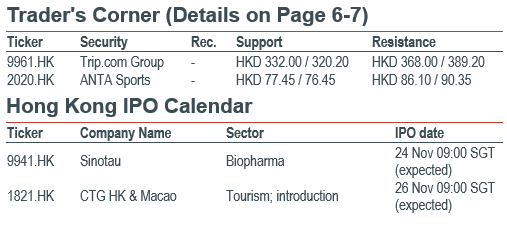
Market Movers: U.S. equities fell on 16 November, with the S&P 500 declining 1.9% and the Nasdaq losing 2.5%, as technology selling intensified. Nvidia (NVDA US) dropped 4.1% as Washington published new restrictions on overseas AI access and President Trump voiced support for Jensen Huang’s return; no reinstatement was announced. Tesla (TSLA US) fell 2.7% despite announcing a €3bn German expansion targeting one million Cybercabs annually, with production planned for 2029. Tyson Foods (TSN US) rose 8.7% after adjusted EPS of US$0.61 beat expectations, although earnings fell 47% YoY and management projected weaker annual sales. The contrasting reactions highlight sensitivity to both AI execution risk and earnings surprises. (AP / Reuters / Tyson) Nvidia (NVDA US) is our Core Recommendation.
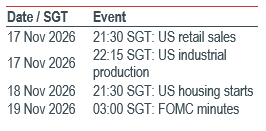
Macro: New York manufacturing growth slowed: the Empire State headline index fell to 7.8 from 25.5, and new orders eased to 3.0. Employment strengthened to 18.1, while input-price pressures moderated but remained elevated. This combination suggests cooling demand without a broad labour retrenchment. US retail sales, due at 21:30 SGT on 17 November, provide the next test of household spending resilience. (New York Fed / Census)
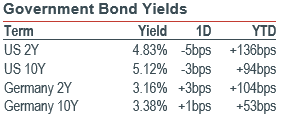
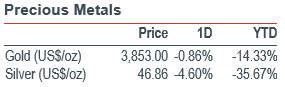
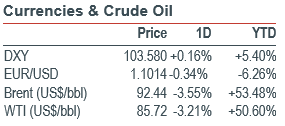
FICC: January Brent settled 3.5% lower at US$92.44/bbl and December WTI lost 3.20% to US$85.72/bbl as recovering supply outweighed fresh shipping disruptions. December silver fell 4.6% to US$46.86/oz. The US 10-year official par yield eased 3bps to 5.12%. Cheaper energy offers some inflation relief, but continued maritime risk leaves that improvement vulnerable to supply interruptions. (DTN / eOption / US Treasury)
AI
Nvidia faces a new policy and leadership test. Nvidia (NVDA US) fell 4.1% as Washington published a rule to restrict overseas access to advanced computing and President Trump said he would not mind Jensen Huang returning as chief executive. His comments did not constitute a reinstatement. The developments add policy uncertainty to an unresolved leadership transition, sharpening scrutiny of future customer demand and export access. A strong order book would still need to be assessed alongside potential compliance constraints on overseas customers and their access to US technology. (Reuters / AP / Market data) Nvidia (NVDA US) is our Core Recommendation.
Remote AI access becomes an export-control target. The US Commerce Department released a rule targeting overseas data centres that provide substantial remote computing access to China-linked entities and other restricted destinations. Existing qualifying operators would have 90 days from effectiveness to obtain licences. Separate controls cover advanced-chip shipments to Singapore, Malaysia, Indonesia, Thailand and Brazil, with a reporting-based exception for qualifying US-headquartered customers. Customer ownership checks and licensing uncertainty could delay projects and shift the economics of offshore AI capacity, even without an outright ban. (BIS rule / BIS announcement)
Baidu’s cloud growth offsets advertising pressure. Baidu (BIDU US; 9888.HK) closed 5.4% lower in US trading after reporting AI Cloud Infra revenue of RMB8.2bn, up 94% YoY, while GPU Cloud revenue rose 191%. Its AI-powered businesses supplied 53% of General Business revenue, helping that segment return to 1% YoY growth. Yet AI-native marketing revenue fell 15% to RMB2.4bn. The contrast shows infrastructure monetisation gaining scale while the search transition still weighs on advertising; investors should watch whether cloud growth converts into sustainable group profitability. (Baidu / HKEX / Baidu / Market data)
OpenAI opens internal systems to independent assessors. OpenAI said it had signed agreements with four independent assessors—Apollo Research, Goodfire, METR and Transluce—to examine model alignment and safeguards with access to selected internal resources. The work can include unreleased models, training checkpoints, evaluation data and discussions with researchers. Public reporting remains subject to confidentiality redactions and responsible-disclosure delays. The arrangement could strengthen confidence in deployment controls, but its investment relevance depends on the assessors' practical independence, breadth of access and whether adverse findings lead to timely remediation. (OpenAI)
Americas
Tesla commits €3bn to German Cybercab capacity. Tesla (TSLA US) announced a €3bn expansion of its German factory to produce up to one million Cybercabs annually. Construction is scheduled for the first half of 2027 and production for 2029, subject to the planned permitting process; shares fell 2.7%. The commitment strengthens the long-term autonomous-mobility manufacturing option, but ties capital to a product that has yet to be sold commercially at scale. Approval, utilisation and execution will determine whether capacity translates into attractive returns. (Reuters / Market data)
Eli Lilly adds an early blood-cancer programme. Eli Lilly (LLY US) agreed to acquire Calytrix Bio for up to US$1.5bn in cash, including an undisclosed upfront payment and subsequent clinical and regulatory milestones. Calytrix's lead programme is a preclinical antibody targeting mutant calreticulin in essential thrombocythaemia and myelofibrosis. The acquisition extends Lilly's blood-cancer capabilities and potential future treatment breadth, but the early development stage means the headline consideration should be viewed as contingent pipeline investment rather than near-term earnings support. (Calytrix Bio) Eli Lilly (LLY US) is our Core Recommendation.
JPMorgan transaction delays expose operational friction. JPMorgan Chase (JPM US) attributed transaction delays to a software bug in internal hardware systems, saying customers retained access to their accounts and funds and that there was no evidence of a cyberattack. The bank said counterparties could experience delays in transactions involving it; Zelle said its network was operating normally. The episode highlights payment-network resilience and timely operational disclosure, with any financial impact dependent on duration, affected transaction volumes and subsequent remediation. (Reuters / Yahoo Finance)
Johnson & Johnson expands its eye-disease pipeline. Johnson & Johnson (JNJ US) agreed to acquire Ollin Biosciences for US$2.2bn upfront plus up to US$1.125bn in regulatory and commercial milestones. The deal adds OLN324, a phase-three investigational antibody for retinal vascular diseases. Separately, Blackstone would provide US$750m over several years to fund that development in exchange for potential milestones and royalties. The structure broadens the ophthalmology pipeline while sharing development funding, although clinical success and approval remain necessary before the asset can contribute commercial revenue. (Johnson & Johnson) Johnson & Johnson (JNJ US) is our Core Recommendation.
TELUS rejects the economics of Québecor's approach. TELUS (TU US) disclosed Québecor's unsolicited, non-binding takeover proposal, offering C$6.35 cash and 0.1700 Québecor shares per TELUS share. The bidder valued that package at approximately C$19.45 using Friday's share price, a 60% premium. TELUS said the consideration inadequately reflected its value and identified regulatory, execution and governance concerns while continuing discussions. The public approach crystallises consolidation value, but a floating share component and an extended approval process make the quoted premium materially different from assured proceeds. (TELUS / Québecor)
Tyson rallies despite a weaker annual sales outlook. Tyson Foods (TSN US) rallied 8.7% after quarterly adjusted EPS of US$0.61 exceeded expectations, although it fell 47% YoY. Reported sales rose 5.2% to US$14.585bn, helped by an extra week; comparable sales excluding that week and legal accrual effects fell 4.0%. Management projects fiscal-2027 sales down 3.5–5.5% against a comparable 52-week base as beef volumes contract. The rally reflects relief over earnings, while cattle availability and restructuring still constrain the durability of recovery. (Tyson Foods / AP / Market data)
Summit reprices an approval setback. Summit Therapeutics (SMMT US) fell 16.5% in the first cash session following Sunday's FDA complete response letter for ivonescimab with chemotherapy in previously treated EGFR-mutated lung cancer. Its new filing said the application cannot be approved in its present form because a statistically significant overall-survival improvement was not established. The distinction between delaying progression and demonstrating survival benefit is now central to the approval case, raising uncertainty over additional evidence requirements and the timing of potential US commercialisation. (Summit filing / Market data)
Greater China
New World’s recapitalisation hits existing equity. New World Development (0017.HK) fell 40.80% to HK$2.885 on resumed trading after Sunday’s proposal for an 11-for-1 rights issue at HK$0.90, targeting approximately HK$24.9bn gross proceeds. The financing remains conditional and accompanies debt-restructuring measures. Existing holders face a substantial cash commitment to maintain their stakes, while non-participation brings dilution. The first market reaction highlights the difference between extending a developer’s financial runway and preserving value for its current shareholders. (ET Net / New World / HKEX)
KE converts efficiency gains into higher earnings. KE Holdings (BEKE US; 2423.HK) rose 4.4% in US trading after reporting 3Q26 revenue of RMB21.0bn, down 8.9% YoY, even as gross transaction value rose 4.5% to RMB769.7bn. Adjusted net income increased 102.6% to RMB2.61bn and adjusted net margin reached 12.4%, up 6.8 percentage points, as operating expenses declined 22.4%. The divergence indicates a substantial efficiency benefit rather than broad revenue recovery; investors should test whether leaner operations can preserve profitability if housing activity remains uneven. (KE Holdings / Market data)
Asia ex. China
SK hynix targets supplier qualification bottlenecks. SK hynix (000660 KS; SKHY US) outlined supplier support spanning research, testing, production and sales, including a KRW874.6bn shared testing facility in Yongin scheduled to open in May 2027. The chipmaker will contribute KRW443.2bn and provide up to 50% of initial development costs under its research programme, including compensation when projects miss targets. These measures aim to shorten qualification cycles and reduce smaller suppliers’ financing burden, improving the resilience of its AI-memory production chain. (Reuters) SK Hynix ADR (SKHY US) is our Investment Opportunity.
ST Engineering buys shares during a sharp selloff. ST Engineering (S63 SG) closed 6.6% lower at S$9.03, the weakest Straits Times Index constituent, as Singapore shares retreated. Its subsequent SGX filing disclosed the purchase of 500,000 shares for S$4.58m, at S$9.05–9.21 each, taking cumulative mandate purchases to 6.5m shares. The buyback provides a concrete capital-allocation signal during the decline, but its size does not establish a valuation floor and the broader market weakness does not prove an issuer-specific cause. (ST Engineering / SGXNet / Business Times)
EMEA and Others
AstraZeneca broadens its approved treatment portfolio. AstraZeneca (AZN LN) announced US approval for Imfinzi with enfortumab vedotin before surgery in muscle-invasive bladder cancer patients unable or unwilling to receive cisplatin-based chemotherapy. The supporting late-stage trial showed relative reductions of 49% in the composite risk of progression, recurrence, missed surgery or death and 42% in death risk. Its rare-disease unit also secured US and EU approvals for Klygefa in eligible adults with generalised myasthenia gravis. The decisions expand commercial opportunities, although approvals alone do not establish uptake or reimbursement levels. (AstraZeneca filing / Reuters)
UniCredit clears major Commerzbank regulatory hurdles. UniCredit (UCG IM) secured unconditional European Commission clearance and US Federal Reserve approval for its proposed €45bn Commerzbank acquisition. EU regulators found sufficient alternatives for German corporate borrowers and trade-finance customers despite the banks’ overlapping operations. The decisions materially reduce regulatory uncertainty around a major cross-border banking combination, following earlier ECB approval. They do not mean the takeover has completed; settlement and the execution of any subsequent integration remain separate steps for investors to monitor. (European Commission / UniCredit / Reuters)
Prysmian revisits a US listing as demand expands. Prysmian (PRY IM) will resume analysing a US dual listing in coming months, chief executive Massimo Battaini said, while cautioning that a decision would take longer. North America supplies 40% of revenue, and he said power and fibre-optic cable demand strengthened in 3Q26 and 4Q26 versus the first half. That exposure links the group to data-centre investment; a listing could broaden investor access, but management’s demand assessment does not remove financing or valuation risks across AI infrastructure. (Reuters)
Traders' Corner
Our Technical View
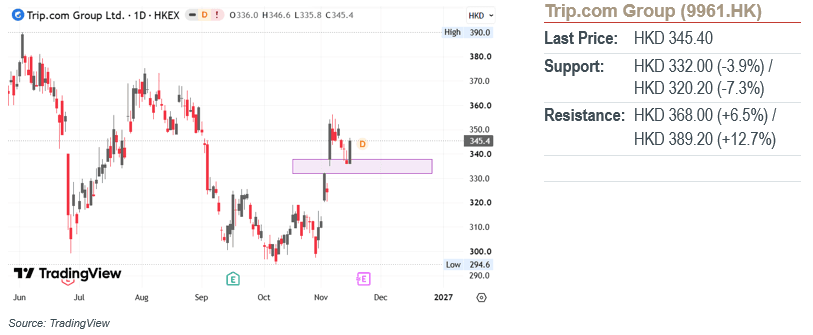
Price rebounded from its gap support zone during recent pullback testing, preserving an intact sequence of higher highs and higher lows.
The RSI stays solidly in bullish territory and continues to rise.
Provided price remains supported above the gap support baseline, we see continued upward progression toward higher resistance.
Our Technical View
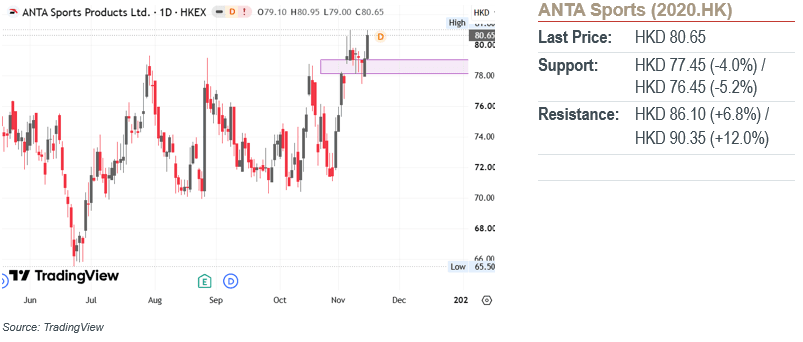
Price holds firmly within and above its established gap support zone during recent pullback testing.
The RSI stays solidly in bullish territory and continues to rise.
Provided price remains supported above the gap support baseline on intraday dips, we see continued upward progression toward upper resistance target.
Market Movers: U.S. equities fell on 16 November, with the S&P 500 declining 1.9% and the Nasdaq losing 2.5%, as technology selling intensified. Nvidia (NVDA US) dropped 4.1% as Washington published new restrictions on overseas AI access and President Trump voiced support for Jensen Huang’s return; no reinstatement was announced. Tesla (TSLA US) fell 2.7% despite announcing a €3bn German expansion targeting one million Cybercabs annually, with production planned for 2029. Tyson Foods (TSN US) rose 8.7% after adjusted EPS of US$0.61 beat expectations, although earnings fell 47% YoY and management projected weaker annual sales. The contrasting reactions highlight sensitivity to both AI execution risk and earnings surprises. (AP / Reuters / Tyson) Nvidia (NVDA US) is our Core Recommendation.
Macro: New York manufacturing growth slowed: the Empire State headline index fell to 7.8 from 25.5, and new orders eased to 3.0. Employment strengthened to 18.1, while input-price pressures moderated but remained elevated. This combination suggests cooling demand without a broad labour retrenchment. US retail sales, due at 21:30 SGT on 17 November, provide the next test of household spending resilience. (New York Fed / Census)
FICC: January Brent settled 3.5% lower at US$92.44/bbl and December WTI lost 3.20% to US$85.72/bbl as recovering supply outweighed fresh shipping disruptions. December silver fell 4.6% to US$46.86/oz. The US 10-year official par yield eased 3bps to 5.12%. Cheaper energy offers some inflation relief, but continued maritime risk leaves that improvement vulnerable to supply interruptions. (DTN / eOption / US Treasury)
AI
Nvidia faces a new policy and leadership test. Nvidia (NVDA US) fell 4.1% as Washington published a rule to restrict overseas access to advanced computing and President Trump said he would not mind Jensen Huang returning as chief executive. His comments did not constitute a reinstatement. The developments add policy uncertainty to an unresolved leadership transition, sharpening scrutiny of future customer demand and export access. A strong order book would still need to be assessed alongside potential compliance constraints on overseas customers and their access to US technology. (Reuters / AP / Market data) Nvidia (NVDA US) is our Core Recommendation.
Remote AI access becomes an export-control target. The US Commerce Department released a rule targeting overseas data centres that provide substantial remote computing access to China-linked entities and other restricted destinations. Existing qualifying operators would have 90 days from effectiveness to obtain licences. Separate controls cover advanced-chip shipments to Singapore, Malaysia, Indonesia, Thailand and Brazil, with a reporting-based exception for qualifying US-headquartered customers. Customer ownership checks and licensing uncertainty could delay projects and shift the economics of offshore AI capacity, even without an outright ban. (BIS rule / BIS announcement)
Baidu’s cloud growth offsets advertising pressure. Baidu (BIDU US; 9888.HK) closed 5.4% lower in US trading after reporting AI Cloud Infra revenue of RMB8.2bn, up 94% YoY, while GPU Cloud revenue rose 191%. Its AI-powered businesses supplied 53% of General Business revenue, helping that segment return to 1% YoY growth. Yet AI-native marketing revenue fell 15% to RMB2.4bn. The contrast shows infrastructure monetisation gaining scale while the search transition still weighs on advertising; investors should watch whether cloud growth converts into sustainable group profitability. (Baidu / HKEX / Baidu / Market data)
OpenAI opens internal systems to independent assessors. OpenAI said it had signed agreements with four independent assessors—Apollo Research, Goodfire, METR and Transluce—to examine model alignment and safeguards with access to selected internal resources. The work can include unreleased models, training checkpoints, evaluation data and discussions with researchers. Public reporting remains subject to confidentiality redactions and responsible-disclosure delays. The arrangement could strengthen confidence in deployment controls, but its investment relevance depends on the assessors' practical independence, breadth of access and whether adverse findings lead to timely remediation. (OpenAI)
Americas
Tesla commits €3bn to German Cybercab capacity. Tesla (TSLA US) announced a €3bn expansion of its German factory to produce up to one million Cybercabs annually. Construction is scheduled for the first half of 2027 and production for 2029, subject to the planned permitting process; shares fell 2.7%. The commitment strengthens the long-term autonomous-mobility manufacturing option, but ties capital to a product that has yet to be sold commercially at scale. Approval, utilisation and execution will determine whether capacity translates into attractive returns. (Reuters / Market data)
Eli Lilly adds an early blood-cancer programme. Eli Lilly (LLY US) agreed to acquire Calytrix Bio for up to US$1.5bn in cash, including an undisclosed upfront payment and subsequent clinical and regulatory milestones. Calytrix's lead programme is a preclinical antibody targeting mutant calreticulin in essential thrombocythaemia and myelofibrosis. The acquisition extends Lilly's blood-cancer capabilities and potential future treatment breadth, but the early development stage means the headline consideration should be viewed as contingent pipeline investment rather than near-term earnings support. (Calytrix Bio) Eli Lilly (LLY US) is our Core Recommendation.
JPMorgan transaction delays expose operational friction. JPMorgan Chase (JPM US) attributed transaction delays to a software bug in internal hardware systems, saying customers retained access to their accounts and funds and that there was no evidence of a cyberattack. The bank said counterparties could experience delays in transactions involving it; Zelle said its network was operating normally. The episode highlights payment-network resilience and timely operational disclosure, with any financial impact dependent on duration, affected transaction volumes and subsequent remediation. (Reuters / Yahoo Finance)
Johnson & Johnson expands its eye-disease pipeline. Johnson & Johnson (JNJ US) agreed to acquire Ollin Biosciences for US$2.2bn upfront plus up to US$1.125bn in regulatory and commercial milestones. The deal adds OLN324, a phase-three investigational antibody for retinal vascular diseases. Separately, Blackstone would provide US$750m over several years to fund that development in exchange for potential milestones and royalties. The structure broadens the ophthalmology pipeline while sharing development funding, although clinical success and approval remain necessary before the asset can contribute commercial revenue. (Johnson & Johnson) Johnson & Johnson (JNJ US) is our Core Recommendation.
TELUS rejects the economics of Québecor's approach. TELUS (TU US) disclosed Québecor's unsolicited, non-binding takeover proposal, offering C$6.35 cash and 0.1700 Québecor shares per TELUS share. The bidder valued that package at approximately C$19.45 using Friday's share price, a 60% premium. TELUS said the consideration inadequately reflected its value and identified regulatory, execution and governance concerns while continuing discussions. The public approach crystallises consolidation value, but a floating share component and an extended approval process make the quoted premium materially different from assured proceeds. (TELUS / Québecor)
Tyson rallies despite a weaker annual sales outlook. Tyson Foods (TSN US) rallied 8.7% after quarterly adjusted EPS of US$0.61 exceeded expectations, although it fell 47% YoY. Reported sales rose 5.2% to US$14.585bn, helped by an extra week; comparable sales excluding that week and legal accrual effects fell 4.0%. Management projects fiscal-2027 sales down 3.5–5.5% against a comparable 52-week base as beef volumes contract. The rally reflects relief over earnings, while cattle availability and restructuring still constrain the durability of recovery. (Tyson Foods / AP / Market data)
Summit reprices an approval setback. Summit Therapeutics (SMMT US) fell 16.5% in the first cash session following Sunday's FDA complete response letter for ivonescimab with chemotherapy in previously treated EGFR-mutated lung cancer. Its new filing said the application cannot be approved in its present form because a statistically significant overall-survival improvement was not established. The distinction between delaying progression and demonstrating survival benefit is now central to the approval case, raising uncertainty over additional evidence requirements and the timing of potential US commercialisation. (Summit filing / Market data)
Greater China
New World’s recapitalisation hits existing equity. New World Development (0017.HK) fell 40.80% to HK$2.885 on resumed trading after Sunday’s proposal for an 11-for-1 rights issue at HK$0.90, targeting approximately HK$24.9bn gross proceeds. The financing remains conditional and accompanies debt-restructuring measures. Existing holders face a substantial cash commitment to maintain their stakes, while non-participation brings dilution. The first market reaction highlights the difference between extending a developer’s financial runway and preserving value for its current shareholders. (ET Net / New World / HKEX)
KE converts efficiency gains into higher earnings. KE Holdings (BEKE US; 2423.HK) rose 4.4% in US trading after reporting 3Q26 revenue of RMB21.0bn, down 8.9% YoY, even as gross transaction value rose 4.5% to RMB769.7bn. Adjusted net income increased 102.6% to RMB2.61bn and adjusted net margin reached 12.4%, up 6.8 percentage points, as operating expenses declined 22.4%. The divergence indicates a substantial efficiency benefit rather than broad revenue recovery; investors should test whether leaner operations can preserve profitability if housing activity remains uneven. (KE Holdings / Market data)
Asia ex. China
SK hynix targets supplier qualification bottlenecks. SK hynix (000660 KS; SKHY US) outlined supplier support spanning research, testing, production and sales, including a KRW874.6bn shared testing facility in Yongin scheduled to open in May 2027. The chipmaker will contribute KRW443.2bn and provide up to 50% of initial development costs under its research programme, including compensation when projects miss targets. These measures aim to shorten qualification cycles and reduce smaller suppliers’ financing burden, improving the resilience of its AI-memory production chain. (Reuters) SK Hynix ADR (SKHY US) is our Investment Opportunity.
ST Engineering buys shares during a sharp selloff. ST Engineering (S63 SG) closed 6.6% lower at S$9.03, the weakest Straits Times Index constituent, as Singapore shares retreated. Its subsequent SGX filing disclosed the purchase of 500,000 shares for S$4.58m, at S$9.05–9.21 each, taking cumulative mandate purchases to 6.5m shares. The buyback provides a concrete capital-allocation signal during the decline, but its size does not establish a valuation floor and the broader market weakness does not prove an issuer-specific cause. (ST Engineering / SGXNet / Business Times)
EMEA and Others
AstraZeneca broadens its approved treatment portfolio. AstraZeneca (AZN LN) announced US approval for Imfinzi with enfortumab vedotin before surgery in muscle-invasive bladder cancer patients unable or unwilling to receive cisplatin-based chemotherapy. The supporting late-stage trial showed relative reductions of 49% in the composite risk of progression, recurrence, missed surgery or death and 42% in death risk. Its rare-disease unit also secured US and EU approvals for Klygefa in eligible adults with generalised myasthenia gravis. The decisions expand commercial opportunities, although approvals alone do not establish uptake or reimbursement levels. (AstraZeneca filing / Reuters)
UniCredit clears major Commerzbank regulatory hurdles. UniCredit (UCG IM) secured unconditional European Commission clearance and US Federal Reserve approval for its proposed €45bn Commerzbank acquisition. EU regulators found sufficient alternatives for German corporate borrowers and trade-finance customers despite the banks’ overlapping operations. The decisions materially reduce regulatory uncertainty around a major cross-border banking combination, following earlier ECB approval. They do not mean the takeover has completed; settlement and the execution of any subsequent integration remain separate steps for investors to monitor. (European Commission / UniCredit / Reuters)
Prysmian revisits a US listing as demand expands. Prysmian (PRY IM) will resume analysing a US dual listing in coming months, chief executive Massimo Battaini said, while cautioning that a decision would take longer. North America supplies 40% of revenue, and he said power and fibre-optic cable demand strengthened in 3Q26 and 4Q26 versus the first half. That exposure links the group to data-centre investment; a listing could broaden investor access, but management’s demand assessment does not remove financing or valuation risks across AI infrastructure. (Reuters)
Traders' Corner
Our Technical View
Price rebounded from its gap support zone during recent pullback testing, preserving an intact sequence of higher highs and higher lows.
The RSI stays solidly in bullish territory and continues to rise.
Provided price remains supported above the gap support baseline, we see continued upward progression toward higher resistance.
Our Technical View
Price holds firmly within and above its established gap support zone during recent pullback testing.
The RSI stays solidly in bullish territory and continues to rise.
Provided price remains supported above the gap support baseline on intraday dips, we see continued upward progression toward upper resistance target.
Disclosures and disclaimers
This report is provided subject to, and must be read together with, the full Disclosures / Disclaimers available at this link, which are incorporated by reference into this report. In particular, this report is intended for general circulation and informational purposes only and does not constitute personal investment advice or a recommendation to buy or sell any investment product or security. You should independently evaluate the information and, where necessary, seek advice from a qualified financial adviser regarding the suitability of any investment. Analyst certifications required under applicable regulations, including SEC Regulation AC (where relevant), are included in this report. By accessing, receiving or using this report, you acknowledge that you have read, understood and agreed to be bound by the Disclosures / Disclaimers, as may be amended, supplemented or updated from time to time.


