

Periodic/Sector reports
Banking: SAL Is Propping Up Headline Liquidity
MARKET WEIGHT (Maintained)
Analyst
Highlights
- Underlying liquidity is tighter than headline ratios suggest. Adjusted for SAL, we estimate BMRI’s LDR at around 101.0% (vs 94.4% reported) and BBNI’s at around 95.0% (vs 86.9%), with additional SAL expected to roll off through 4Q26 and uncertainty remaining over the maturity of the initial placements.
- Strong loan growth is exerting more pressure on both funding and capital. Loan growth at BMRI and BBNI continues to outpace organic CASA growth, increasing reliance on TD and other funding sources, while Tier 1/CET1 ratios at the SOE banks declined 180-270bp in 1H26.
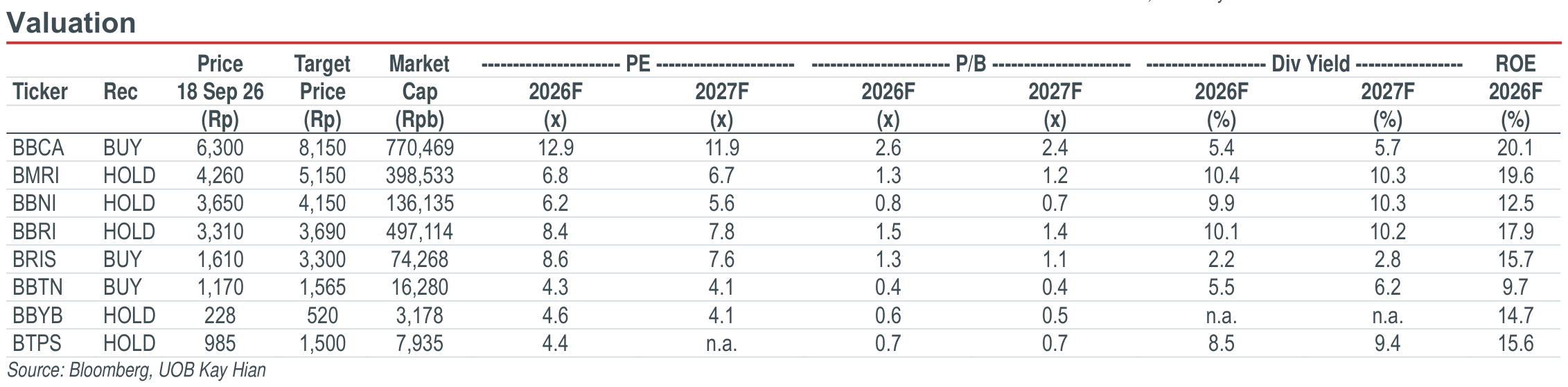
- Maintain MARKET WEIGHT; remain selective on SOE banks. Strong balance sheet growth is becoming more funding- and capital-intensive, while KopDes adds uncertainty around repayment and provisioning. BBCA remains our preferred pick, and HOLD BBRI, BMRI and BBNI.
Analysis
- Funding conditions have improved since 2Q26, although costs remain elevated. This is consistent with our recent discussions with banks, which generally pointed to April-June as the most difficult period for liquidity. Since then, funding pressure has eased, but banks have responded differently. Private banks remain relatively cautious on loan growth, while SOE banks continue to grow faster, supported by government liquidity or excess budget balance (SAL) placements, time deposit (TD) and other funding sources. In Aug 26, Bank Central Asia’s (BBCA) loans grew 10.5% yoy, broadly in line with current account and savings account (CASA) growth of 10.8% and loan-to-deposit ratio (LDR) stood at 81.0%. Bank Mandiri’s (BMRI) loans rose 17.6% against a CASA growth of 8.2%, with TD up 47.8% and LDR at 94.4%. Bank Negara Indonesia’s (BBNI) LDR was lower at 86.9%, although TD grew 63.7%. Funding costs have yet to fully reflect the improvement in liquidity conditions: interest expense declined 3.8% mom at BBCA in August but increased 1.2% at BMRI and 5.8% at BBNI. Nevertheless, management teams at some banks indicated that special deposit rates have started to fall.
- BMRI leans hardest on non-deposit funding. At end-Aug 26, BMRI had around Rp341t of repo, borrowings, liabilities to other banks, and securities issued, equivalent to 21% of loans. This compares with only Rp28t, or less than 3% of loans, at BBCA. This gives BMRI additional room to fund the balance sheet despite its higher LDR, although these sources are generally more expensive and market-sensitive than CASA. BBCA is in a different position as CASA alone exceeds its loan book, while its Rp394t securities portfolio provides another liquidity buffer.
Highlights
- Underlying liquidity is tighter than headline ratios suggest. Adjusted for SAL, we estimate BMRI’s LDR at around 101.0% (vs 94.4% reported) and BBNI’s at around 95.0% (vs 86.9%), with additional SAL expected to roll off through 4Q26 and uncertainty remaining over the maturity of the initial placements.
- Strong loan growth is exerting more pressure on both funding and capital. Loan growth at BMRI and BBNI continues to outpace organic CASA growth, increasing reliance on TD and other funding sources, while Tier 1/CET1 ratios at the SOE banks declined 180-270bp in 1H26.
- Maintain MARKET WEIGHT; remain selective on SOE banks. Strong balance sheet growth is becoming more funding- and capital-intensive, while KopDes adds uncertainty around repayment and provisioning. BBCA remains our preferred pick, and HOLD BBRI, BMRI and BBNI.
Analysis
- Funding conditions have improved since 2Q26, although costs remain elevated. This is consistent with our recent discussions with banks, which generally pointed to April-June as the most difficult period for liquidity. Since then, funding pressure has eased, but banks have responded differently. Private banks remain relatively cautious on loan growth, while SOE banks continue to grow faster, supported by government liquidity or excess budget balance (SAL) placements, time deposit (TD) and other funding sources. In Aug 26, Bank Central Asia’s (BBCA) loans grew 10.5% yoy, broadly in line with current account and savings account (CASA) growth of 10.8% and loan-to-deposit ratio (LDR) stood at 81.0%. Bank Mandiri’s (BMRI) loans rose 17.6% against a CASA growth of 8.2%, with TD up 47.8% and LDR at 94.4%. Bank Negara Indonesia’s (BBNI) LDR was lower at 86.9%, although TD grew 63.7%. Funding costs have yet to fully reflect the improvement in liquidity conditions: interest expense declined 3.8% mom at BBCA in August but increased 1.2% at BMRI and 5.8% at BBNI. Nevertheless, management teams at some banks indicated that special deposit rates have started to fall.
- BMRI leans hardest on non-deposit funding. At end-Aug 26, BMRI had around Rp341t of repo, borrowings, liabilities to other banks, and securities issued, equivalent to 21% of loans. This compares with only Rp28t, or less than 3% of loans, at BBCA. This gives BMRI additional room to fund the balance sheet despite its higher LDR, although these sources are generally more expensive and market-sensitive than CASA. BBCA is in a different position as CASA alone exceeds its loan book, while its Rp394t securities portfolio provides another liquidity buffer.
MARKET WEIGHT (Maintained)
Analyst
IMPORTANT NOTICE - DISCLOSURES AND DISCLAIMERS
This report is provided subject to, and must be read together with, the full Disclosures / Disclaimers available at this link, which are incorporated by reference into this report. In particular, this report is intended for general circulation and informational purposes only and does not constitute personal investment advice or a recommendation to buy or sell any investment product or security. You should independently evaluate the information and, where necessary, seek advice from a qualified financial adviser regarding the suitability of any investment. Analyst certifications required under applicable regulations, including SEC Regulation AC (where relevant), are included in this report. By accessing, receiving or using this report, you acknowledge that you have read, understood and agreed to be bound by the Disclosures / Disclaimers, as may be amended, supplemented or updated from time to time.
Our latest research

21 Sept 2026
China Internet: Hyperscalers Moving Into AI Chips: Custom Silicon Gains Traction, Compute Strategies Diverge

18 Sept 2026
