

Periodic/Sector reports
China Internet: Hyperscalers Moving Into AI Chips: Custom Silicon Gains Traction, Compute Strategies Diverge
Highlights
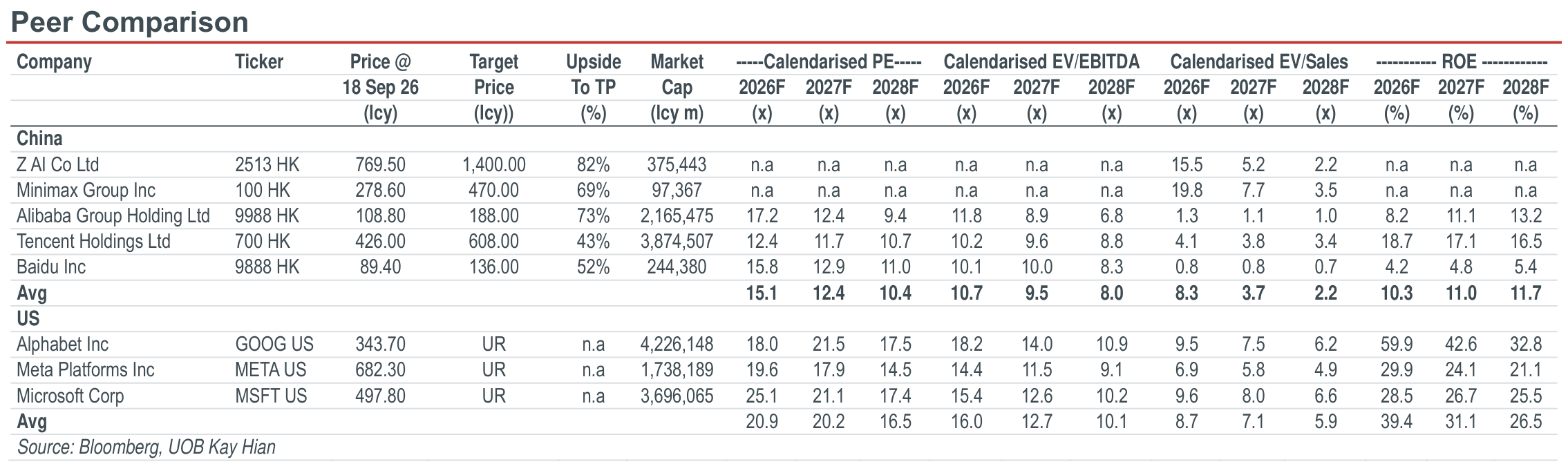
- Chinese cloud and LLM companies are increasingly moving into chip development, with the strategic goals of reducing compute costs, securing supply, and improving model-hardware co-optimisation. The economic benefits ultimately show up in lower cost per token and better returns on AI capex.
- Maintain MARKET WEIGHT. Top BUYs: Alibaba and Z.AI.
Analysis
- Custom AI silicon is gaining traction, with players taking different routes to secure compute through proprietary chip development, strategic partnerships and multi-vendor procurement. Alibaba and Baidu are building more vertically integrated stacks, Tencent combines Zixiao with strategic exposure to Enflame, while Z.AI is moving upstream through greater control of domestic compute infrastructure and MiniMax remains more reliant on external multi-cloud capacity.
- Alibaba is moving towards a more vertically-integrated AI compute stack, spanning accelerators, networking, rack-scale systems and software. Alibaba unveiled the Zhenwu M890 in May 26 as a unified training-and-inference accelerator, with 144GB of high-bandwidth memory and 800GB/s of inter-chip bandwidth. The accompanying ICN Switch 1.0 enables a 64-accelerator full-bandwidth domain, while the Panjiu AL128 connects 128 M890 chips in a rack-scale supernode. T-Head plans to release the V900 in 3Q27, targeting roughly 3x M890 performance, and the J900 in 3Q28. We think the broader significance lies in Alibaba’s ability to co-optimise chips, networking and cloud infrastructure instead of relying solely on standalone accelerator performance.
- Zhenwu adoption is broadening, although external shipment and monetisation visibility remain limited. T-Head has emerged as China’s second-largest domestic AI accelerator supplier after Huawei. It had cumulatively shipped more than 560,000 Zhenwu chips as of Apr 26, of which more than 60% were serving external customers through Alibaba Cloud, to over 650 customers across more than 20 industries. In Mar 26, Eddie Wu disclosed that T-Head’s annualised revenue exceeded Rmb10b. Alibaba has gradually opened SAIL, its AI accelerator software stack, supporting more than 260 training and inference frameworks including PyTorch, TensorFlow, vLLM and SGLang. Better compatibility should lower migration costs and support wider Zhenwu adoption, although SAIL remains under development and is not yet a proven compute unified device architecture substitute across all workloads.
Highlights
- Chinese cloud and LLM companies are increasingly moving into chip development, with the strategic goals of reducing compute costs, securing supply, and improving model-hardware co-optimisation. The economic benefits ultimately show up in lower cost per token and better returns on AI capex.
- Maintain MARKET WEIGHT. Top BUYs: Alibaba and Z.AI.
Analysis
- Custom AI silicon is gaining traction, with players taking different routes to secure compute through proprietary chip development, strategic partnerships and multi-vendor procurement. Alibaba and Baidu are building more vertically integrated stacks, Tencent combines Zixiao with strategic exposure to Enflame, while Z.AI is moving upstream through greater control of domestic compute infrastructure and MiniMax remains more reliant on external multi-cloud capacity.
- Alibaba is moving towards a more vertically-integrated AI compute stack, spanning accelerators, networking, rack-scale systems and software. Alibaba unveiled the Zhenwu M890 in May 26 as a unified training-and-inference accelerator, with 144GB of high-bandwidth memory and 800GB/s of inter-chip bandwidth. The accompanying ICN Switch 1.0 enables a 64-accelerator full-bandwidth domain, while the Panjiu AL128 connects 128 M890 chips in a rack-scale supernode. T-Head plans to release the V900 in 3Q27, targeting roughly 3x M890 performance, and the J900 in 3Q28. We think the broader significance lies in Alibaba’s ability to co-optimise chips, networking and cloud infrastructure instead of relying solely on standalone accelerator performance.
- Zhenwu adoption is broadening, although external shipment and monetisation visibility remain limited. T-Head has emerged as China’s second-largest domestic AI accelerator supplier after Huawei. It had cumulatively shipped more than 560,000 Zhenwu chips as of Apr 26, of which more than 60% were serving external customers through Alibaba Cloud, to over 650 customers across more than 20 industries. In Mar 26, Eddie Wu disclosed that T-Head’s annualised revenue exceeded Rmb10b. Alibaba has gradually opened SAIL, its AI accelerator software stack, supporting more than 260 training and inference frameworks including PyTorch, TensorFlow, vLLM and SGLang. Better compatibility should lower migration costs and support wider Zhenwu adoption, although SAIL remains under development and is not yet a proven compute unified device architecture substitute across all workloads.
IMPORTANT NOTICE - DISCLOSURES AND DISCLAIMERS
This report is provided subject to, and must be read together with, the full Disclosures / Disclaimers available at this link, which are incorporated by reference into this report. In particular, this report is intended for general circulation and informational purposes only and does not constitute personal investment advice or a recommendation to buy or sell any investment product or security. You should independently evaluate the information and, where necessary, seek advice from a qualified financial adviser regarding the suitability of any investment. Analyst certifications required under applicable regulations, including SEC Regulation AC (where relevant), are included in this report. By accessing, receiving or using this report, you acknowledge that you have read, understood and agreed to be bound by the Disclosures / Disclaimers, as may be amended, supplemented or updated from time to time.
Related articles

3 Sept 2026
Internet: AI Capex: Returns Remain Attractive, Funding Risk Diverging

16 Sept 2026
China AI - AI Landscape: Efficiency And Adoption Improve, Cybersecurity Emerges, Funding Risks Diverge

15 Sept 2026
Internet: Feedback From Marketing Trip
Our latest research

18 Sept 2026
Automobile: Weekly: Lithium Carbonate Price Drop Reconfirms Our Preference For OEMs; Bottom-fishing Opportunity Emerges For CATL

18 Sept 2026
Consumer: China Consumer: Assessing The Impacts Of El Niño

17 Sept 2026