

Periodic/Sector reports
Internet: Feedback From Marketing Trip
MARKET WEIGHT (Maintained)
Analyst
Highlights
- Key investor focus areas discussed during the marketing trip include: a) AI capex requirements, b) funding methodology, c) investment payback period, and d) open-source AI monetisation and the competitive landscape.
- In our view, AI/AI Cloud, online gaming and OTAs are poised for further re-rating, supported by stronger growth delivery and eased regulatory overhangs.
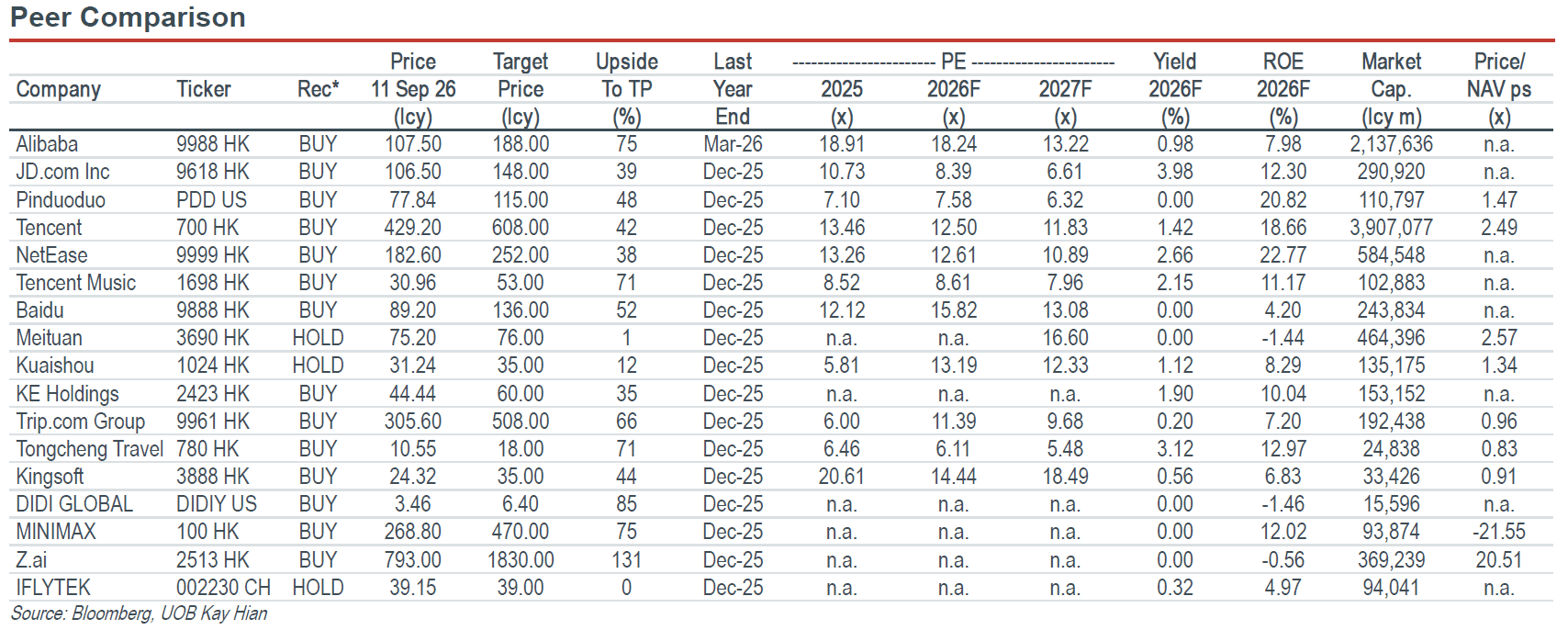
- Maintain MARKET WEIGHT. Top BUYs: Alibaba, NetEase, Z.ai and TCOM.
Analysis
- Positioning remains selective. Investors focused on AI/LLM monetisation, capex returns and durable China exposure. They remain constructive on Alibaba and Tencent, but largely as a relative trade as Asian semiconductors remained the preferred earnings-momentum exposure, rather than a strategic sector reallocation. We would turn more positive on the broader sector only if earnings upgrades and fund flows broaden beyond Alibaba and Tencent.
- What is the capex outlook for hyperscalers? We estimate FY27/2026 capex of Rmb225b/Rmb200b/Rmb55b for Alibaba/Tencent/Baidu, vs latest-quarter spending of Rmb67.7b/Rmb59.3b/Rmb11.5b. Alibaba remains the most aggressive, having deployed around Rmb190b of its Rmb380b three-year AI plan. Tencent continues to front-load compute and storage investment, while Baidu expects capex to moderate in 3Q-4Q26 after heavy 2Q26 server and chip purchases. High capex will pressure near-term free cash flow (FCF), but improving utilisation should support returns over time.
- How sustainable is AI capex funding? Alibaba has the largest structural gap, with Rmb135b normalised operating cash flow vs Rmb225b FY27 capex, partly offset by its HK$80b placement and Rmb330b listed investment portfolio. Tencent is best funded, with annualised 1H26 operating cash flow of Rmb310b comfortably covering Rmb200b capex, plus further asset-recycling optionality. Baidu has weaker internal funding, with 2Q26 operating cash flow of Rmb3.4b vs Rmb11.4b capex, implying greater reliance on debt, leasing and subsidiary financing, although Rmb100b adjusted liquidity provides several years of runway.
Highlights
- Key investor focus areas discussed during the marketing trip include: a) AI capex requirements, b) funding methodology, c) investment payback period, and d) open-source AI monetisation and the competitive landscape.
- In our view, AI/AI Cloud, online gaming and OTAs are poised for further re-rating, supported by stronger growth delivery and eased regulatory overhangs.
- Maintain MARKET WEIGHT. Top BUYs: Alibaba, NetEase, Z.ai and TCOM.
Analysis
- Positioning remains selective. Investors focused on AI/LLM monetisation, capex returns and durable China exposure. They remain constructive on Alibaba and Tencent, but largely as a relative trade as Asian semiconductors remained the preferred earnings-momentum exposure, rather than a strategic sector reallocation. We would turn more positive on the broader sector only if earnings upgrades and fund flows broaden beyond Alibaba and Tencent.
- What is the capex outlook for hyperscalers? We estimate FY27/2026 capex of Rmb225b/Rmb200b/Rmb55b for Alibaba/Tencent/Baidu, vs latest-quarter spending of Rmb67.7b/Rmb59.3b/Rmb11.5b. Alibaba remains the most aggressive, having deployed around Rmb190b of its Rmb380b three-year AI plan. Tencent continues to front-load compute and storage investment, while Baidu expects capex to moderate in 3Q-4Q26 after heavy 2Q26 server and chip purchases. High capex will pressure near-term free cash flow (FCF), but improving utilisation should support returns over time.
- How sustainable is AI capex funding? Alibaba has the largest structural gap, with Rmb135b normalised operating cash flow vs Rmb225b FY27 capex, partly offset by its HK$80b placement and Rmb330b listed investment portfolio. Tencent is best funded, with annualised 1H26 operating cash flow of Rmb310b comfortably covering Rmb200b capex, plus further asset-recycling optionality. Baidu has weaker internal funding, with 2Q26 operating cash flow of Rmb3.4b vs Rmb11.4b capex, implying greater reliance on debt, leasing and subsidiary financing, although Rmb100b adjusted liquidity provides several years of runway.
MARKET WEIGHT (Maintained)
Analyst
IMPORTANT NOTICE - DISCLOSURES AND DISCLAIMERS
This report is provided subject to, and must be read together with, the full Disclosures / Disclaimers available at this link, which are incorporated by reference into this report. In particular, this report is intended for general circulation and informational purposes only and does not constitute personal investment advice or a recommendation to buy or sell any investment product or security. You should independently evaluate the information and, where necessary, seek advice from a qualified financial adviser regarding the suitability of any investment. Analyst certifications required under applicable regulations, including SEC Regulation AC (where relevant), are included in this report. By accessing, receiving or using this report, you acknowledge that you have read, understood and agreed to be bound by the Disclosures / Disclaimers, as may be amended, supplemented or updated from time to time.
Related articles

4 Sept 2026
Internet - 2Q26 Results Recap: AI Cloud Accelerates; E-Commerce Still Soft; Gaming Resilient

3 Sept 2026
Internet: AI Capex: Returns Remain Attractive, Funding Risk Diverging

27 Aug 2026
Internet: AI Model: Scaling Intelligence, Winning On Cost
Our latest research

15 Sept 2026
China Property: New Home Sales Accelerate In Tier 1 Cities In Early-Sep 26 But Weaken In Lower-tier Cities

14 Sept 2026
IT Hardware - Handset: Apple-linked And Premium Suppliers To Widen Their Lead Amid The Downcycle

11 Sept 2026