

Periodic/Sector reports
China Internet: Shifting Profit Pool: From AI Infrastructure Investment To Intelligence Monetisation
Highlights
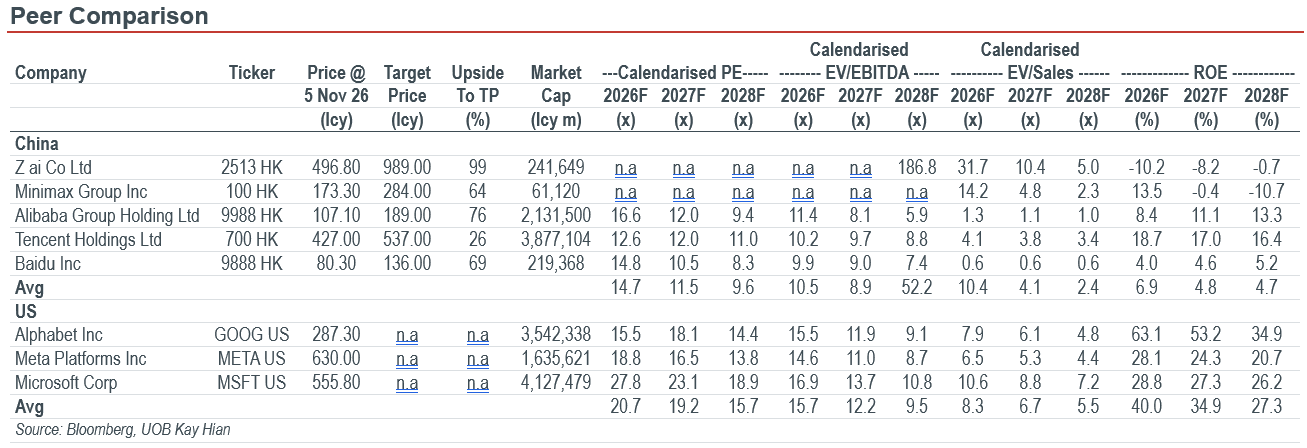
We see that the AI industry is transitioning from a capacity-driven investment cycle towards an intelligence monetisation cycle, where model differentiation, inference efficiency, enterprise adoption and sustainable gross profit generation will increasingly determine value capture. We remain constructive on China's AI value chain, with a preference for Alibaba and Z.ai, while viewing Tencent as a longer-term beneficiary of AI application monetisation.
Maintain MARKET WEIGHT. Top BUYs: Alibaba, Tencent and Z.ai.
Analysis
Narrowing the capability gap, accelerating monetisation. We have seen a widening of the capability gap between leading US and Chinese models since mid-26, particularly in complex reasoning, coding and long-horizon agentic tasks. Recent Artificial Analysis benchmarks highlight the divergence, with Claude Opus 5.5 scoring 58 vs 46 for Kimi K3.1 Pro and 32 for GLM-5.3. Despite persistent compute constraints, the stronger real-world data flywheels, increased investment in post-training and recursive self-improvement are likely to help Chinese models narrow the gap by mid-27. China's leading model developers are increasingly shifting their focus from benchmark performance towards real-world adoption and commercial scalability. We see coding, cloud service provider (CSP) partnerships and vertical AI agents as key drivers of the next phase of monetisation.
Anti-distillation could accelerate industry consolidation. While anti-distillation measures raise data acquisition costs rather than fundamentally constrain model scaling, Chinese labs are developing harnesses and synthetic data pipelines to sustain progress. Rising capital, data and engineering requirements should increasingly favour Tier 1 labs with proprietary feedback loops, advanced post-training and efficient inference infrastructure, widening the competitive gap with smaller players.
- Geopolitics and interest rates: Potential tailwinds for China internet valuations. Democratic control of Congress could accelerate a resolution to the US-Iran conflict, ease oil prices and inflation, and potentially pave the way for Fed easing and improved liquidity for China ADRs. We see three potential benefits for China’s internet sector: a) improving foreign inflows into Hong Kong and China ADRs, b) lower AI hardware costs supporting CSP margins and FCF, and c) lower energy prices easing inflationary pressure and supporting consumption. We expect the liquidity-driven valuation uplift to be the most immediate catalyst, particularly for Alibaba and Tencent, while fundamental benefits could materialise more gradually.
Highlights
We see that the AI industry is transitioning from a capacity-driven investment cycle towards an intelligence monetisation cycle, where model differentiation, inference efficiency, enterprise adoption and sustainable gross profit generation will increasingly determine value capture. We remain constructive on China's AI value chain, with a preference for Alibaba and Z.ai, while viewing Tencent as a longer-term beneficiary of AI application monetisation.
Maintain MARKET WEIGHT. Top BUYs: Alibaba, Tencent and Z.ai.
Analysis
Narrowing the capability gap, accelerating monetisation. We have seen a widening of the capability gap between leading US and Chinese models since mid-26, particularly in complex reasoning, coding and long-horizon agentic tasks. Recent Artificial Analysis benchmarks highlight the divergence, with Claude Opus 5.5 scoring 58 vs 46 for Kimi K3.1 Pro and 32 for GLM-5.3. Despite persistent compute constraints, the stronger real-world data flywheels, increased investment in post-training and recursive self-improvement are likely to help Chinese models narrow the gap by mid-27. China's leading model developers are increasingly shifting their focus from benchmark performance towards real-world adoption and commercial scalability. We see coding, cloud service provider (CSP) partnerships and vertical AI agents as key drivers of the next phase of monetisation.
Anti-distillation could accelerate industry consolidation. While anti-distillation measures raise data acquisition costs rather than fundamentally constrain model scaling, Chinese labs are developing harnesses and synthetic data pipelines to sustain progress. Rising capital, data and engineering requirements should increasingly favour Tier 1 labs with proprietary feedback loops, advanced post-training and efficient inference infrastructure, widening the competitive gap with smaller players.
- Geopolitics and interest rates: Potential tailwinds for China internet valuations. Democratic control of Congress could accelerate a resolution to the US-Iran conflict, ease oil prices and inflation, and potentially pave the way for Fed easing and improved liquidity for China ADRs. We see three potential benefits for China’s internet sector: a) improving foreign inflows into Hong Kong and China ADRs, b) lower AI hardware costs supporting CSP margins and FCF, and c) lower energy prices easing inflationary pressure and supporting consumption. We expect the liquidity-driven valuation uplift to be the most immediate catalyst, particularly for Alibaba and Tencent, while fundamental benefits could materialise more gradually.
IMPORTANT NOTICE - DISCLOSURES AND DISCLAIMERS
This report is provided subject to, and must be read together with, the full Disclosures / Disclaimers available at this link, which are incorporated by reference into this report. In particular, this report is intended for general circulation and informational purposes only and does not constitute personal investment advice or a recommendation to buy or sell any investment product or security. You should independently evaluate the information and, where necessary, seek advice from a qualified financial adviser regarding the suitability of any investment. Analyst certifications required under applicable regulations, including SEC Regulation AC (where relevant), are included in this report. By accessing, receiving or using this report, you acknowledge that you have read, understood and agreed to be bound by the Disclosures / Disclaimers, as may be amended, supplemented or updated from time to time.
Related articles

16 Oct 2026
China Healthcare - Bi-Weekly: Profit-taking Drags HSHCI; ESMO Data Brightens Biopharma Outlook

20 Oct 2026
China Property: NBS: New-home Sales Decline Deepens To 22.6% yoy In Sep 26; Second-Hand Market Continues To Outperform

15 Oct 2026
Automobile: China Auto Sector Weekly
Our latest research

5 Nov 2026
Automobile: China Auto Sector Weekly (5 Nov 26)

27 Oct 2026
China Property: Oct 26: Supply Keeps Contracting While Sales Diverge, With Tier 1 And Second-hand Homes Ahead

23 Oct 2026