

Periodic/Sector reports
Construction: Dissecting GE16 Impact And Domestic Infrastructure Momentum
OVERWEIGHT (Maintained)
Analyst
Analyst
Highlights
- The rollout of domestic projects has seen a slowdown in 7M26 (-7% yoy); government-awarded projects stand at RM29b (22% of total).
- A trifecta of impediments may further delay mega project awards: a) rising building material and diesel costs; b) a change in the political landscape; c) a potential cut in government expenditure due to rising petrol subsidies.
- Based on historical trends, there is minimum downside risk from general elections, which suggest that sector share prices should re-rate upwards from here on.
- Maintain OVERWEIGHT; top picks are Gamuda, Binastra and Kerjaya.
Analysis
- Rollout of mega projects may be selectively put on hold, with some delays expected… We opine that several domestic developments are not in the sector’s favour in terms of mega projects roll-out, and we may see slower progress due to the financial constraints faced by the federal government. Note that the rollout of domestic projects has been slower in 7M26, with the total value of projects awarded standing at around RM131b (-7% yoy). Out of this, only RM29b (22%) are projects awarded by the government, far below 2025’s government projects (at only 50%).
- • …despite certain large infrastructure projects coming on-stream this year. Notable mega infrastructure projects awarded ytd include: a) Phase 1 of the Ulu Padas water supply scheme in Sabah (RM5.98b); b) Penang LRT Mutiara Line project system packages (RM3.03b); and c) Tanah Rata bypass and federal road upgrade (RM430m). Some key mega projects anticipated in 4Q26-2027 are: a) EPCC contract for Perak-Penang Water Supply Scheme (e.RM4b); b) Penang LRT Mutiara Line Segment 2 (~RM4b); c) Johor’s Elevated Autonomous Rapid Transit (e-ART) project (RM7b-10b); d) East Coast Rail Link-Port Klang extension (RM0.7b-0.9b), and e) more water related infrastructure projects in the pipeline.
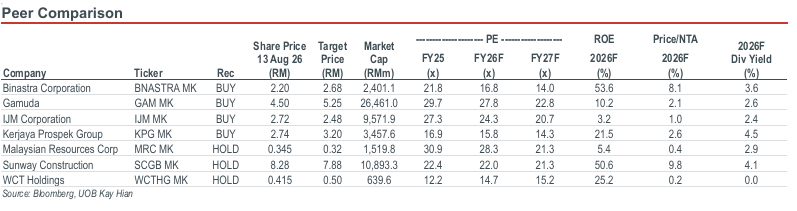
- • Pump-priming of domestic mega projects due to looming GE16 also unlikely, and we think that election risks are mostly priced in. Fundamental impacts of the 16th General Election (GE16) on the construction sector may be fairly limited, given that the award of mega projects, which provide crucial fiscal stimuli, have seen a slowdown in the past three years due to the government’s more conservative budget allocation. We also believe that the potential downside risk is limited given the market has already partially priced in the election risk premium into valuations. Sector valuations now trade at 18-19x 2027F PE, which are still attractive after factoring in earnings growth amidst the private job flow upcycle.
- Trifecta of impediments may slow down pace of public infrastructure projects award during 2H26-1H27. 1. Rising building material and diesel costs. Despite building material prices having normalised from March-April’s peak due to the de-escalation of Iran war, we estimate that general construction costs for public infrastructure projects are still 10-15% higher than before the Iran war, mainly due to diesel price (50% higher than pre-Iran war) related cost escalations. Furthermore, there is limited variation of prices (VOP) for public infrastructure projects as compared with private job flows, and infrastructure projects usually do not allow delays or work orders as it is deemed as a violation of contract conditions. 2. Changes in the political landscape are likely to lead to delays in public projects (especially large infrastructure projects). Projects are now under more careful scrutiny and key development policies may require a longer tender processing period. 3. Potential cut in government expenditure to cope with rising petrol subsidies. Given the rising crude oil prices and constraints on petrol price hikes currently, the federal government would need to control expenditure to achieve its budget deficit target of 3.5% (or RM74.6b) of GDP for 2026. At the current high crude oil prices of above US$84/barrel, the government’s fuel subsidy allocation has increased to RM40b from the RM15b initially budgeted for 2026. We are of the view that more fiscal constraint on government expenditure will potentially delay the rollout of certain mega-projects, despite broad-based construction expenditure possibly remaining at high levels.
- Update on MRT3 and HSR railway projects. To recall, the final railway scheme for the Mass Rapid Transit 3 (MRT3) circle line was approved back in 3Q25, with landbank acquisition targeted to be completed by end-2026. Nevertheless, we do not rule out a further delay into 2027, anticipating that the tender awards for contractors will materialise only in 2H27-1H28. Meanwhile, we also understand that there is no major progress for the KL Singapore High-Speed-Rail (HSR) projects, as the government had earlier proposed that the project be private sector-led and funded, under a concession model. There is also no newsflow on any specific proposal raised with the Singapore government yet.
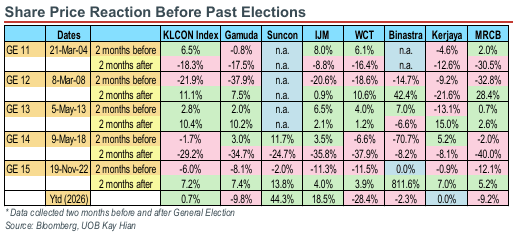
- A simple comparison between general elections - minimum downside risk. Construction companies are unlikely to suffer the magnitude of the 2018 election sell-down when Barisan Nasional ended its 60-year reign as the ruling government for the first time. During the 15th General Election (GE15) in 2022, the KLCON index and most construction stocks within our coverage saw a correction of 1-12% two months before the election, and surged 4-14% two months after the GE15. We are of the view that the downside from the upcoming election is limited as: a) the market has already factored in the volatility, and b) sector bellwethers are riding on the data centre (DC) upcycle with record-high earnings delivery. As such, we expect share prices to re rate upwards from here on, limiting the impact and sentiment from GE16.
Highlights
- The rollout of domestic projects has seen a slowdown in 7M26 (-7% yoy); government-awarded projects stand at RM29b (22% of total).
- A trifecta of impediments may further delay mega project awards: a) rising building material and diesel costs; b) a change in the political landscape; c) a potential cut in government expenditure due to rising petrol subsidies.
- Based on historical trends, there is minimum downside risk from general elections, which suggest that sector share prices should re-rate upwards from here on.
- Maintain OVERWEIGHT; top picks are Gamuda, Binastra and Kerjaya.
Analysis
- Rollout of mega projects may be selectively put on hold, with some delays expected… We opine that several domestic developments are not in the sector’s favour in terms of mega projects roll-out, and we may see slower progress due to the financial constraints faced by the federal government. Note that the rollout of domestic projects has been slower in 7M26, with the total value of projects awarded standing at around RM131b (-7% yoy). Out of this, only RM29b (22%) are projects awarded by the government, far below 2025’s government projects (at only 50%).
- • …despite certain large infrastructure projects coming on-stream this year. Notable mega infrastructure projects awarded ytd include: a) Phase 1 of the Ulu Padas water supply scheme in Sabah (RM5.98b); b) Penang LRT Mutiara Line project system packages (RM3.03b); and c) Tanah Rata bypass and federal road upgrade (RM430m). Some key mega projects anticipated in 4Q26-2027 are: a) EPCC contract for Perak-Penang Water Supply Scheme (e.RM4b); b) Penang LRT Mutiara Line Segment 2 (~RM4b); c) Johor’s Elevated Autonomous Rapid Transit (e-ART) project (RM7b-10b); d) East Coast Rail Link-Port Klang extension (RM0.7b-0.9b), and e) more water related infrastructure projects in the pipeline.
- • Pump-priming of domestic mega projects due to looming GE16 also unlikely, and we think that election risks are mostly priced in. Fundamental impacts of the 16th General Election (GE16) on the construction sector may be fairly limited, given that the award of mega projects, which provide crucial fiscal stimuli, have seen a slowdown in the past three years due to the government’s more conservative budget allocation. We also believe that the potential downside risk is limited given the market has already partially priced in the election risk premium into valuations. Sector valuations now trade at 18-19x 2027F PE, which are still attractive after factoring in earnings growth amidst the private job flow upcycle.
- Trifecta of impediments may slow down pace of public infrastructure projects award during 2H26-1H27. 1. Rising building material and diesel costs. Despite building material prices having normalised from March-April’s peak due to the de-escalation of Iran war, we estimate that general construction costs for public infrastructure projects are still 10-15% higher than before the Iran war, mainly due to diesel price (50% higher than pre-Iran war) related cost escalations. Furthermore, there is limited variation of prices (VOP) for public infrastructure projects as compared with private job flows, and infrastructure projects usually do not allow delays or work orders as it is deemed as a violation of contract conditions. 2. Changes in the political landscape are likely to lead to delays in public projects (especially large infrastructure projects). Projects are now under more careful scrutiny and key development policies may require a longer tender processing period. 3. Potential cut in government expenditure to cope with rising petrol subsidies. Given the rising crude oil prices and constraints on petrol price hikes currently, the federal government would need to control expenditure to achieve its budget deficit target of 3.5% (or RM74.6b) of GDP for 2026. At the current high crude oil prices of above US$84/barrel, the government’s fuel subsidy allocation has increased to RM40b from the RM15b initially budgeted for 2026. We are of the view that more fiscal constraint on government expenditure will potentially delay the rollout of certain mega-projects, despite broad-based construction expenditure possibly remaining at high levels.
- Update on MRT3 and HSR railway projects. To recall, the final railway scheme for the Mass Rapid Transit 3 (MRT3) circle line was approved back in 3Q25, with landbank acquisition targeted to be completed by end-2026. Nevertheless, we do not rule out a further delay into 2027, anticipating that the tender awards for contractors will materialise only in 2H27-1H28. Meanwhile, we also understand that there is no major progress for the KL Singapore High-Speed-Rail (HSR) projects, as the government had earlier proposed that the project be private sector-led and funded, under a concession model. There is also no newsflow on any specific proposal raised with the Singapore government yet.
- A simple comparison between general elections - minimum downside risk. Construction companies are unlikely to suffer the magnitude of the 2018 election sell-down when Barisan Nasional ended its 60-year reign as the ruling government for the first time. During the 15th General Election (GE15) in 2022, the KLCON index and most construction stocks within our coverage saw a correction of 1-12% two months before the election, and surged 4-14% two months after the GE15. We are of the view that the downside from the upcoming election is limited as: a) the market has already factored in the volatility, and b) sector bellwethers are riding on the data centre (DC) upcycle with record-high earnings delivery. As such, we expect share prices to re rate upwards from here on, limiting the impact and sentiment from GE16.
OVERWEIGHT (Maintained)
Analyst
Analyst
IMPORTANT NOTICE - DISCLOSURES AND DISCLAIMERS
This report is provided subject to, and must be read together with, the full Disclosures / Disclaimers available at the following link: this link, which are incorporated by reference into this report. In particular, this report is intended for general circulation and informational purposes only and does not constitute personal investment advice or a recommendation to buy or sell any investment product or security. You should independently evaluate the information and, where necessary, seek advice from a qualified financial adviser regarding the suitability of any investment. Analyst certifications required under applicable regulations, including SEC Regulation AC (where relevant), are included in this report. By accessing, receiving or using this report, you acknowledge that you have read, understood and agreed to be bound by the Disclosures / Disclaimers, as may be amended, supplemented or updated from time to time.


