

Analyst
Analyst
July Trade Growth Moderates But Stays Strong
- July export growth eased to 23.9% yoy (-3.1ppt mom), still ahead of Bloomberg's consensus estimate of 23.0% yoy, with continued strength in the Hong Kong and ASEAN markets.
- Import growth moderated to 27.5% yoy (-8.5ppt mom), below consensus of 29.7% yoy, largely reflecting a higher base from Jul 25, while integrated circuits imports growth held near record at 71.1% yoy.
- The trade surplus narrowed slightly to US$112.5b from US$125.6b, though above consensus' US$107.1b. The import deceleration was concentrated outside tech-related growth, with integrated circuits import growth little changed, making it the key swing factor for headline import growth in 2H26.
What’s New
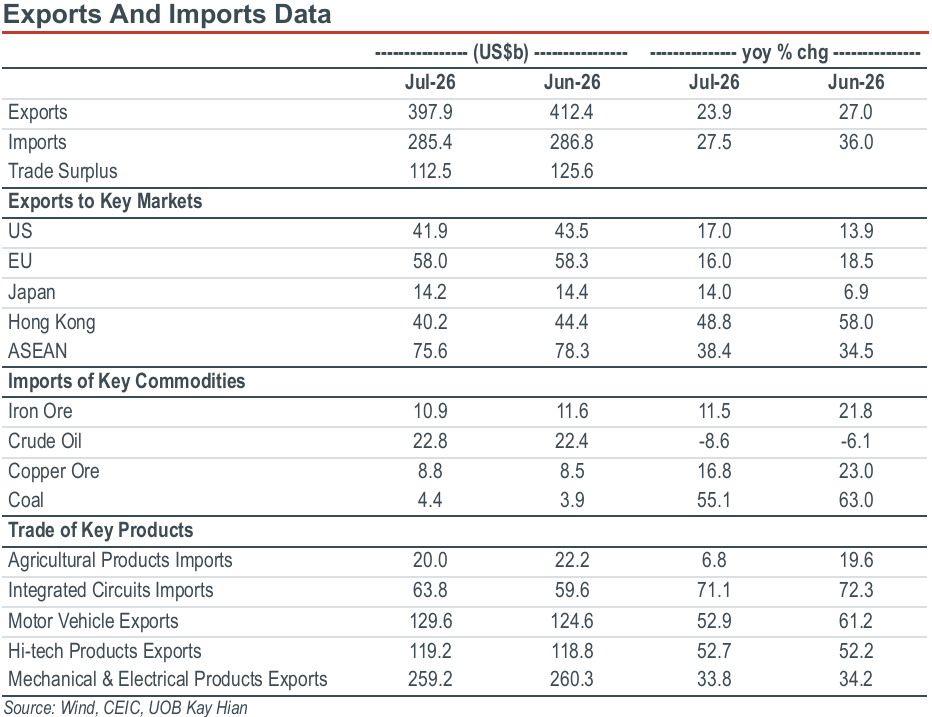
China’s export growth eased to 23.9% yoy in July from 27.0% yoy in June (-3.1ppt mom), still ahead of Bloomberg's consensus estimate of 23.0% yoy. The moderation was concentrated in two markets rather than broad-based. China's export growth to Hong Kong eased to 48.8% yoy ( 9.2ppt mom), though it remained the fastest-growing key market, while China's export growth to the EU slowed to 16.0% yoy (-2.5ppt mom). Momentum improved elsewhere. China's export growth to ASEAN strengthened to 38.4% yoy (+3.9ppt mom), China's export growth to the US picked up to 17.0% yoy (+3.1ppt mom) due to the lower base and China's export growth to Japan rose to 14.0% yoy (+7.1ppt mom).
China's import growth came in at 27.5% yoy in July (-8.5ppt mom), below Bloomberg's consensus estimate of 29.7% yoy. Among key commodities, there was a broad-based slowdown in import growth; China's import growth of coal eased to 55.1% yoy (-7.9ppt mom) and iron ore to 11.5% yoy (-10.3ppt mom), though both remained supported by domestic seasonal demand. China's import growth of copper ore moderated to 16.8% yoy (-6.2ppt mom), while crude oil stayed in negative territory at -8.6% yoy ( 2.5ppt mom), continuing to reflect fading price support from the earlier Strait of Hormuz disruption.
Integrated circuits remained the standout among key trade product categories, with import growth at 71.1% yoy (-1.2ppt mom) and import value setting a fresh record. China's hi-tech products export growth edged up to 52.7% yoy (+0.5ppt mom) and mechanical and electrical products export growth was broadly unchanged at 33.8% yoy (-0.4ppt mom), consistent with the strength in integrated circuits. China's motor vehicle export growth eased to 52.9% yoy (-8.3ppt mom) but remained robust, while China's agricultural products import growth slowed to 6.8% yoy (-12.8ppt mom).
The trade surplus narrowed to US$112.5b from June's US$125.6b, though above consensus' US$107.1b. Going forward, July's import moderation was uneven, with integrated circuits import growth easing only 1.2ppt mom against a broader slowdown across key commodities and agricultural products. We therefore see integrated circuits demand as the key swing factor for headline import growth in 2H26.
July Trade Growth Moderates But Stays Strong
- July export growth eased to 23.9% yoy (-3.1ppt mom), still ahead of Bloomberg's consensus estimate of 23.0% yoy, with continued strength in the Hong Kong and ASEAN markets.
- Import growth moderated to 27.5% yoy (-8.5ppt mom), below consensus of 29.7% yoy, largely reflecting a higher base from Jul 25, while integrated circuits imports growth held near record at 71.1% yoy.
- The trade surplus narrowed slightly to US$112.5b from US$125.6b, though above consensus' US$107.1b. The import deceleration was concentrated outside tech-related growth, with integrated circuits import growth little changed, making it the key swing factor for headline import growth in 2H26.
What’s New
China’s export growth eased to 23.9% yoy in July from 27.0% yoy in June (-3.1ppt mom), still ahead of Bloomberg's consensus estimate of 23.0% yoy. The moderation was concentrated in two markets rather than broad-based. China's export growth to Hong Kong eased to 48.8% yoy ( 9.2ppt mom), though it remained the fastest-growing key market, while China's export growth to the EU slowed to 16.0% yoy (-2.5ppt mom). Momentum improved elsewhere. China's export growth to ASEAN strengthened to 38.4% yoy (+3.9ppt mom), China's export growth to the US picked up to 17.0% yoy (+3.1ppt mom) due to the lower base and China's export growth to Japan rose to 14.0% yoy (+7.1ppt mom).
China's import growth came in at 27.5% yoy in July (-8.5ppt mom), below Bloomberg's consensus estimate of 29.7% yoy. Among key commodities, there was a broad-based slowdown in import growth; China's import growth of coal eased to 55.1% yoy (-7.9ppt mom) and iron ore to 11.5% yoy (-10.3ppt mom), though both remained supported by domestic seasonal demand. China's import growth of copper ore moderated to 16.8% yoy (-6.2ppt mom), while crude oil stayed in negative territory at -8.6% yoy ( 2.5ppt mom), continuing to reflect fading price support from the earlier Strait of Hormuz disruption.
Integrated circuits remained the standout among key trade product categories, with import growth at 71.1% yoy (-1.2ppt mom) and import value setting a fresh record. China's hi-tech products export growth edged up to 52.7% yoy (+0.5ppt mom) and mechanical and electrical products export growth was broadly unchanged at 33.8% yoy (-0.4ppt mom), consistent with the strength in integrated circuits. China's motor vehicle export growth eased to 52.9% yoy (-8.3ppt mom) but remained robust, while China's agricultural products import growth slowed to 6.8% yoy (-12.8ppt mom).
The trade surplus narrowed to US$112.5b from June's US$125.6b, though above consensus' US$107.1b. Going forward, July's import moderation was uneven, with integrated circuits import growth easing only 1.2ppt mom against a broader slowdown across key commodities and agricultural products. We therefore see integrated circuits demand as the key swing factor for headline import growth in 2H26.
Analyst
Analyst
IMPORTANT NOTICE - DISCLOSURES AND DISCLAIMERS
This report is provided subject to, and must be read together with, the full Disclosures / Disclaimers available at the following link, which are incorporated by reference into this report. In particular, this report is intended for general circulation and informational purposes only and does not constitute personal investment advice or a recommendation to buy or sell any investment product or security. You should independently evaluate the information and, where necessary, seek advice from a qualified financial adviser regarding the suitability of any investment. Analyst certifications required under applicable regulations, including SEC Regulation AC (where relevant), are included in this report. By accessing, receiving or using this report, you acknowledge that you have read, understood and agreed to be bound by the Disclosures / Disclaimers, as may be amended, supplemented or updated from time to time.


