

Company Coverage
Banking: Jun 26 BNM Statistics: Loan Growth Eases, Pipeline Firms
OVERWEIGHT (Maintained)
Analyst
Analyst
Highlights
- The banking sector’s stats remained resilient in Jun 26 despite macro headwinds. Loan growth eased but leading indicators have rebounded strongly. Deposit growth accelerated while asset quality was stable.
- We expect sector earnings to grow a decent 3% and 6% in 2026 and 2027 respectively. Earnings resilience will be underpinned by modest loans growth, stable credit costs and relatively stable NIM with banks’ asset liability management helping to offset some of the headwinds from yield pressure.
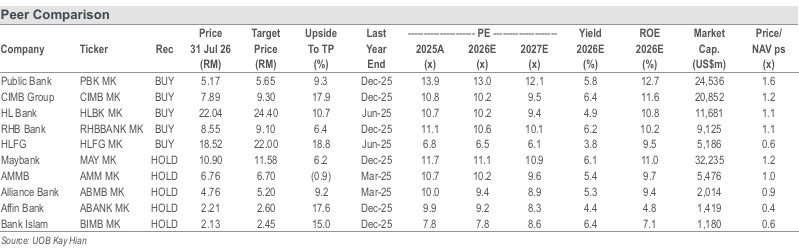
- Maintain OVERWEIGHT. Amid the ongoing Middle East geopolitical uncertainties, we adopt a barbell strategy, favouring Public Bank and Hong Leong Bank for their defensive profiles and capital management upside, while CIMB offers attractive value with one of the sector’s highest dividend yields at around 6.5%.
Analysis
- Loan growth moderated slightly, easing to 5.5% yoy in Jun 26 (May 26: 5.7%). Business and household loan growth slowed to 6.1% and 5.0% respectively, while mortgage growth remained healthy at 5.4%. We maintain our 2026 loan growth forecast at 5.0–5.5%, supported by continued household lending demand.
- Leading loan growth indicators rebounds. Loan applications and approvals rose 27.0% and 22.8% yoy respectively in Jun 26 (May 26: -2.8% and +2.7%). Business lending remained key, with applications and approvals increasing 45.9% and 35.3% respectively, while household applications and approvals grew 12.5% and 8.6%.
- Deposit growth accelerated to 6.0% yoy in Jun 26 (May 26: 4.4%), despite CASA growth moderating to 7.7% from 9.6%. Consequently, the loans-to deposits ratio improved to 88.3% from 89.3% in May 26. Overall liquidity remains healthy, with banks retaining flexibility to access bond markets as a cheaper alternative to wholesale deposits.
- Asset quality was stable with GIL ratio unchanged at 1.43%, remaining low by historical standards. Business GIL improved marginally by 1bp to 1.91%. in contrast to household GIL edging 1bp higher to 1.11%. Loan-loss coverage eased to 81.3% from 82.6%, but continues to provide a decent buffer (pre pandemic: ~80%) against potential asset-quality deterioration.
Highlights
- The banking sector’s stats remained resilient in Jun 26 despite macro headwinds. Loan growth eased but leading indicators have rebounded strongly. Deposit growth accelerated while asset quality was stable.
- We expect sector earnings to grow a decent 3% and 6% in 2026 and 2027 respectively. Earnings resilience will be underpinned by modest loans growth, stable credit costs and relatively stable NIM with banks’ asset liability management helping to offset some of the headwinds from yield pressure.
- Maintain OVERWEIGHT. Amid the ongoing Middle East geopolitical uncertainties, we adopt a barbell strategy, favouring Public Bank and Hong Leong Bank for their defensive profiles and capital management upside, while CIMB offers attractive value with one of the sector’s highest dividend yields at around 6.5%.
Analysis
- Loan growth moderated slightly, easing to 5.5% yoy in Jun 26 (May 26: 5.7%). Business and household loan growth slowed to 6.1% and 5.0% respectively, while mortgage growth remained healthy at 5.4%. We maintain our 2026 loan growth forecast at 5.0–5.5%, supported by continued household lending demand.
- Leading loan growth indicators rebounds. Loan applications and approvals rose 27.0% and 22.8% yoy respectively in Jun 26 (May 26: -2.8% and +2.7%). Business lending remained key, with applications and approvals increasing 45.9% and 35.3% respectively, while household applications and approvals grew 12.5% and 8.6%.
- Deposit growth accelerated to 6.0% yoy in Jun 26 (May 26: 4.4%), despite CASA growth moderating to 7.7% from 9.6%. Consequently, the loans-to deposits ratio improved to 88.3% from 89.3% in May 26. Overall liquidity remains healthy, with banks retaining flexibility to access bond markets as a cheaper alternative to wholesale deposits.
- Asset quality was stable with GIL ratio unchanged at 1.43%, remaining low by historical standards. Business GIL improved marginally by 1bp to 1.91%. in contrast to household GIL edging 1bp higher to 1.11%. Loan-loss coverage eased to 81.3% from 82.6%, but continues to provide a decent buffer (pre pandemic: ~80%) against potential asset-quality deterioration.
OVERWEIGHT (Maintained)
Analyst
Analyst
IMPORTANT NOTICE - DISCLOSURES AND DISCLAIMERS
This report is provided subject to, and must be read together with, the full Disclosures / Disclaimers available at the following link: https://research-api.uobkayhian.com/assets/disclaimer/df64a6ea-7980-447c-ae9e-fd19b93257dc, which are incorporated by reference into this report. In particular, this report is intended for general circulation and informational purposes only and does not constitute personal investment advice or a recommendation to buy or sell any investment product or security. You should independently evaluate the information and, where necessary, seek advice from a qualified financial adviser regarding the suitability of any investment. Analyst certifications required under applicable regulations, including SEC Regulation AC (where relevant), are included in this report. By accessing, receiving or using this report, you acknowledge that you have read, understood and agreed to be bound by the Disclosures / Disclaimers, as may be amended, supplemented or updated from time to time.

