

Highlights
- Availability, access and utilisation measure a company's contribution to Malaysia's food security; stability measures the resilience of that contribution.
- Essential food producers and distributors contribute most but generally face greater agricultural, climate, disease and commodity exposure.
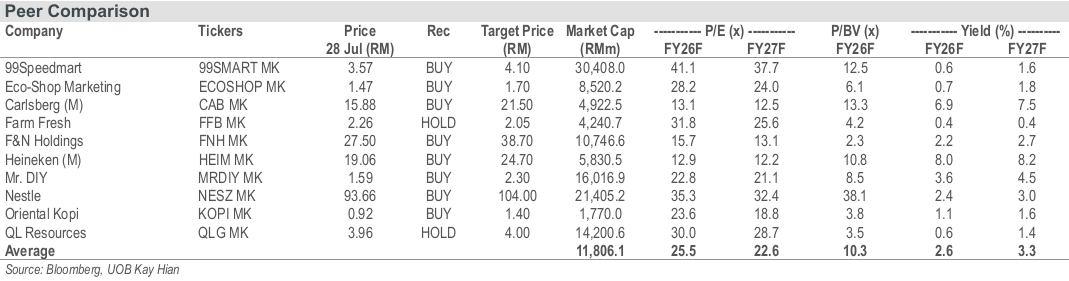
- Breweries and non-food retailers may be operationally resilient, but their direct contribution to food security is limited or narrower. Maintain MARKET WEIGHT.
Analysis
- Food security is both a societal outcome and a financially material business issue. Our assessment asks two separate questions: a) how materially does a company strengthen Malaysia's food availability, affordability, physical reach, nutrition and safety; and b) how exposed is its ability to sustain that contribution to food-system shocks? Disruptions to agricultural output, water, labour, logistics, commodities or household purchasing power can affect input availability, costs, pricing, demand and reputations. The Food and Agriculture Organization (FAO) defines food security as a condition in which people consistently have physical and economic access to sufficient, safe and nutritious food that meets dietary needs and preferences.
- Two-lens assessment framework. We assess Malaysian consumer companies across the FAO's four dimensions. Availability measures the physical supply of food; access measures affordability and reach; utilisation measures nutrition, safety and quality; and stability measures whether these benefits can be maintained through climate, water, disease, imported-input, commodity, forex, logistics and regulatory shocks. We then map the dimensions onto two axes. Availability, access and utilisation determine the strength and breadth of a company's contribution towards national food security. Stability captures the resilience of that contribution — or, conversely, the company's net exposure to food-system risks after considering mitigation.
- Essential food producers and distributors lead on contribution. QL Resources, Farm Fresh and F&N rank furthest to the right because they directly support domestic protein and dairy supply, while 99Speedmart (99SM) combines broad neighbourhood access with strong distribution resilience. Nestlé Malaysia (Nestlé) stands out for nutrition, product safety, supplier governance and supply-chain preparedness. However, high contribution does not necessarily mean low risk: producers are more exposed to feed and commodity costs, livestock disease, as well as climate, water and agricultural inputs, which moderate their resilience.
Highlights
- Availability, access and utilisation measure a company's contribution to Malaysia's food security; stability measures the resilience of that contribution.
- Essential food producers and distributors contribute most but generally face greater agricultural, climate, disease and commodity exposure.
- Breweries and non-food retailers may be operationally resilient, but their direct contribution to food security is limited or narrower. Maintain MARKET WEIGHT.
Analysis
- Food security is both a societal outcome and a financially material business issue. Our assessment asks two separate questions: a) how materially does a company strengthen Malaysia's food availability, affordability, physical reach, nutrition and safety; and b) how exposed is its ability to sustain that contribution to food-system shocks? Disruptions to agricultural output, water, labour, logistics, commodities or household purchasing power can affect input availability, costs, pricing, demand and reputations. The Food and Agriculture Organization (FAO) defines food security as a condition in which people consistently have physical and economic access to sufficient, safe and nutritious food that meets dietary needs and preferences.
- Two-lens assessment framework. We assess Malaysian consumer companies across the FAO's four dimensions. Availability measures the physical supply of food; access measures affordability and reach; utilisation measures nutrition, safety and quality; and stability measures whether these benefits can be maintained through climate, water, disease, imported-input, commodity, forex, logistics and regulatory shocks. We then map the dimensions onto two axes. Availability, access and utilisation determine the strength and breadth of a company's contribution towards national food security. Stability captures the resilience of that contribution — or, conversely, the company's net exposure to food-system risks after considering mitigation.
- Essential food producers and distributors lead on contribution. QL Resources, Farm Fresh and F&N rank furthest to the right because they directly support domestic protein and dairy supply, while 99Speedmart (99SM) combines broad neighbourhood access with strong distribution resilience. Nestlé Malaysia (Nestlé) stands out for nutrition, product safety, supplier governance and supply-chain preparedness. However, high contribution does not necessarily mean low risk: producers are more exposed to feed and commodity costs, livestock disease, as well as climate, water and agricultural inputs, which moderate their resilience.
IMPORTANT NOTICE - DISCLOSURES AND DISCLAIMERS
This report is provided subject to, and must be read together with, the full Disclosures / Disclaimers available at the following link: https://research-api.uobkayhian.com/assets/disclaimer/df64a6ea-7980-447c-ae9e-fd19b93257dc, which are incorporated by reference into this report. In particular, this report is intended for general circulation and informational purposes only and does not constitute personal investment advice or a recommendation to buy or sell any investment product or security. You should independently evaluate the information and, where necessary, seek advice from a qualified financial adviser regarding the suitability of any investment. Analyst certifications required under applicable regulations, including SEC Regulation AC (where relevant), are included in this report. By accessing, receiving or using this report, you acknowledge that you have read, understood and agreed to be bound by the Disclosures / Disclaimers, as may be amended, supplemented or updated from time to time.


