

Wealth Daily
AI Investment Plans Lift Shares as Oil Retreats
Today’s Must-Know News
Overnight Markets
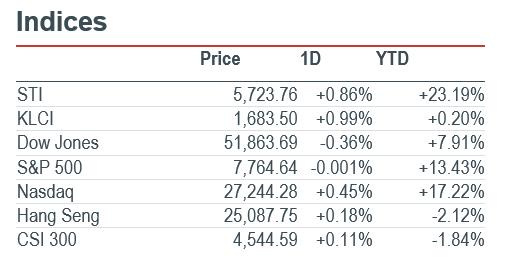
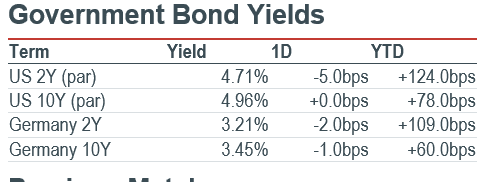
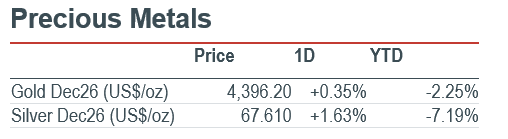
Market Movers: US equities diverged in Tuesday’s completed session: the S&P 500 was essentially unchanged and the Nasdaq rose 0.45%. Alibaba (9988.HK) gained about 2.0% in Hong Kong as its Apsara conference outlined a computing-capacity target exceeding 20GW by 2032 and a broader chip-to-model strategy. Tencent (0700.HK) advanced about 5.0% alongside the public preview of Hy Image 3.5, extending its image-generation offering. SanDisk (SNDK US) rose about 6.8% following Rosenblatt’s Monday initiation at Buy, highlighting AI-related storage demand. Singapore’s STI rose 0.86%, while Hong Kong’s Hang Seng and China’s CSI 300 added 0.18% and 0.11%, respectively. (Company / Reuters / 24/7 Wall St. / AFP) Alibaba (9988.HK) & Tencent (0700.HK) are our Core Recommendations.
Macro: Richmond Fed President Thomas Barkin said on Tuesday that inflation risks currently outweigh employment concerns as US demand firms. More than 60% of the PCE basket was rising faster than 3% year on year, he noted, despite attention on tariffs and energy. He cited July headline PCE inflation of 3.7% and core inflation of 3.3%, underscoring the breadth of price pressures. His remarks support vigilance after last week’s rate increase; further tightening remains conditional on incoming data rather than a commitment to another hike. (Richmond Fed / Reuters)
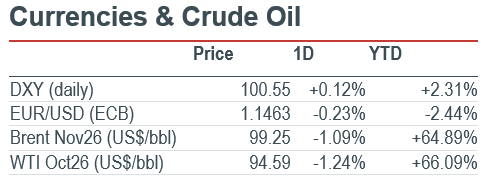
FICC: Brent November futures settled down 1.09% at US$99.25/bbl on Tuesday as Saudi pipeline flows improved. Prices pared earlier losses after President Trump indicated a peace agreement with Iran might wait until after the US midterm elections. A lasting reopening of Hormuz remains conditional, leaving oil exposed to renewed disruptions. (Reuters)
AI
Alibaba raises the scale of its AI ambitions. Alibaba (9988.HK) outlined a cloud-capacity target exceeding 20GW by 2032 and unveiled its Zhenwu V900 accelerator, targeting mass production in 1Q27. The company said Qwen 4 is in training, while later Qwen 4.5/5 models could reach 5–10tn parameters. These are development and capacity targets, rather than deployed assets. Its Hong Kong shares rose about 2.0% on Tuesday. The roadmap broadens its domestic AI proposition but raises the importance of funding, chip yields and delivery execution. (Company / Reuters) Alibaba (9988.HK) is our Core Recommendation.
Muse adoption puts agentic commerce in focus. Tuesday reporting put downloads of Meta Platforms’ (META US) Muse at 2.8mn over its first 12 days, according to Apptopia. Shopify (SHOP US) extended gains by about 7.1% after Monday’s agreement to support Muse purchases through Shop Pay. Jefferies’ US$10.8bn annualised revenue scenario for Meta assumes 1bn Muse users by end-2027 and 3% paid conversion; it is not company guidance. Merchant acceptance remains important after Amazon said on Monday that Muse lacked authorisation to access its store. (Reuters / The Motley Fool) Meta Platforms (META US) is our Core Recommendation.
Frontier-model competition shifts toward lower costs. OpenAI launched GPT-6 Sol and Luna, pricing Sol at US$2 per million input tokens and US$10 per million output tokens, half the corresponding GPT-5.6 Sol rates. Anthropic released Claude Opus 5.5 at US$4/US$20 per million input/output tokens, a 20% token-price reduction from Opus 5. Anthropic separately estimates roughly 40% lower cost for typical workloads. Cheaper inference can broaden agent adoption, while increasing pressure on model providers to convert efficiency gains into sufficient usage and revenue. (Company / Company)
Apple brings its local-AI desktops to market. Apple (AAPL US) began availability of its new Mac mini and Mac Studio on Tuesday, with U.S. starting prices of US$899 and US$2,499 respectively. The systems position Apple silicon as another way to run AI workloads locally, alongside the cloud-model price cuts announced the same day. The investment question is whether customers value local control and reusable hardware enough to support a refresh cycle as hosted inference becomes cheaper; actual savings depend on utilisation and workload requirements. (Company / Company)
Americas
Memory shares rally on AI demand visibility. SanDisk (SNDK US) rose about 6.8% and Micron Technology (MU US) about 5.0% at Tuesday’s close, extending the AI-memory rally after Rosenblatt initiated SanDisk at Buy on Monday with a US$2,400 target. The broker estimates new customer agreements could cover 65% of FY28 production. That would improve demand visibility, but the estimate is not guaranteed revenue: contract execution, pricing and the memory industry’s historical cyclicality remain central to the valuation debate. (24/7 Wall St. / Reuters)
Schwab falls as AI concerns reach wealth management. Charles Schwab (SCHW US) fell about 6.1% at Tuesday’s close as investors reassessed the threat from AI agents to financial advice and other fee-based services. Reuters also linked weakness across financial stocks to a flatter yield curve, which can reduce the appeal of traditional lending margins. These are valuation concerns rather than evidence of lost Schwab revenue. The next test is whether advisers can use agents to improve productivity while preserving client relationships and pricing power. (Reuters)
Amgen advances a treatment for Sjögren’s disease. Amgen (AMGN US) said dazodalibep met the primary endpoint in its Phase 3 OASIZ 301 study, improving systemic disease activity at week 48 in patients with moderate-to-severe Sjögren’s disease. Most common adverse events were generally mild to moderate, according to the company. The result addresses a disease with no FDA-approved medicines, but detailed efficacy comparisons remain pending. A separate OASIZ 303 study is expected to complete in 4Q26, leaving further clinical and regulatory hurdles before commercialisation. (Company / Reuters)
Viking’s maintenance data broaden its obesity proposition. Viking Therapeutics (VKTX US) surged about 35.7% on Tuesday after reporting that selected every-other-week VK2735 regimens preserved up to 97% of initial weight loss over a 12-week maintenance period, versus 61% for placebo. Monthly dosing preserved up to 90%. Less frequent injections could improve treatment adherence and competitive positioning, but the figures come from an exploratory maintenance study with small dosing cohorts. Larger late-stage programmes still need to establish the drug’s longer-term efficacy and safety. (Company / Reuters)
Safety concerns temper Celldex’s trial success. Celldex Therapeutics (CLDX US) lost about 11.6% on Tuesday even though both Phase 3 trials of barzolvolimab met their primary endpoints in chronic spontaneous urticaria. At week 12, 42.1–45.7% of treated patients had no itching or hives, versus 9.3–12.6% on placebo. Investors focused on two probable anaphylaxis cases, including one hospitalisation. A planned 2027 U.S. filing keeps the programme moving, but labelling, treatment monitoring and tolerability will matter alongside efficacy in determining its commercial potential. (Reuters)
Data-centre supplier sets sizeable IPO terms. Accelevation and its private-equity backer outlined a U.S. IPO of 30mn shares at US$20–24, potentially raising US$720mn and valuing the data-centre equipment supplier at up to US$5.4bn, Bloomberg reported. Only 8.6mn shares would be issued by the company; the remainder are secondary sales. First-half revenue rose to US$437.5mn from US$158.6mn, but two customers accounted for 61% of FY25 sales. The offering tests demand for AI infrastructure alongside customer concentration and sponsor monetisation. (Bloomberg)
AutoZone’s margin improvement includes tariff refunds. AutoZone (AZO US) rose about 3.3% on Tuesday after reporting FY26 fourth-quarter sales of US$6.6bn, up 5.6%, and EPS of US$56.05 versus US$48.71 a year earlier. Domestic same-store sales grew 1.6%. Gross margin increased 182bps to 53.3%, including a 145bps benefit from tariff refunds and a favourable year-on-year LIFO effect. The distinction matters: underlying sales and commercial execution need to sustain earnings once those accounting and refund comparisons normalise. (Company / Company)
KB Home’s orders remain under pressure. KB Home (KBH US) reported after Tuesday’s close that 3Q26 revenue fell 20% to US$1.30bn and net orders declined 12% to 2,604 homes. EPS was US$1.05 versus US$1.61 a year earlier. Housing gross margin of 16.5% improved sequentially but remained below last year’s 18.2%. Management maintained its FY26 delivery outlook of 10,500–11,000 homes, making order conversion and margins important measures of whether operational improvements can offset subdued demand. (Company)
Greater China
Tencent broadens its image-model rollout. Tencent (0700.HK) gained about 5.0% on Tuesday. The company released a public preview of its Hy Image 3.5 model. The model supports text-to-image and image-to-image generation, with up to five reference images per request and editing across successive conversations. Distribution across Tencent applications creates more scope for design and advertising workflows; conversion of those capabilities into paid usage remains the key commercial test. (Reuters / The Latent) Tencent (0700.HK) is our Core Recommendation.
Ligent’s debut channels AI demand into optical connectivity. Ligent Technologies (9856.HK) closed its Tuesday Hong Kong debut at HK$34.48, 4.61% above the HK$32.96 IPO price, after raising approximately HK$5.67bn. The optical-transceiver supplier plans to devote most proceeds to research and development and capacity expansion. AI data-centre connectivity provides a demand opportunity, but the smaller closing premium after a stronger opening leaves execution and valuation in focus. (Reuters / HKEX)
Reported forbearance eases Vanke’s immediate funding pressure. Chinese regulators have informally asked banks to avoid classifying overdue China Vanke (2202.HK) loans as non-performing, extend repayment deadlines and defer interest collection, Reuters reported on Tuesday, citing sources. Vanke had RMB351bn of interest-bearing debt at end-June, with bank loans accounting for 72%. Forbearance could buy the developer time and limit recognised bank impairments, while leaving weak property cash generation and ultimate credit losses unresolved. (Reuters)
Offshore trust taxes create shareholder-liquidity risk. Bank of America warned on Tuesday that China’s offshore-trust tax enforcement could pressure individual Hong Kong-listed companies through their shareholders, rather than becoming a broad market driver. The previously announced 90-day settlement period increases the importance of owners’ funding needs; private enterprises are more exposed than state-controlled groups, the bank said. Investors should distinguish potential block-sale supply from deterioration in a company’s operating earnings when assessing any resulting share-price weakness. (Reuters)
Asia ex. China
IDP rejects Blackstone’s approach on valuation. IDP Education (IEL AU) disclosed on Tuesday that it had rejected Blackstone’s conditional A$2.50-a-share cash proposal, following an earlier A$2.30 approach. The board said the offer undervalued the business; requested due diligence included four weeks of exclusive negotiations without a fiduciary exception. The disclosure sharpens the choice between a potential cash exit and the value management expects from a recovery, although the proposal was non-binding and no transaction is assured. (Company / Reuters)
MAS stress test highlights corporate debt sensitivity. A severe AI-investment downturn could leave 32% of Singapore-listed firms at risk, representing 16% of corporate debt, according to Tuesday’s Business Times report on MAS’s Financial Stability Review. The exercise combined revenue shocks of up to 30% with interest-rate increases of up to 400bps. The result makes cash buffers, refinancing requirements and customer concentration useful distinctions within AI-linked exposures, even while most firms remain resilient in the scenario. (Business Times)
Seatrium’s buyback supports capital returns. Seatrium (5E2 SG) rose 4.88% to S$2.15 at Tuesday’s close following its pre-market disclosure of a S$200mn buyback programme, double the preceding S$100mn programme. Existing cash will fund purchases under a mandate permitting repurchases of up to 2% of issued shares. Execution will be progressive and depend on market conditions and capital priorities, so the headline allocation signals capacity rather than a fixed timetable for cash returns. (SGX / ShareInvestor)
EMEA and Others
Kingfisher raises its profit outlook as margins improve. Kingfisher (KGF LN) gained about 12.4% on Tuesday after lifting FY26/27 adjusted pre-tax profit guidance to GBP595–635mn from GBP565–625mn. First-half adjusted profit rose 9.9% to GBP404mn, including a GBP14mn one-off business-rates refund, while gross margin increased 70bps. The upgrade points to better commercial execution, but the refund means the reported profit increase should not all be extrapolated as recurring growth. (Company / Reuters)
Smiths sharpens its portfolio and margin targets. Smiths Group (SMIN LN) rose about 7.5% on Tuesday after reporting a 20.6% headline operating margin and targeting approximately 4% organic revenue growth and a 21% margin in FY27. The group also launched a process to sell its John Crane US asbestos liabilities, following the disposal of its Detection and Interconnect divisions. A simpler portfolio and lower legacy exposure could improve capital allocation, with the liability transaction’s terms and execution still decisive. (Smiths Group / Reuters)
Drugmakers press Europe for a stronger investment framework. Chairs of nine European pharmaceutical companies urged policymakers on Tuesday to accelerate clinical trials, strengthen intellectual-property protection and increase healthcare investment. Their letter said Europe’s share of global pharmaceutical research spending had fallen from 43% in 1990 to 31%, while its share of clinical trials had halved over a decade to 9%. The appeal highlights competition for research capital and launch markets, although it does not itself change reimbursement policy or public budgets. (Company / Chiesi)
Snam recycles capital while retaining De Nora exposure. Snam (SRG IM) said on Tuesday its subsidiary had completed the placement of about 10mn Industrie De Nora shares at EUR6.69 each, raising roughly EUR67mn. The sale represents approximately 5% of De Nora’s capital; Snam retains a 16.6% interest, subject to a 90-day lock-up. The transaction releases cash without eliminating strategic exposure, while the retained stake leaves both further monetisation potential and a possible longer-term share-supply overhang. (Trend News Agency)
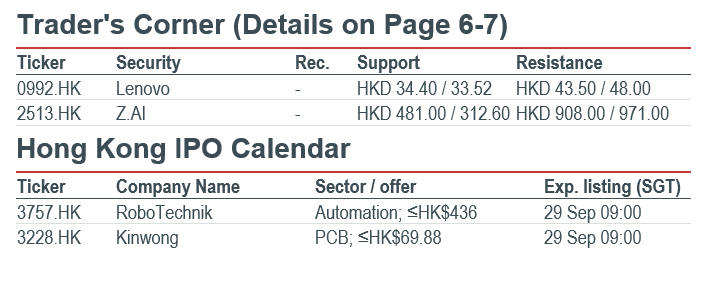
Traders’ corner
Our Technical View
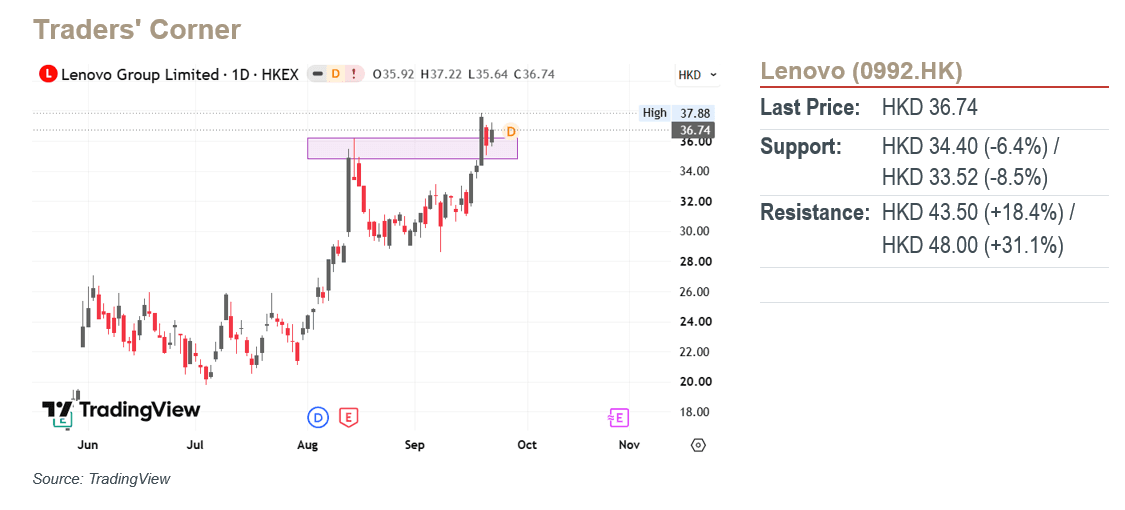
Price successfully defended its position above the resistance-turned-support zone, validating the newly converted boundary as a key demand floor.
The RSI remains firmly established above its neutral 50-midline, reflecting sustained trend velocity.
- As long as price maintains above this core support anchor, we could see a continued upward expansion toward higher extension targets.
Our Technical View
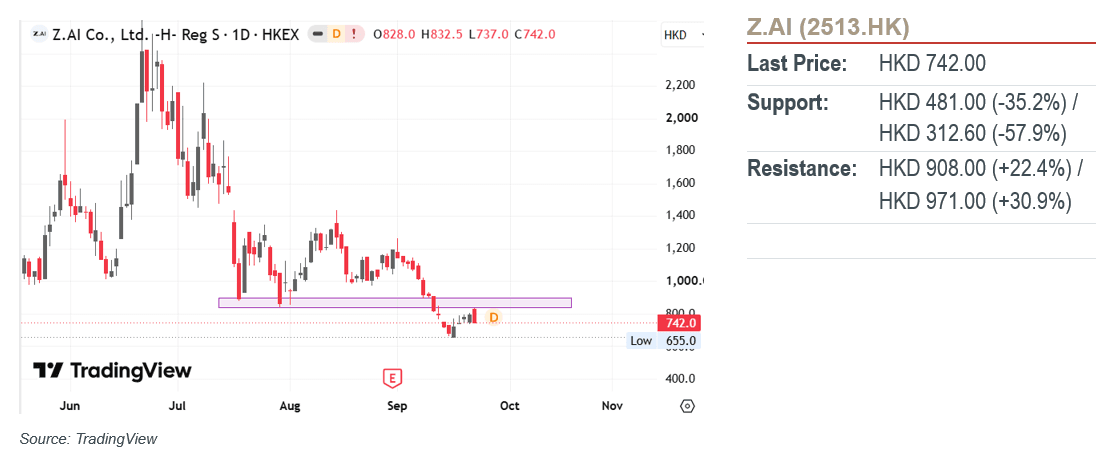
Price executed a precise retest and rejection at its support-turned-resistance zone, establishing the newly converted anchor as a dominant supply ceiling.
The RSI maintains its position below the neutral 50-midline and continues to slope downward, signaling accelerating downward trend velocity.
As long as counter-trend rallies remain strictly capped below this critical resistance anchor, we could expect continued downward expansion toward lower support targets.
Market Movers: US equities diverged in Tuesday’s completed session: the S&P 500 was essentially unchanged and the Nasdaq rose 0.45%. Alibaba (9988.HK) gained about 2.0% in Hong Kong as its Apsara conference outlined a computing-capacity target exceeding 20GW by 2032 and a broader chip-to-model strategy. Tencent (0700.HK) advanced about 5.0% alongside the public preview of Hy Image 3.5, extending its image-generation offering. SanDisk (SNDK US) rose about 6.8% following Rosenblatt’s Monday initiation at Buy, highlighting AI-related storage demand. Singapore’s STI rose 0.86%, while Hong Kong’s Hang Seng and China’s CSI 300 added 0.18% and 0.11%, respectively. (Company / Reuters / 24/7 Wall St. / AFP) Alibaba (9988.HK) & Tencent (0700.HK) are our Core Recommendations.
Macro: Richmond Fed President Thomas Barkin said on Tuesday that inflation risks currently outweigh employment concerns as US demand firms. More than 60% of the PCE basket was rising faster than 3% year on year, he noted, despite attention on tariffs and energy. He cited July headline PCE inflation of 3.7% and core inflation of 3.3%, underscoring the breadth of price pressures. His remarks support vigilance after last week’s rate increase; further tightening remains conditional on incoming data rather than a commitment to another hike. (Richmond Fed / Reuters)
FICC: Brent November futures settled down 1.09% at US$99.25/bbl on Tuesday as Saudi pipeline flows improved. Prices pared earlier losses after President Trump indicated a peace agreement with Iran might wait until after the US midterm elections. A lasting reopening of Hormuz remains conditional, leaving oil exposed to renewed disruptions. (Reuters)
AI
Alibaba raises the scale of its AI ambitions. Alibaba (9988.HK) outlined a cloud-capacity target exceeding 20GW by 2032 and unveiled its Zhenwu V900 accelerator, targeting mass production in 1Q27. The company said Qwen 4 is in training, while later Qwen 4.5/5 models could reach 5–10tn parameters. These are development and capacity targets, rather than deployed assets. Its Hong Kong shares rose about 2.0% on Tuesday. The roadmap broadens its domestic AI proposition but raises the importance of funding, chip yields and delivery execution. (Company / Reuters) Alibaba (9988.HK) is our Core Recommendation.
Muse adoption puts agentic commerce in focus. Tuesday reporting put downloads of Meta Platforms’ (META US) Muse at 2.8mn over its first 12 days, according to Apptopia. Shopify (SHOP US) extended gains by about 7.1% after Monday’s agreement to support Muse purchases through Shop Pay. Jefferies’ US$10.8bn annualised revenue scenario for Meta assumes 1bn Muse users by end-2027 and 3% paid conversion; it is not company guidance. Merchant acceptance remains important after Amazon said on Monday that Muse lacked authorisation to access its store. (Reuters / The Motley Fool) Meta Platforms (META US) is our Core Recommendation.
Frontier-model competition shifts toward lower costs. OpenAI launched GPT-6 Sol and Luna, pricing Sol at US$2 per million input tokens and US$10 per million output tokens, half the corresponding GPT-5.6 Sol rates. Anthropic released Claude Opus 5.5 at US$4/US$20 per million input/output tokens, a 20% token-price reduction from Opus 5. Anthropic separately estimates roughly 40% lower cost for typical workloads. Cheaper inference can broaden agent adoption, while increasing pressure on model providers to convert efficiency gains into sufficient usage and revenue. (Company / Company)
Apple brings its local-AI desktops to market. Apple (AAPL US) began availability of its new Mac mini and Mac Studio on Tuesday, with U.S. starting prices of US$899 and US$2,499 respectively. The systems position Apple silicon as another way to run AI workloads locally, alongside the cloud-model price cuts announced the same day. The investment question is whether customers value local control and reusable hardware enough to support a refresh cycle as hosted inference becomes cheaper; actual savings depend on utilisation and workload requirements. (Company / Company)
Americas
Memory shares rally on AI demand visibility. SanDisk (SNDK US) rose about 6.8% and Micron Technology (MU US) about 5.0% at Tuesday’s close, extending the AI-memory rally after Rosenblatt initiated SanDisk at Buy on Monday with a US$2,400 target. The broker estimates new customer agreements could cover 65% of FY28 production. That would improve demand visibility, but the estimate is not guaranteed revenue: contract execution, pricing and the memory industry’s historical cyclicality remain central to the valuation debate. (24/7 Wall St. / Reuters)
Schwab falls as AI concerns reach wealth management. Charles Schwab (SCHW US) fell about 6.1% at Tuesday’s close as investors reassessed the threat from AI agents to financial advice and other fee-based services. Reuters also linked weakness across financial stocks to a flatter yield curve, which can reduce the appeal of traditional lending margins. These are valuation concerns rather than evidence of lost Schwab revenue. The next test is whether advisers can use agents to improve productivity while preserving client relationships and pricing power. (Reuters)
Amgen advances a treatment for Sjögren’s disease. Amgen (AMGN US) said dazodalibep met the primary endpoint in its Phase 3 OASIZ 301 study, improving systemic disease activity at week 48 in patients with moderate-to-severe Sjögren’s disease. Most common adverse events were generally mild to moderate, according to the company. The result addresses a disease with no FDA-approved medicines, but detailed efficacy comparisons remain pending. A separate OASIZ 303 study is expected to complete in 4Q26, leaving further clinical and regulatory hurdles before commercialisation. (Company / Reuters)
Viking’s maintenance data broaden its obesity proposition. Viking Therapeutics (VKTX US) surged about 35.7% on Tuesday after reporting that selected every-other-week VK2735 regimens preserved up to 97% of initial weight loss over a 12-week maintenance period, versus 61% for placebo. Monthly dosing preserved up to 90%. Less frequent injections could improve treatment adherence and competitive positioning, but the figures come from an exploratory maintenance study with small dosing cohorts. Larger late-stage programmes still need to establish the drug’s longer-term efficacy and safety. (Company / Reuters)
Safety concerns temper Celldex’s trial success. Celldex Therapeutics (CLDX US) lost about 11.6% on Tuesday even though both Phase 3 trials of barzolvolimab met their primary endpoints in chronic spontaneous urticaria. At week 12, 42.1–45.7% of treated patients had no itching or hives, versus 9.3–12.6% on placebo. Investors focused on two probable anaphylaxis cases, including one hospitalisation. A planned 2027 U.S. filing keeps the programme moving, but labelling, treatment monitoring and tolerability will matter alongside efficacy in determining its commercial potential. (Reuters)
Data-centre supplier sets sizeable IPO terms. Accelevation and its private-equity backer outlined a U.S. IPO of 30mn shares at US$20–24, potentially raising US$720mn and valuing the data-centre equipment supplier at up to US$5.4bn, Bloomberg reported. Only 8.6mn shares would be issued by the company; the remainder are secondary sales. First-half revenue rose to US$437.5mn from US$158.6mn, but two customers accounted for 61% of FY25 sales. The offering tests demand for AI infrastructure alongside customer concentration and sponsor monetisation. (Bloomberg)
AutoZone’s margin improvement includes tariff refunds. AutoZone (AZO US) rose about 3.3% on Tuesday after reporting FY26 fourth-quarter sales of US$6.6bn, up 5.6%, and EPS of US$56.05 versus US$48.71 a year earlier. Domestic same-store sales grew 1.6%. Gross margin increased 182bps to 53.3%, including a 145bps benefit from tariff refunds and a favourable year-on-year LIFO effect. The distinction matters: underlying sales and commercial execution need to sustain earnings once those accounting and refund comparisons normalise. (Company / Company)
KB Home’s orders remain under pressure. KB Home (KBH US) reported after Tuesday’s close that 3Q26 revenue fell 20% to US$1.30bn and net orders declined 12% to 2,604 homes. EPS was US$1.05 versus US$1.61 a year earlier. Housing gross margin of 16.5% improved sequentially but remained below last year’s 18.2%. Management maintained its FY26 delivery outlook of 10,500–11,000 homes, making order conversion and margins important measures of whether operational improvements can offset subdued demand. (Company)
Greater China
Tencent broadens its image-model rollout. Tencent (0700.HK) gained about 5.0% on Tuesday. The company released a public preview of its Hy Image 3.5 model. The model supports text-to-image and image-to-image generation, with up to five reference images per request and editing across successive conversations. Distribution across Tencent applications creates more scope for design and advertising workflows; conversion of those capabilities into paid usage remains the key commercial test. (Reuters / The Latent) Tencent (0700.HK) is our Core Recommendation.
Ligent’s debut channels AI demand into optical connectivity. Ligent Technologies (9856.HK) closed its Tuesday Hong Kong debut at HK$34.48, 4.61% above the HK$32.96 IPO price, after raising approximately HK$5.67bn. The optical-transceiver supplier plans to devote most proceeds to research and development and capacity expansion. AI data-centre connectivity provides a demand opportunity, but the smaller closing premium after a stronger opening leaves execution and valuation in focus. (Reuters / HKEX)
Reported forbearance eases Vanke’s immediate funding pressure. Chinese regulators have informally asked banks to avoid classifying overdue China Vanke (2202.HK) loans as non-performing, extend repayment deadlines and defer interest collection, Reuters reported on Tuesday, citing sources. Vanke had RMB351bn of interest-bearing debt at end-June, with bank loans accounting for 72%. Forbearance could buy the developer time and limit recognised bank impairments, while leaving weak property cash generation and ultimate credit losses unresolved. (Reuters)
Offshore trust taxes create shareholder-liquidity risk. Bank of America warned on Tuesday that China’s offshore-trust tax enforcement could pressure individual Hong Kong-listed companies through their shareholders, rather than becoming a broad market driver. The previously announced 90-day settlement period increases the importance of owners’ funding needs; private enterprises are more exposed than state-controlled groups, the bank said. Investors should distinguish potential block-sale supply from deterioration in a company’s operating earnings when assessing any resulting share-price weakness. (Reuters)
Asia ex. China
IDP rejects Blackstone’s approach on valuation. IDP Education (IEL AU) disclosed on Tuesday that it had rejected Blackstone’s conditional A$2.50-a-share cash proposal, following an earlier A$2.30 approach. The board said the offer undervalued the business; requested due diligence included four weeks of exclusive negotiations without a fiduciary exception. The disclosure sharpens the choice between a potential cash exit and the value management expects from a recovery, although the proposal was non-binding and no transaction is assured. (Company / Reuters)
MAS stress test highlights corporate debt sensitivity. A severe AI-investment downturn could leave 32% of Singapore-listed firms at risk, representing 16% of corporate debt, according to Tuesday’s Business Times report on MAS’s Financial Stability Review. The exercise combined revenue shocks of up to 30% with interest-rate increases of up to 400bps. The result makes cash buffers, refinancing requirements and customer concentration useful distinctions within AI-linked exposures, even while most firms remain resilient in the scenario. (Business Times)
Seatrium’s buyback supports capital returns. Seatrium (5E2 SG) rose 4.88% to S$2.15 at Tuesday’s close following its pre-market disclosure of a S$200mn buyback programme, double the preceding S$100mn programme. Existing cash will fund purchases under a mandate permitting repurchases of up to 2% of issued shares. Execution will be progressive and depend on market conditions and capital priorities, so the headline allocation signals capacity rather than a fixed timetable for cash returns. (SGX / ShareInvestor)
EMEA and Others
Kingfisher raises its profit outlook as margins improve. Kingfisher (KGF LN) gained about 12.4% on Tuesday after lifting FY26/27 adjusted pre-tax profit guidance to GBP595–635mn from GBP565–625mn. First-half adjusted profit rose 9.9% to GBP404mn, including a GBP14mn one-off business-rates refund, while gross margin increased 70bps. The upgrade points to better commercial execution, but the refund means the reported profit increase should not all be extrapolated as recurring growth. (Company / Reuters)
Smiths sharpens its portfolio and margin targets. Smiths Group (SMIN LN) rose about 7.5% on Tuesday after reporting a 20.6% headline operating margin and targeting approximately 4% organic revenue growth and a 21% margin in FY27. The group also launched a process to sell its John Crane US asbestos liabilities, following the disposal of its Detection and Interconnect divisions. A simpler portfolio and lower legacy exposure could improve capital allocation, with the liability transaction’s terms and execution still decisive. (Smiths Group / Reuters)
Drugmakers press Europe for a stronger investment framework. Chairs of nine European pharmaceutical companies urged policymakers on Tuesday to accelerate clinical trials, strengthen intellectual-property protection and increase healthcare investment. Their letter said Europe’s share of global pharmaceutical research spending had fallen from 43% in 1990 to 31%, while its share of clinical trials had halved over a decade to 9%. The appeal highlights competition for research capital and launch markets, although it does not itself change reimbursement policy or public budgets. (Company / Chiesi)
Snam recycles capital while retaining De Nora exposure. Snam (SRG IM) said on Tuesday its subsidiary had completed the placement of about 10mn Industrie De Nora shares at EUR6.69 each, raising roughly EUR67mn. The sale represents approximately 5% of De Nora’s capital; Snam retains a 16.6% interest, subject to a 90-day lock-up. The transaction releases cash without eliminating strategic exposure, while the retained stake leaves both further monetisation potential and a possible longer-term share-supply overhang. (Trend News Agency)
Traders’ corner
Our Technical View
Price successfully defended its position above the resistance-turned-support zone, validating the newly converted boundary as a key demand floor.
The RSI remains firmly established above its neutral 50-midline, reflecting sustained trend velocity.
- As long as price maintains above this core support anchor, we could see a continued upward expansion toward higher extension targets.
Our Technical View
Price executed a precise retest and rejection at its support-turned-resistance zone, establishing the newly converted anchor as a dominant supply ceiling.
The RSI maintains its position below the neutral 50-midline and continues to slope downward, signaling accelerating downward trend velocity.
As long as counter-trend rallies remain strictly capped below this critical resistance anchor, we could expect continued downward expansion toward lower support targets.
Disclosures and disclaimers
This report is provided subject to, and must be read together with, the full Disclosures / Disclaimers available at this link, which are incorporated by reference into this report. In particular, this report is intended for general circulation and informational purposes only and does not constitute personal investment advice or a recommendation to buy or sell any investment product or security. You should independently evaluate the information and, where necessary, seek advice from a qualified financial adviser regarding the suitability of any investment. Analyst certifications required under applicable regulations, including SEC Regulation AC (where relevant), are included in this report. By accessing, receiving or using this report, you acknowledge that you have read, understood and agreed to be bound by the Disclosures / Disclaimers, as may be amended, supplemented or updated from time to time.


