

Analyst
Wendy Chen
wendy.chen@uobkh.comAnalyst
Wang Qi, CFA
qi.wang@uobkh.comAnalyst
In collaboration with UOBKH Institutional Research
Key US Market Indices
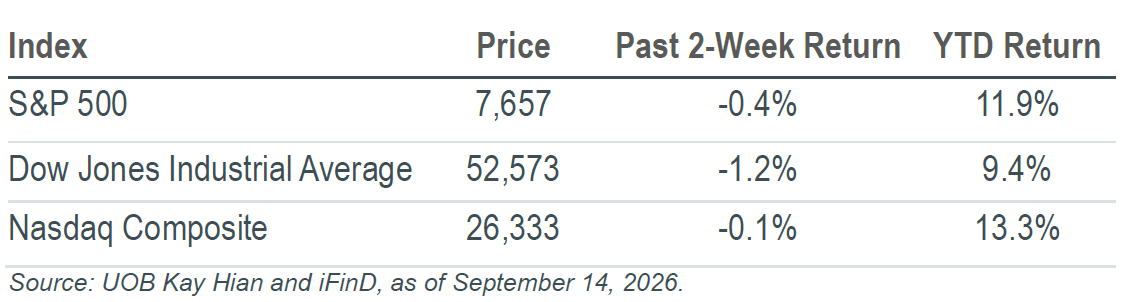
A macro-eventful September unfolds. Hotter-than-expected August Core CPI (+0.3% MoM) has pushed September rate hike probabilities to 87%, making this nearly a done deal. What’s more, Trump signaled that the Iran conflict will likely extend through the midterm elections – adding to macro pressures.
Three layers of the "Fed Wildcard". Amid rising macro risks, our "Fed Wildcard" thesis remains paramount. This is no longer just a hawkish-versus-dovish debate, but a complex dynamic with three distinctive layers: (1) Mixed data and the lack of Fed forward guidance increase speculation and volatility. (2) The Fed and Treasury are currently pulling in opposite directions. (3) Longer-term, the Fed would have more policy flexibility, given Warsh’s belief in AI’s positive economic impact and its deflationary potential. See our latest Wealth Monthly for more information.
Markets are digesting macro headwinds. US equities posted mild, mixed performance over the past two weeks, reflecting the market’s gradual digestion of macro headwinds and geopolitical tensions. The tech-heavy Nasdaq proved relatively resilient (-0.1%), slightly outperforming the S&P 500 (-0.4%) and the Dow Jones (-1.2%), reflecting our prior call that AI-driven growth continues to provide a fundamental floor (Macro Shocks vs. AI Tailwinds). YTD returns in the US remain robust across the board (9.4% to 13.3%). However, the short-term tape is defined by a tilt toward caution, with capital rotating between high-beta momentum names and defensive havens as investors await the September FOMC.
AI safety concerns. Founders of Anthropic and OpenAI, along with Elon Musk, have collectively called for slowdown in superintelligence development for safety reasons. We see their warnings highlighting an escalating "risk of malevolence", but not yet undermining AI’s fundamental investment thesis. Hyperscaler capex is evolving from a pure ROIC exercise to compulsory "business protection", forcing Corporate America to "stay on the gas". Therefore, we expect a more jagged path forward, requiring heavier security buffers and tighter scrutiny in the quest for AGI.
Forward-looking: Bracing for the macro gauntlet. As stated in our last US Bi-weekly, macro concerns are taking center stage in September and amplifying near-term volatility. However, history offers a "rainbow beyond the storm", with markets tending to rally post midterms as the overhang is removed. We continue to recommend navigating this autumn turbulence with a Barbell Strategy (AI leaders + Defensives/Real assets) to weather any upcoming turbulence.
Best performing sectors: Energy (XLE) +1.8%, Comm Serv (XLC) +1.0%, Info Tech (XLK) +0.6%.
Potential movers and shakers:

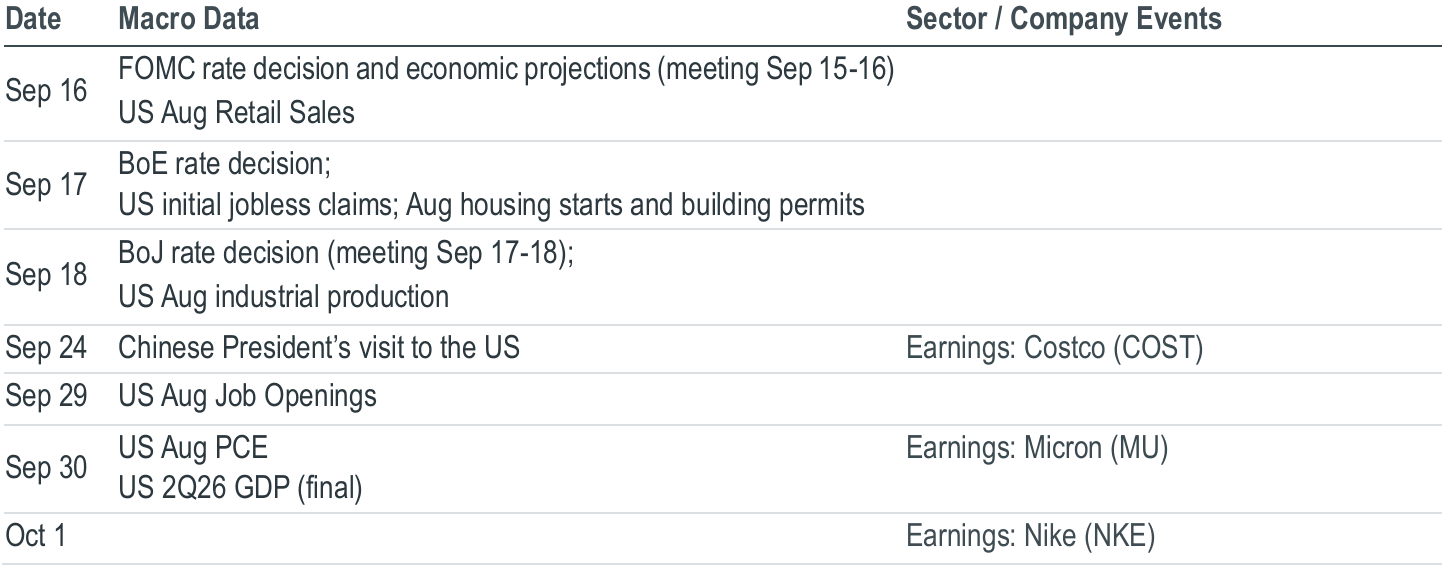
Must Watch Events: FOMC Rate Decision & economic projections (Sep 15-16), BoE rate decision & US housing data (Sep 17), BoJ rate decision & US industrial production (Sep 18), US industrial production (Sep 18), Chinese President’s visit to the US (Sep 24), US Job Openings (Sep 29), US PCE and GDP final read (Sep 30). Earnings:COST, MU, NKE. Details below.
Best 3 S&P Sectors (Past 2 Weeks)
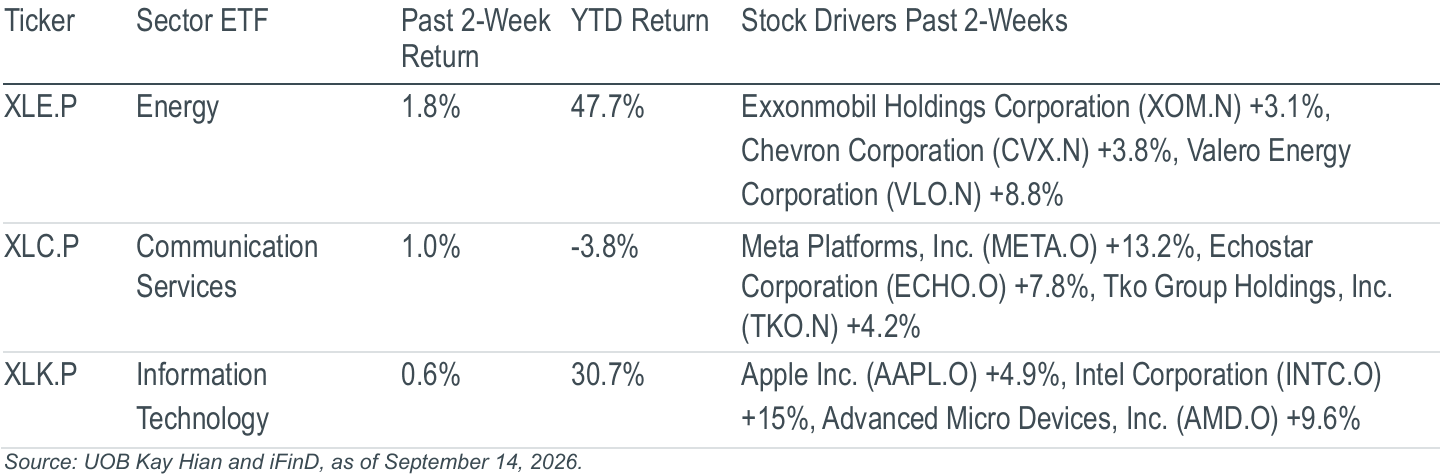
Energy (XLE) extended its market leadership, gaining 1.8% over the past two weeks and pushing its YTD return to a stellar 47.7%. As expected, the sector continues to serve as a portfolio hedge against geopolitical risk. Not only does the Iran conflict provides a firm floor under crude prices, but record-high crack spreads are also keeping downstream product prices at a premium. As a result, the past fortnight saw exceptional strength in the downstream refining complex, led by Valero Energy (VLO), which surged 8.8% on favourable crack spreads. Integrated majors ExxonMobil (XOM) and Chevron (CVX) also added steady gains of 3.1% and 3.8% respectively. Given ongoing geopolitical tensions globally, XLE remains our Core Recommendation.
Communication Services (XLC) managed a 1.0% gain, helping the sector claw back some ground and improve its YTD return to -3.8%. Strength was driven mainly by Meta Platforms (META), which surged 13.2% on the back of its highly anticipated AI agent rollout, confirming our investment thesis on Meta as a consumer AI leader. Echostar (ECHO) added 7.8% on satellite and broadband momentum, while TKO Group (TKO) climbed 4.2%, benefiting from growth in live sports broadcasting and premium entertainment content. META is our Core Recommendation.
Information Technology (XLK) posted a modest 0.6% advance, and its YTD return remained a robust 30.7%. Past two weeks highlighted a healthy broadening of leadership within the sector. Mega-cap stalwarts like Apple (AAPL) provided stable support with a 4.9% gain, catalyzed by its highly anticipated launch of iPhone 18 and the new foldable iPhone Duo. The more interesting story was a surprise rebound in semiconductor and AI hardware names, despite inflation and rate hike worries. Intel (INTC) rallied 15.0% and Advanced Micro Devices (AMD) gained 9.6%, suggesting that semiconductor investors may have looked past the near-term macro uncertainty. SOXX, a collection of leading US-listed semiconductor stocks, is our Trading Buy.
Worst 3 S&P Sectors (Past 2 Weeks)
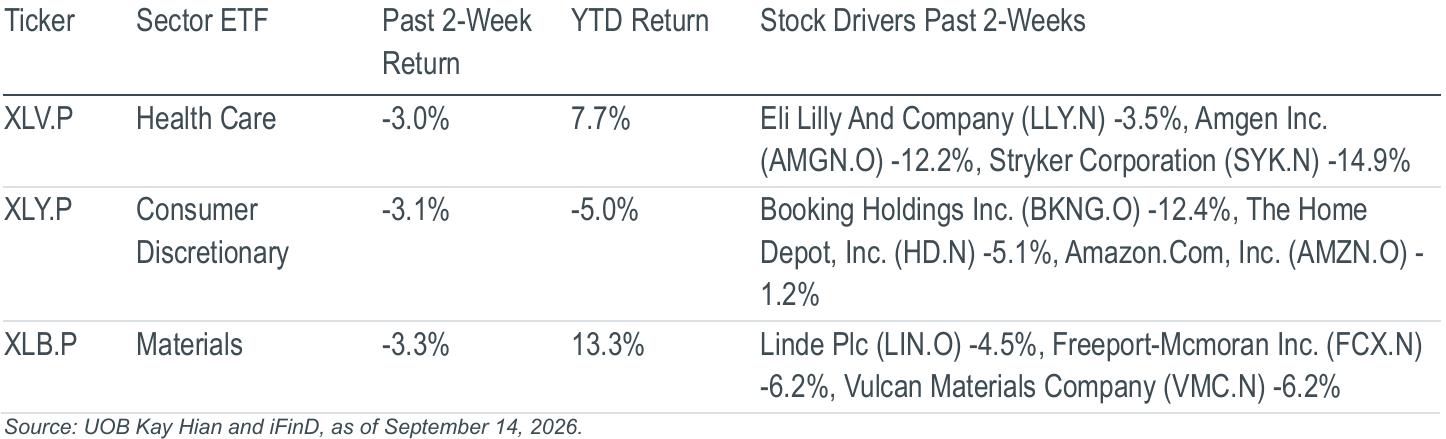
Health Care (XLV) slipped 3.0%, marking a notable, albeit healthy, consolidation in a sector that had recently served as a defensive haven (YTD return remains a solid 7.7%). The decline was driven by sharp, stock-specific profit-taking rather than a deterioration in sector-wide fundamentals. Stryker (SYK) plummeted 14.9% following a significant valuation reset and concerns over near-term procedural volume growth. Amgen (AMGN) dropped 12.2% as investors locked in gains after its recent metabolic and obesity pipeline rally. Eli Lilly (LLY) saw a mild 3.5% pullback, reflecting normal digestion after its relentless year-to-date ascent. Despite near-term volatility, the sector’s long-term structural growth drivers in GLP-1 therapies and medical device innovation remain firmly intact. LLY is our Core Recommendation.
Consumer Discretionary (XLY) retreated 3.1%, pushing the sector deeper into negative YTD territory at -5.0%. The pullback highlights persistent anxieties over the US consumer spending power amid stagnant real wage growth. Booking Holdings (BKNG) suffered a sharp 12.4% decline as investors priced in a continued normalization of post-pandemic travel and potential margin pressures heading into the slower autumn season. The Home Depot (HD) fell 5.1%, which continue to face headwinds from elevated mortgage rates that suppress home turnover and large-scale renovations. Amazon (AMZN) dipped 1.2% as part of a broader, milder profit-taking wave in mega-cap retail names following their recent strong runs. Amazon remains our Core Recommendation.
Materials (XLB) edged lower by 3.3%, moderating its YTD advance to 13.3%. The sector’s weakness was broad-based, reflecting renewed sensitivity to "higher-for-longer" interest rates and a resilient US dollar. Freeport-McMoRan (FCX) and Vulcan Materials (VMC) both declined 6.2%, as elevated borrowing costs continue to weigh on sentiment for industrial metals and domestic construction aggregates. Meanwhile, industrial gas leader Linde (LIN) slipped 4.5% amid lingering concerns over softer manufacturing PMIs globally. The contrast between resilient domestic pricing power and pressured global cyclicals underscores the need for selective, bottom-up stock picking within the sector.
Stocks: Potential Movers and Shakers

OpenAI released GPT-6 Astra on September 3, introducing several key technological advancements including upgraded computer-use capabilities and a looped transformer architecture that can make model distillation far more difficult. GPT-6 Astra was trained on 100,000 GB300 GPUs in the Stargate facility in Texas, which is built and hosted via Oracle Cloud Infrastructure (OCI).
Scaling Laws still hold. Trained on the largest compute cluster so far, with 10 times the compute of GPT-5, Astra indicates that Scaling Laws still hold and AI infrastructure demand is strong.
Separately, Oracle reported a solid earnings beat. The company also successfully completed a USD 20 billion equity offering through its ATM program, alleviating investor concerns over its balance sheet and funding requirements for future AI investments – again positive for AI infrastructure and hardware, with Nvidia as one of our top picks.
Computer use could unlock another massive market. As computer-use capabilities scale, AI models will likely operate complex professional software stably within the next 6 to 9 months. This creates a massive market beyond coding automation by enabling the direct automation of general white-collar workflows. (Garrick Li)

CIOE 2026 sent three unmistakable signals. (1) The optical component supply chain is heavily supply-constrained, order backlogs extend beyond 2028. (2) While near- term key contributor seems to be traditional 1.6T optical transceivers, NPO and its related supply chain participants had taken the absolute center stage given the high visibility of production ramp in 2H27; and (3) Bottlenecks are crowded on the upstream with notable mentions including (a) DSP, (b) high-power CW lasers, (c) advanced process switch silicon and (d) high-performance optical fibers.
Read-across maps to four clear sub-segments. OCS is expanding from a Google-only application to Nvidia, OpenAI, and a dozen additional customers, directly benefiting MEMS and silicon-photonic switch suppliers. DSP emerged as the single tightest bottleneck — 1.6T 3nm DSP is 100% US-supplied with no near-term Chinese alternative. Switch silicon is acutely constrained: Broadcom's TH5 allocation to China is only ~20% of global output, with expedite fees of 30-50% and no viable substitute at scale. Fiber and passive components see demand pulled by OCS/CPO adoption, with premium grades commanding higher ASPs.
Potential beneficiaries are as follows: Lumentum and Coherent and the primary beneficiary of the tightening high-power CW laser (200mW+) for CPO/NPO, as well as the accelerating penetration of OCS. Marvel sits as the biggest beneficiary of the DSP bottleneck. Broadcom is expected to benefit from the on-going shortages in the high-end 51.2T switch chips. Corning will be the on-going beneficiary of the optical fiber industry’s structural shortages in the next few years.
For optics, we recommend players with better execution, ranked as follow: Lumentum (Trading Buy) > Broadcom (Core Recommendation) > Coherent > Corning > Marvell. (Johnny Yum)

Brand partnerships broaden advertising opportunities. Netflix outlined partnerships with DoorDash, Dunkin’ and Pantene on 10 Sep for its reality series “Earle Meets World”, combining in-show integrations with social campaigns and fan experiences. These partnerships demonstrate Netflix’s ability to offer advertisers more ways to reach audiences, potentially attracting additional brand spending and strengthening advertising monetization.
Content performance supports engagement across films and series. In Netflix’s weekly ratings, “The Whisper Man” topped the English film list with 33.4m views, while “Death of the Pastor’s Wife” led the English TV list with 13.9m views. “The Gentleman” Season 2 also deputed at No.3 with 6.7m views. Performance across films, documentaries and returning franchises should support viewer engagement and subscriber retention.
Mexican content slate expands international offering. Netflix announced 15 upcoming Mexican productions to mark its 15th anniversary in the country, spanning films, series, documentaries and reality shows. The slate includes a new “Counterattack” installment and “Physical 100: Mexico”. Continued investment in local storytelling and adaptions of established formats should strengthen Netflix’s regional appeal while creating opportunities for local titles to reach global audience.
Positive on long-term earnings growth. We remain positive on Netflix as its broad content offering and continued investment in local productions should support engagement and subscriber retention. Expanding brand partnerships also provide opportunities to monetise audiences more effectively. These drivers should support long-term earnings growth and margin expansion, although the pace of improvement will depend on advertising execution and content cost discipline. (Shaina Kamlesh Mahtani)

Management highlights streaming and cruise momentum. At the Goldman Sachs conference, Disney CFO Hugh Johnston highlighted Disney+’s 13% quarterly operating margin, with content technology and retention investments supporting further revenue and profit growth. He also noted continued cruise sell-outs despite approximately 50% more guest rooms, highlighting strong demand. This momentum should sustain earnings expansion across Entertainment and Experiences.
Stronger streaming and sports audiences support engagement. Disney’s streaming viewing rose 4% month-on-month in July, capturing 4.7% of US TV viewing, with “The Bear” and “King of the Hill” contributing nearly 3bn viewing minutes combined. ESPN’s studio audiences increased 13% year-on-year in August, while “NBA Today” grew 64% to its strongest August audience. Audience growth reinforces Disney’s content appeal, supporting engagement and subscriber retention.
Box-office momentum reinforces franchise monetisation. Disney reported that its studios had surpassed USD4bn at the global box office in 2026, with “Toy Story 5” contributing more than USD1.1bn. upcoming releases include “Hexed” in November and “Avengers: Doomsday” in December. Successful films should contribute to theatrical earnings and drive demand across streaming, merchandise and parks.
Positive on Disney’s earnings outlook. We are positive on Disney as improving streaming profitability, resilience cruise demand and strong streaming and film performance should support its earnings growth. Its strong franchises offer further opportunities across streaming, merchandise and parks. While sports-rights costs and softer consumer spending remain key risks, continued investment and cost discipline should underpin long-term growth. (Shaina Kamlesh Mahtani)

Management highlights improving earnings and cash-flow momentum. At the Goldman Sachs conference, CEO Dan Schulman reiterated forecasted adjusted EPS growth of 6-7% and free cash flow growth of 9-10% in 2026. Postpaid phone net additions are expected towards the top end of the 750,000-1m guidance range. Improving customer retention and operating efficiency should support earnings, although the turnaround remains a multi-year effort.
Steady dividend maintains shareholder income. Verizon declared a quarterly dividend of USD 0.7075 per share, unchanged from the previous quarter and payable on 2 Nov. Management highlighted sustainable cash generation as supporting shareholder distributions alongside investment in growth. The maintained payout supports Verizon’s income appeal, while continued cash-flow improvement remains important to balancing dividends, investment and debt reduction.
Corning agreement supports broadband and AI infrastructure expansion. Verizon announced a multibillion-dollar agreement with Corning for more than 80m miles of optical fibre and connectivity solutions over 2027-2032. The agreement will support broadband expansion and connections between AI data centres. Securing fibre supply should strengthen Verizon’s ability to capture connectivity demand, although returns will depend on deployment execution and customer uptake.
Neutral as improving momentum is balanced by growth and leverage constraints. We remain neutral on Verizon as stronger subscriber trends, improving cash generation and fibre expansion should support its outlook. However, wireless service revenue is still expected to be broadly flat in 2026, while elevated debt and network investment requirements limit financial flexibility. (Shaina Kamlesh Mahtani)

Tesla finally launched the Cybercab, and the market handed the gain straight back. The 3 September Austin event put the Cybercab into paid public service on 4 September – no steering wheel, pedals or mirrors – alongside 1 million unsupervised Robotaxi miles (380,000 just six weeks earlier), about 200 driverless vehicles running across six cities in Texas and Florida, a fleet-buyer interest form and a rare-earth-free motor. TSLA rose 5.4% on the day.
The stock gave it all back on 4 September, −5.9% to USD 354.08, after an invite-only event that Musk did not attend disclosed little, and as NHTSA opened an audit of Tesla’s federal safety self-certification covering roughly 1,000 Cybercabs. Cybercab also experienced several technical failures on its first day of operation. Tesla’s China sales remained weak – August deliveries at 50,047 (−12.4% yoy, a third straight fall) and Model Y sales down 26% – prompting quarter-end discounts of RMB 10,000 on Model Y and RMB 5,000 on Model 3.
We remain cautious on Tesla. Cybercab faces both certification and technological risks. China volume is still falling. Key triggers to watch: the NHTSA audit, September China deliveries, and the Cybercab’s mid-September Beijing and Shanghai display – display only, with no China operation planned yet. (Ken Lee)

Nestle raises prices to cover Middle East-driven cost inflation. CEO Philipp Navratil told Reuters on Sept 9 that Nestle is raising prices, reformulating products and cutting items consumers won't pay more for, as costs from the Middle East conflict spread through its supplier base.
Despite minimal direct sales exposure to the region, he said every supplier faces higher costs, and where those costs are passed on, Nestle will need to mitigate them and ensure consumers come along with any price increases.
We see this as a negative read across US consumption and consumer-facing stocks, with WTI crude back near USD 100 per barrel and Zone Americas contributing 43% of Nestle's total revenue in 1H26 (Ejann Hiew).
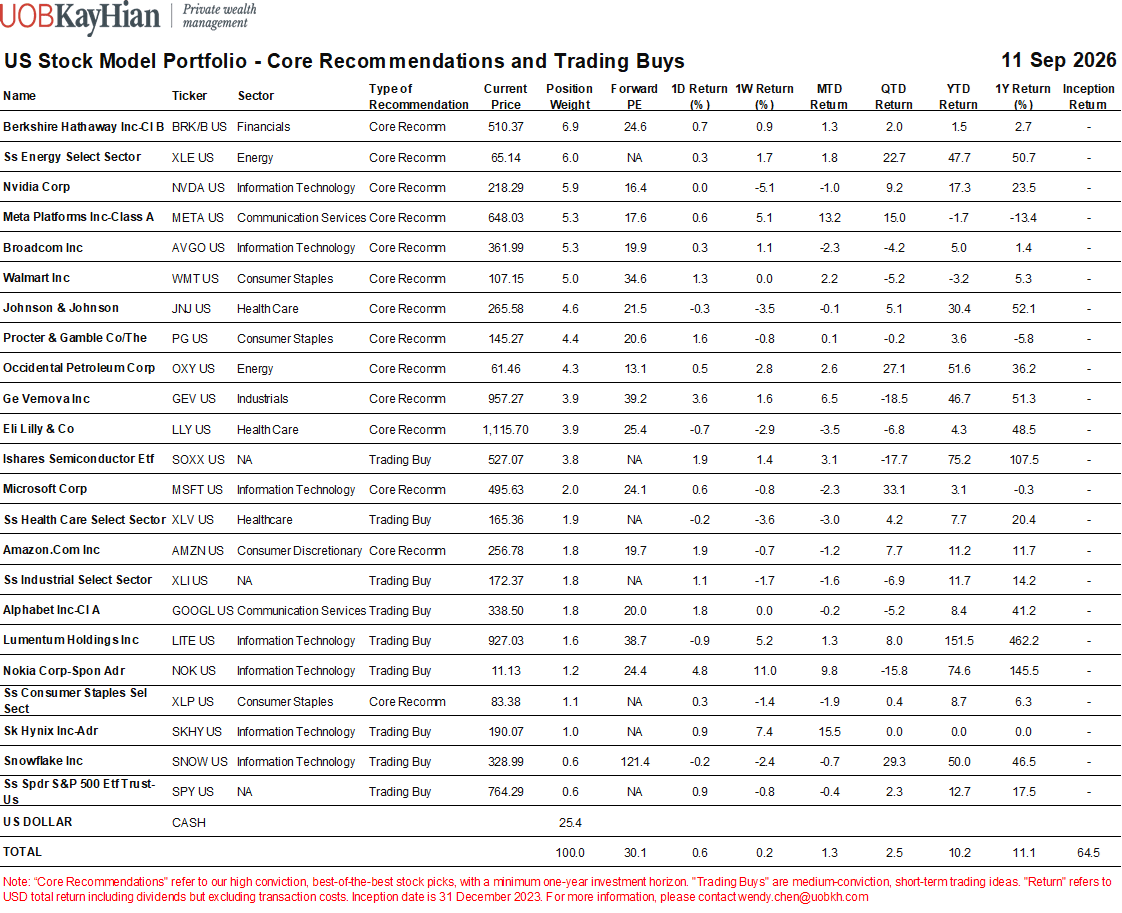
Appendix A – US Stock Model Portfolio
Key US Market Indices
A macro-eventful September unfolds. Hotter-than-expected August Core CPI (+0.3% MoM) has pushed September rate hike probabilities to 87%, making this nearly a done deal. What’s more, Trump signaled that the Iran conflict will likely extend through the midterm elections – adding to macro pressures.
Three layers of the "Fed Wildcard". Amid rising macro risks, our "Fed Wildcard" thesis remains paramount. This is no longer just a hawkish-versus-dovish debate, but a complex dynamic with three distinctive layers: (1) Mixed data and the lack of Fed forward guidance increase speculation and volatility. (2) The Fed and Treasury are currently pulling in opposite directions. (3) Longer-term, the Fed would have more policy flexibility, given Warsh’s belief in AI’s positive economic impact and its deflationary potential. See our latest Wealth Monthly for more information.
Markets are digesting macro headwinds. US equities posted mild, mixed performance over the past two weeks, reflecting the market’s gradual digestion of macro headwinds and geopolitical tensions. The tech-heavy Nasdaq proved relatively resilient (-0.1%), slightly outperforming the S&P 500 (-0.4%) and the Dow Jones (-1.2%), reflecting our prior call that AI-driven growth continues to provide a fundamental floor (Macro Shocks vs. AI Tailwinds). YTD returns in the US remain robust across the board (9.4% to 13.3%). However, the short-term tape is defined by a tilt toward caution, with capital rotating between high-beta momentum names and defensive havens as investors await the September FOMC.
AI safety concerns. Founders of Anthropic and OpenAI, along with Elon Musk, have collectively called for slowdown in superintelligence development for safety reasons. We see their warnings highlighting an escalating "risk of malevolence", but not yet undermining AI’s fundamental investment thesis. Hyperscaler capex is evolving from a pure ROIC exercise to compulsory "business protection", forcing Corporate America to "stay on the gas". Therefore, we expect a more jagged path forward, requiring heavier security buffers and tighter scrutiny in the quest for AGI.
Forward-looking: Bracing for the macro gauntlet. As stated in our last US Bi-weekly, macro concerns are taking center stage in September and amplifying near-term volatility. However, history offers a "rainbow beyond the storm", with markets tending to rally post midterms as the overhang is removed. We continue to recommend navigating this autumn turbulence with a Barbell Strategy (AI leaders + Defensives/Real assets) to weather any upcoming turbulence.
Best performing sectors: Energy (XLE) +1.8%, Comm Serv (XLC) +1.0%, Info Tech (XLK) +0.6%.
Potential movers and shakers:
Must Watch Events: FOMC Rate Decision & economic projections (Sep 15-16), BoE rate decision & US housing data (Sep 17), BoJ rate decision & US industrial production (Sep 18), US industrial production (Sep 18), Chinese President’s visit to the US (Sep 24), US Job Openings (Sep 29), US PCE and GDP final read (Sep 30). Earnings:COST, MU, NKE. Details below.
Best 3 S&P Sectors (Past 2 Weeks)
Energy (XLE) extended its market leadership, gaining 1.8% over the past two weeks and pushing its YTD return to a stellar 47.7%. As expected, the sector continues to serve as a portfolio hedge against geopolitical risk. Not only does the Iran conflict provides a firm floor under crude prices, but record-high crack spreads are also keeping downstream product prices at a premium. As a result, the past fortnight saw exceptional strength in the downstream refining complex, led by Valero Energy (VLO), which surged 8.8% on favourable crack spreads. Integrated majors ExxonMobil (XOM) and Chevron (CVX) also added steady gains of 3.1% and 3.8% respectively. Given ongoing geopolitical tensions globally, XLE remains our Core Recommendation.
Communication Services (XLC) managed a 1.0% gain, helping the sector claw back some ground and improve its YTD return to -3.8%. Strength was driven mainly by Meta Platforms (META), which surged 13.2% on the back of its highly anticipated AI agent rollout, confirming our investment thesis on Meta as a consumer AI leader. Echostar (ECHO) added 7.8% on satellite and broadband momentum, while TKO Group (TKO) climbed 4.2%, benefiting from growth in live sports broadcasting and premium entertainment content. META is our Core Recommendation.
Information Technology (XLK) posted a modest 0.6% advance, and its YTD return remained a robust 30.7%. Past two weeks highlighted a healthy broadening of leadership within the sector. Mega-cap stalwarts like Apple (AAPL) provided stable support with a 4.9% gain, catalyzed by its highly anticipated launch of iPhone 18 and the new foldable iPhone Duo. The more interesting story was a surprise rebound in semiconductor and AI hardware names, despite inflation and rate hike worries. Intel (INTC) rallied 15.0% and Advanced Micro Devices (AMD) gained 9.6%, suggesting that semiconductor investors may have looked past the near-term macro uncertainty. SOXX, a collection of leading US-listed semiconductor stocks, is our Trading Buy.
Worst 3 S&P Sectors (Past 2 Weeks)
Health Care (XLV) slipped 3.0%, marking a notable, albeit healthy, consolidation in a sector that had recently served as a defensive haven (YTD return remains a solid 7.7%). The decline was driven by sharp, stock-specific profit-taking rather than a deterioration in sector-wide fundamentals. Stryker (SYK) plummeted 14.9% following a significant valuation reset and concerns over near-term procedural volume growth. Amgen (AMGN) dropped 12.2% as investors locked in gains after its recent metabolic and obesity pipeline rally. Eli Lilly (LLY) saw a mild 3.5% pullback, reflecting normal digestion after its relentless year-to-date ascent. Despite near-term volatility, the sector’s long-term structural growth drivers in GLP-1 therapies and medical device innovation remain firmly intact. LLY is our Core Recommendation.
Consumer Discretionary (XLY) retreated 3.1%, pushing the sector deeper into negative YTD territory at -5.0%. The pullback highlights persistent anxieties over the US consumer spending power amid stagnant real wage growth. Booking Holdings (BKNG) suffered a sharp 12.4% decline as investors priced in a continued normalization of post-pandemic travel and potential margin pressures heading into the slower autumn season. The Home Depot (HD) fell 5.1%, which continue to face headwinds from elevated mortgage rates that suppress home turnover and large-scale renovations. Amazon (AMZN) dipped 1.2% as part of a broader, milder profit-taking wave in mega-cap retail names following their recent strong runs. Amazon remains our Core Recommendation.
Materials (XLB) edged lower by 3.3%, moderating its YTD advance to 13.3%. The sector’s weakness was broad-based, reflecting renewed sensitivity to "higher-for-longer" interest rates and a resilient US dollar. Freeport-McMoRan (FCX) and Vulcan Materials (VMC) both declined 6.2%, as elevated borrowing costs continue to weigh on sentiment for industrial metals and domestic construction aggregates. Meanwhile, industrial gas leader Linde (LIN) slipped 4.5% amid lingering concerns over softer manufacturing PMIs globally. The contrast between resilient domestic pricing power and pressured global cyclicals underscores the need for selective, bottom-up stock picking within the sector.
Stocks: Potential Movers and Shakers
OpenAI released GPT-6 Astra on September 3, introducing several key technological advancements including upgraded computer-use capabilities and a looped transformer architecture that can make model distillation far more difficult. GPT-6 Astra was trained on 100,000 GB300 GPUs in the Stargate facility in Texas, which is built and hosted via Oracle Cloud Infrastructure (OCI).
Scaling Laws still hold. Trained on the largest compute cluster so far, with 10 times the compute of GPT-5, Astra indicates that Scaling Laws still hold and AI infrastructure demand is strong.
Separately, Oracle reported a solid earnings beat. The company also successfully completed a USD 20 billion equity offering through its ATM program, alleviating investor concerns over its balance sheet and funding requirements for future AI investments – again positive for AI infrastructure and hardware, with Nvidia as one of our top picks.
Computer use could unlock another massive market. As computer-use capabilities scale, AI models will likely operate complex professional software stably within the next 6 to 9 months. This creates a massive market beyond coding automation by enabling the direct automation of general white-collar workflows. (Garrick Li)
CIOE 2026 sent three unmistakable signals. (1) The optical component supply chain is heavily supply-constrained, order backlogs extend beyond 2028. (2) While near- term key contributor seems to be traditional 1.6T optical transceivers, NPO and its related supply chain participants had taken the absolute center stage given the high visibility of production ramp in 2H27; and (3) Bottlenecks are crowded on the upstream with notable mentions including (a) DSP, (b) high-power CW lasers, (c) advanced process switch silicon and (d) high-performance optical fibers.
Read-across maps to four clear sub-segments. OCS is expanding from a Google-only application to Nvidia, OpenAI, and a dozen additional customers, directly benefiting MEMS and silicon-photonic switch suppliers. DSP emerged as the single tightest bottleneck — 1.6T 3nm DSP is 100% US-supplied with no near-term Chinese alternative. Switch silicon is acutely constrained: Broadcom's TH5 allocation to China is only ~20% of global output, with expedite fees of 30-50% and no viable substitute at scale. Fiber and passive components see demand pulled by OCS/CPO adoption, with premium grades commanding higher ASPs.
Potential beneficiaries are as follows: Lumentum and Coherent and the primary beneficiary of the tightening high-power CW laser (200mW+) for CPO/NPO, as well as the accelerating penetration of OCS. Marvel sits as the biggest beneficiary of the DSP bottleneck. Broadcom is expected to benefit from the on-going shortages in the high-end 51.2T switch chips. Corning will be the on-going beneficiary of the optical fiber industry’s structural shortages in the next few years.
For optics, we recommend players with better execution, ranked as follow: Lumentum (Trading Buy) > Broadcom (Core Recommendation) > Coherent > Corning > Marvell. (Johnny Yum)
Brand partnerships broaden advertising opportunities. Netflix outlined partnerships with DoorDash, Dunkin’ and Pantene on 10 Sep for its reality series “Earle Meets World”, combining in-show integrations with social campaigns and fan experiences. These partnerships demonstrate Netflix’s ability to offer advertisers more ways to reach audiences, potentially attracting additional brand spending and strengthening advertising monetization.
Content performance supports engagement across films and series. In Netflix’s weekly ratings, “The Whisper Man” topped the English film list with 33.4m views, while “Death of the Pastor’s Wife” led the English TV list with 13.9m views. “The Gentleman” Season 2 also deputed at No.3 with 6.7m views. Performance across films, documentaries and returning franchises should support viewer engagement and subscriber retention.
Mexican content slate expands international offering. Netflix announced 15 upcoming Mexican productions to mark its 15th anniversary in the country, spanning films, series, documentaries and reality shows. The slate includes a new “Counterattack” installment and “Physical 100: Mexico”. Continued investment in local storytelling and adaptions of established formats should strengthen Netflix’s regional appeal while creating opportunities for local titles to reach global audience.
Positive on long-term earnings growth. We remain positive on Netflix as its broad content offering and continued investment in local productions should support engagement and subscriber retention. Expanding brand partnerships also provide opportunities to monetise audiences more effectively. These drivers should support long-term earnings growth and margin expansion, although the pace of improvement will depend on advertising execution and content cost discipline. (Shaina Kamlesh Mahtani)
Management highlights streaming and cruise momentum. At the Goldman Sachs conference, Disney CFO Hugh Johnston highlighted Disney+’s 13% quarterly operating margin, with content technology and retention investments supporting further revenue and profit growth. He also noted continued cruise sell-outs despite approximately 50% more guest rooms, highlighting strong demand. This momentum should sustain earnings expansion across Entertainment and Experiences.
Stronger streaming and sports audiences support engagement. Disney’s streaming viewing rose 4% month-on-month in July, capturing 4.7% of US TV viewing, with “The Bear” and “King of the Hill” contributing nearly 3bn viewing minutes combined. ESPN’s studio audiences increased 13% year-on-year in August, while “NBA Today” grew 64% to its strongest August audience. Audience growth reinforces Disney’s content appeal, supporting engagement and subscriber retention.
Box-office momentum reinforces franchise monetisation. Disney reported that its studios had surpassed USD4bn at the global box office in 2026, with “Toy Story 5” contributing more than USD1.1bn. upcoming releases include “Hexed” in November and “Avengers: Doomsday” in December. Successful films should contribute to theatrical earnings and drive demand across streaming, merchandise and parks.
Positive on Disney’s earnings outlook. We are positive on Disney as improving streaming profitability, resilience cruise demand and strong streaming and film performance should support its earnings growth. Its strong franchises offer further opportunities across streaming, merchandise and parks. While sports-rights costs and softer consumer spending remain key risks, continued investment and cost discipline should underpin long-term growth. (Shaina Kamlesh Mahtani)
Management highlights improving earnings and cash-flow momentum. At the Goldman Sachs conference, CEO Dan Schulman reiterated forecasted adjusted EPS growth of 6-7% and free cash flow growth of 9-10% in 2026. Postpaid phone net additions are expected towards the top end of the 750,000-1m guidance range. Improving customer retention and operating efficiency should support earnings, although the turnaround remains a multi-year effort.
Steady dividend maintains shareholder income. Verizon declared a quarterly dividend of USD 0.7075 per share, unchanged from the previous quarter and payable on 2 Nov. Management highlighted sustainable cash generation as supporting shareholder distributions alongside investment in growth. The maintained payout supports Verizon’s income appeal, while continued cash-flow improvement remains important to balancing dividends, investment and debt reduction.
Corning agreement supports broadband and AI infrastructure expansion. Verizon announced a multibillion-dollar agreement with Corning for more than 80m miles of optical fibre and connectivity solutions over 2027-2032. The agreement will support broadband expansion and connections between AI data centres. Securing fibre supply should strengthen Verizon’s ability to capture connectivity demand, although returns will depend on deployment execution and customer uptake.
Neutral as improving momentum is balanced by growth and leverage constraints. We remain neutral on Verizon as stronger subscriber trends, improving cash generation and fibre expansion should support its outlook. However, wireless service revenue is still expected to be broadly flat in 2026, while elevated debt and network investment requirements limit financial flexibility. (Shaina Kamlesh Mahtani)
Tesla finally launched the Cybercab, and the market handed the gain straight back. The 3 September Austin event put the Cybercab into paid public service on 4 September – no steering wheel, pedals or mirrors – alongside 1 million unsupervised Robotaxi miles (380,000 just six weeks earlier), about 200 driverless vehicles running across six cities in Texas and Florida, a fleet-buyer interest form and a rare-earth-free motor. TSLA rose 5.4% on the day.
The stock gave it all back on 4 September, −5.9% to USD 354.08, after an invite-only event that Musk did not attend disclosed little, and as NHTSA opened an audit of Tesla’s federal safety self-certification covering roughly 1,000 Cybercabs. Cybercab also experienced several technical failures on its first day of operation. Tesla’s China sales remained weak – August deliveries at 50,047 (−12.4% yoy, a third straight fall) and Model Y sales down 26% – prompting quarter-end discounts of RMB 10,000 on Model Y and RMB 5,000 on Model 3.
We remain cautious on Tesla. Cybercab faces both certification and technological risks. China volume is still falling. Key triggers to watch: the NHTSA audit, September China deliveries, and the Cybercab’s mid-September Beijing and Shanghai display – display only, with no China operation planned yet. (Ken Lee)
Nestle raises prices to cover Middle East-driven cost inflation. CEO Philipp Navratil told Reuters on Sept 9 that Nestle is raising prices, reformulating products and cutting items consumers won't pay more for, as costs from the Middle East conflict spread through its supplier base.
Despite minimal direct sales exposure to the region, he said every supplier faces higher costs, and where those costs are passed on, Nestle will need to mitigate them and ensure consumers come along with any price increases.
We see this as a negative read across US consumption and consumer-facing stocks, with WTI crude back near USD 100 per barrel and Zone Americas contributing 43% of Nestle's total revenue in 1H26 (Ejann Hiew).
Appendix A – US Stock Model Portfolio
Analyst
Wendy Chen
wendy.chen@uobkh.comAnalyst
Wang Qi, CFA
qi.wang@uobkh.comAnalyst
In collaboration with UOBKH Institutional Research
Disclosures and disclaimers
This report is provided subject to, and must be read together with, the full Disclosures / Disclaimers available at this link, which are incorporated by reference into this report. In particular, this report is intended for general circulation and informational purposes only and does not constitute personal investment advice or a recommendation to buy or sell any investment product or security. You should independently evaluate the information and, where necessary, seek advice from a qualified financial adviser regarding the suitability of any investment. Analyst certifications required under applicable regulations, including SEC Regulation AC (where relevant), are included in this report. By accessing, receiving or using this report, you acknowledge that you have read, understood and agreed to be bound by the Disclosures / Disclaimers, as may be amended, supplemented or updated from time to time.


