

Analyst
Analyst
Highlights
- Indonesia's solar sector has entered an acceleration phase, growing at a 55% CAGR since 2020 on utility-scale and rooftop adoption, though it still
contributes just 0.5% of the power mix. - Government incentives and PLN's 17.1GW RUPTL target underpin the outlook, while a 3.4GW Singapore export initiative adds a new growth vector
- Direct beneficiaries of government initiatives are ADRO and MEDC.
Analysis
- 55% CAGR growth in solar energy installation. Indonesia’s solar energy sector has entered a clear acceleration phase since 2020, with installed capacity rising from around 166MW in 2020 to approximately 1.5GW in 2025, equivalent to a five-year CAGR of about 55%, driven by utility-scale projects, industrial rooftop adoption, and stronger government support. Growth accelerated sharply from 2023 following the commissioning of the Cirata floating solar project (192 MWp). Despite this rapid expansion, solar remains a minor component of Indonesia’s power mix, contributing an estimated 0.5% of total electricity generation in 2025, even though renewable energy accounts for 15.75% of the broader national energy mix. The outlook remains positive, supported by PLN’s plan to add around 17.1GW of solar capacity under the 2025-34 RUPTL, although execution will depend on grid readiness, financing availability, regulatory consistency, and domestic-content requirements.
- Government incentives to support green energy production. Indonesia offers a broad incentive package to accelerate renewable energy investment, covering fiscal support and operational relief. Qualifying projects may receive a corporate income tax allowance equivalent to 30% of the total investment value, deducted at 5% per year over six years, accelerated depreciation, loss carry-forward of up to 10 years, dividend withholding-tax relief, and tax holidays of up to 100% corporate income tax exemption for 5-20 years. Imported renewable energy equipment not available locally may also receive import-duty and VAT exemptions, while super deductions are available for R&D and training, and special economic zone or free trade zone projects may receive 0% duty and VAT exemptions. For industrial self-consumers, capacity charges and emergency-service fees have been abolished, although installed capacity remains subject to PLN quotas.
- Solar export to Singapore. Indonesia and Singapore are advancing a major cross-border green electricity initiative, with Danantara targeting at least 3.4GW of export capacity by 2035 to strengthen regional energy connectivity and support the ASEAN Power Grid. Danantara Investment Management signed MOUs with Keppel Electric and Sembcorp Utilities to explore low carbon electricity offtake, alongside a separate agreement with Singapore Energy Interconnections to assess the commercial and technical requirements for cross-border transmission infrastructure. The electricity will be supplied from additional generation capacity and will not reduce Indonesia's domestic power supply. Indonesia and Singapore will also develop the required regulatory framework, investment policies, and a cross border Renewable Energy Certificate system aligned with international standards before commercial electricity flows commence.
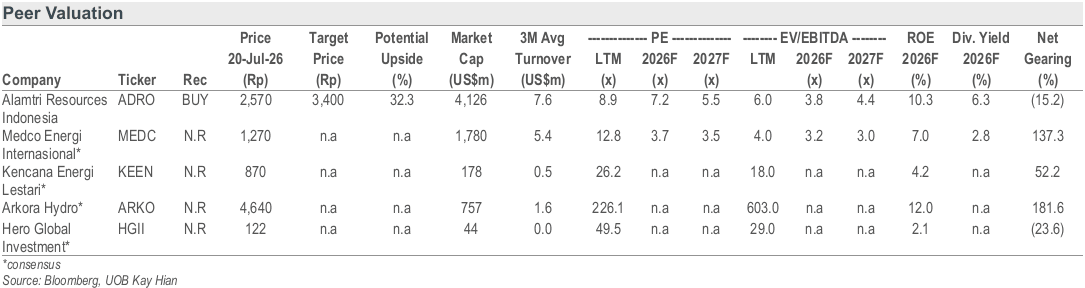
- Major beneficiaries of government green energy initiatives. ADRO and MEDC are among the Indonesian companies best positioned to participate in the planned green-electricity exports to Singapore, as both have already secured conditional licences from Singapore's Energy Market Authority (EMA) since 2023. Through its subsidiary Adaro Solar International, ADRO has secured an allocation of around 0.4GW of clean electricity export capacity to Singapore, with estimated capex of about US$3.2b covering the solar PV plant and battery energy storage system (BESS). Based on our preliminary estimates, the project could generate a project IRR of 15% and equity IRR of 32%, assuming a US$0.20/kWh export tariff and 70% debt financing at an 8% interest cost. This sits alongside ADRO's broader clean energy build-out via Adaro Clean Energy Indonesia, which includes smaller-scale rooftop (130 KWp) and floating (468 KWp) PV assets. MEDC, through the Pacific Medco Solar Energy consortium (in partnership with the Salim Group), has secured conditional approval for up to 600 MW (0.6W) of export capacity, to be supplied from its Bulan Solar PV project that has approximately 2GWp capacity in the Batam area, supported by battery storage and subsea transmission infrastructure to Singapore. That said, both projects have yet to conclude definitive power supply (offtake) agreements with Singapore offtakers, which is the key milestone to lock in export tariffs, and in turn, reach financial close and FID. Hence, our IRR estimates remain indicative for now.
- KEEN has secured a power purchase agreement with PLN for the 10MW Tobelo solar power project, supported by an 8MW battery energy storage system. Construction is expected to be completed in 2H27. Once operational, the project is projected to generate around 20,400 MWh of electricity annually. KEEN also intends to build solar power project(s) in areas with coal mines
Highlights
- Indonesia's solar sector has entered an acceleration phase, growing at a 55% CAGR since 2020 on utility-scale and rooftop adoption, though it still
contributes just 0.5% of the power mix. - Government incentives and PLN's 17.1GW RUPTL target underpin the outlook, while a 3.4GW Singapore export initiative adds a new growth vector
- Direct beneficiaries of government initiatives are ADRO and MEDC.
Analysis
- 55% CAGR growth in solar energy installation. Indonesia’s solar energy sector has entered a clear acceleration phase since 2020, with installed capacity rising from around 166MW in 2020 to approximately 1.5GW in 2025, equivalent to a five-year CAGR of about 55%, driven by utility-scale projects, industrial rooftop adoption, and stronger government support. Growth accelerated sharply from 2023 following the commissioning of the Cirata floating solar project (192 MWp). Despite this rapid expansion, solar remains a minor component of Indonesia’s power mix, contributing an estimated 0.5% of total electricity generation in 2025, even though renewable energy accounts for 15.75% of the broader national energy mix. The outlook remains positive, supported by PLN’s plan to add around 17.1GW of solar capacity under the 2025-34 RUPTL, although execution will depend on grid readiness, financing availability, regulatory consistency, and domestic-content requirements.
- Government incentives to support green energy production. Indonesia offers a broad incentive package to accelerate renewable energy investment, covering fiscal support and operational relief. Qualifying projects may receive a corporate income tax allowance equivalent to 30% of the total investment value, deducted at 5% per year over six years, accelerated depreciation, loss carry-forward of up to 10 years, dividend withholding-tax relief, and tax holidays of up to 100% corporate income tax exemption for 5-20 years. Imported renewable energy equipment not available locally may also receive import-duty and VAT exemptions, while super deductions are available for R&D and training, and special economic zone or free trade zone projects may receive 0% duty and VAT exemptions. For industrial self-consumers, capacity charges and emergency-service fees have been abolished, although installed capacity remains subject to PLN quotas.
- Solar export to Singapore. Indonesia and Singapore are advancing a major cross-border green electricity initiative, with Danantara targeting at least 3.4GW of export capacity by 2035 to strengthen regional energy connectivity and support the ASEAN Power Grid. Danantara Investment Management signed MOUs with Keppel Electric and Sembcorp Utilities to explore low carbon electricity offtake, alongside a separate agreement with Singapore Energy Interconnections to assess the commercial and technical requirements for cross-border transmission infrastructure. The electricity will be supplied from additional generation capacity and will not reduce Indonesia's domestic power supply. Indonesia and Singapore will also develop the required regulatory framework, investment policies, and a cross border Renewable Energy Certificate system aligned with international standards before commercial electricity flows commence.
- Major beneficiaries of government green energy initiatives. ADRO and MEDC are among the Indonesian companies best positioned to participate in the planned green-electricity exports to Singapore, as both have already secured conditional licences from Singapore's Energy Market Authority (EMA) since 2023. Through its subsidiary Adaro Solar International, ADRO has secured an allocation of around 0.4GW of clean electricity export capacity to Singapore, with estimated capex of about US$3.2b covering the solar PV plant and battery energy storage system (BESS). Based on our preliminary estimates, the project could generate a project IRR of 15% and equity IRR of 32%, assuming a US$0.20/kWh export tariff and 70% debt financing at an 8% interest cost. This sits alongside ADRO's broader clean energy build-out via Adaro Clean Energy Indonesia, which includes smaller-scale rooftop (130 KWp) and floating (468 KWp) PV assets. MEDC, through the Pacific Medco Solar Energy consortium (in partnership with the Salim Group), has secured conditional approval for up to 600 MW (0.6W) of export capacity, to be supplied from its Bulan Solar PV project that has approximately 2GWp capacity in the Batam area, supported by battery storage and subsea transmission infrastructure to Singapore. That said, both projects have yet to conclude definitive power supply (offtake) agreements with Singapore offtakers, which is the key milestone to lock in export tariffs, and in turn, reach financial close and FID. Hence, our IRR estimates remain indicative for now.
- KEEN has secured a power purchase agreement with PLN for the 10MW Tobelo solar power project, supported by an 8MW battery energy storage system. Construction is expected to be completed in 2H27. Once operational, the project is projected to generate around 20,400 MWh of electricity annually. KEEN also intends to build solar power project(s) in areas with coal mines
Analyst
Analyst
IMPORTANT NOTICE - DISCLOSURES AND DISCLAIMERS
This report is provided subject to, and must be read together with, the full Disclosures / Disclaimers available at the following link: https://research-api.uobkayhian.com/assets/disclaimer/df64a6ea-7980-447c-ae9e-fd19b93257dc, which are incorporated by reference into this report. In particular, this report is intended for general circulation and informational purposes only and does not constitute personal investment advice or a recommendation to buy or sell any investment product or security. You should independently evaluate the information and, where necessary, seek advice from a qualified financial adviser regarding the suitability of any investment. Analyst certifications required under applicable regulations, including SEC Regulation AC (where relevant), are included in this report. By accessing, receiving or using this report, you acknowledge that you have read, understood and agreed to be bound by the Disclosures / Disclaimers, as may be amended, supplemented or updated from time to time.


