

Strategy
Strategy: Indonesia DCs Capturing The Regional Spillover
Analyst
Analyst
Analyst
Highlights
Indonesia positioned to capture regional DC spillover. Indonesia offers lower development costs, supportive foreign-investment policies and substantial power headroom, while capacity constraints in Singapore and Malaysia should support demand migration into Indonesia.
DC expansion creates broad beneficiary base. DCII, TLKM, ISAT and DSSA offer direct exposure to capacity growth, while POWR, BREN, PGEO, ARKO, TOTL and industrial estates benefit from rising power, construction and land requirements. Fibre and connectivity operators including TLKM, ISAT, MORA, KETR, TOWR, MTEL and INET should also benefit from higher data traffic and utilisation.
Power constraints and valuation remain key risks. Indonesia has limited power headroom relative to its potential data centre (DC) pipeline and tighter regulation around power, water and sustainability could constrain future scalability and development. A slowdown in global AI capex or eventual sector multiple com
Analysis
Indonesia as potential beneficiary of regional DC spillover. Indonesia could benefit from the next wave of regional DC demand as capacity constraints increasingly emerge across Singapore and Malaysia. Singapore’s 2019–22 DC moratorium highlighted constraints on land, power and water, while its subsequent Data Centre Call for Application (DC-CFA) scheme imposed stricter sustainability requirements. Johor then captured significant spillover given its proximity to Singapore, lower costs and abundant land, but rapid growth has increasingly strained resources, with Malaysia tightening power and water screening for DC projects and Johor restricting water-intensive facilities in 2026.
Against this backdrop, Indonesia offers a large and relatively underpenetrated market, supported by foreign-investment flexibility and streamlined DC development. International operators including DayOne, Princeton, AirTrunk and NTT have established or expanded their presence, while local players including Telkom (TLKM), Indosat (ISAT) and Sinar Mas are building sizeable pipelines.
Indonesia’s competitive datacenter economics. Indonesia combines flexible foreign ownership, lower development costs and abundant land. Under Presidential Regulation No. 49/2021 (Positive Investment List), most ICT-related activities relevant to DC allow up to 100% foreign ownership, subject to applicable KBLI and sectoral requirements. Eligible projects can also access tax holidays, tax allowances and customs incentives. In Batam, the Nongsa Digital Park Special Economic Zone (SEZ) provides established DC and subsea-connectivity infrastructure. Indonesia also offers a meaningful construction-cost advantage as Jakarta's DC construction cost was US$11.21/W in 2025, vs US$14.53/W in Singapore, implying a ~23% cost advantage (Turner & Townsend).
Power availability as a potential scalability bottleneck. Indonesia has substantial installed generation capacity, but near-term power availability is tighter than headline capacity suggests. Indonesia had 107.5GW of installed generation capacity in 2025, while ESDM projected 47.2GW of peak load against 51.6GW of Daya Mampu Pasok (DMP) during the Ramadan–Idulfitri 2026 period which is only 4.4GW, or 9.3%, of reserve capacity.
The Java–Madura–Bali (Jamali) system had 38.0GW of DMP against 34.1GW of peak load at the 2025 peak, leaving a 3.9GW or 11.3% reserve. Batam is tighter, with PLN Batam reporting ~881MW of net capable supply against ~761MW of peak load in Mar 26, leaving only ~120MW of reserve. Large DC projects in Batam will therefore require additional generation and grid investment.
Over the longer term, PLN's 2025-34 Electricity Supply Business Plan (RUPTL) targets 69.5GW of additional generation and storage capacity, comprising 42.6GW of renewable generation, 10.3GW of storage and 16.6GW of fossil generation.
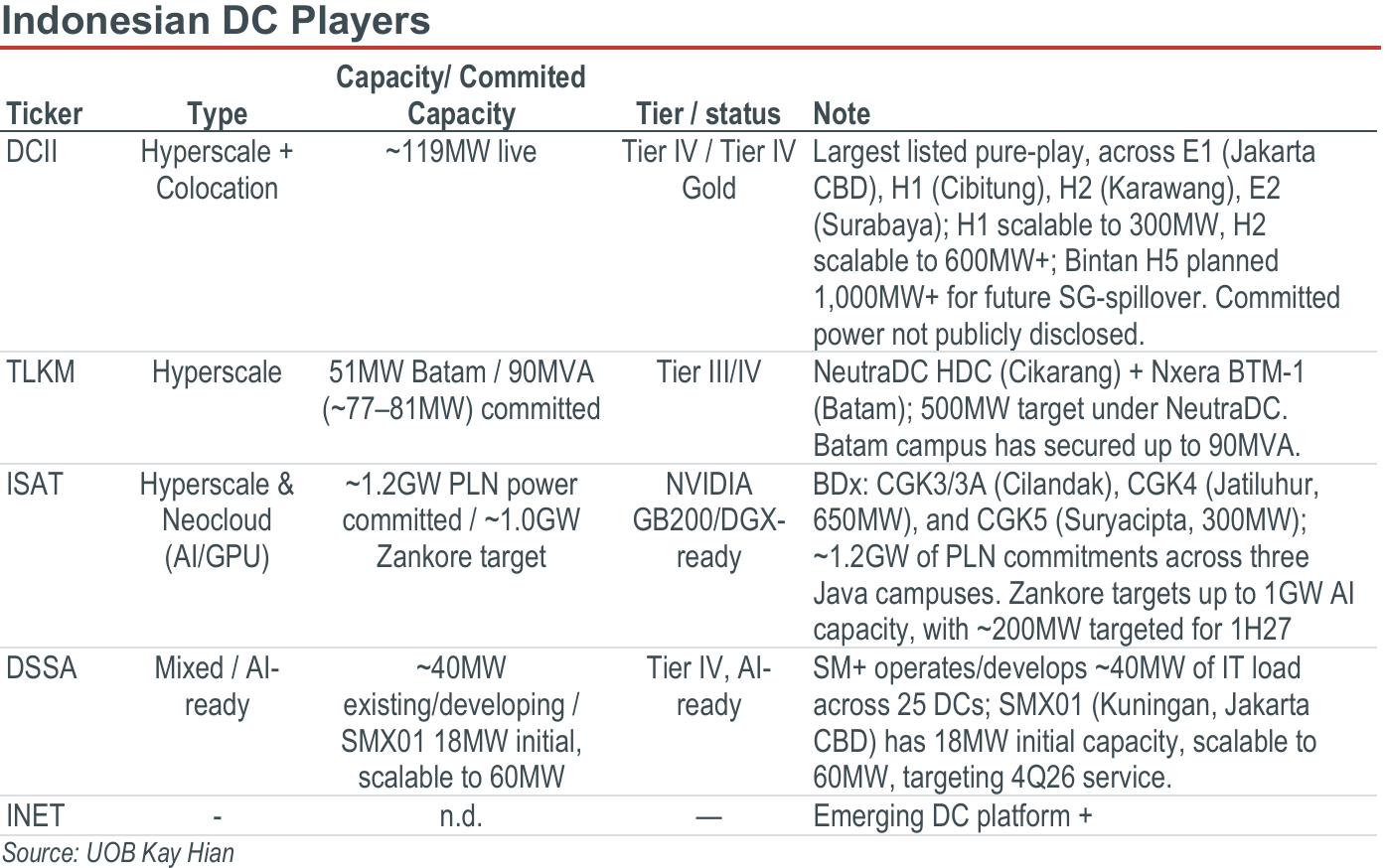
Direct DC beneficiaries are listed below.
Data Center Indonesia (DCII) is the current pure largest listed DC, with ~119MW of installed capacity as of early-26 and expansion plans for up to 300MW in Cibitung and 600MW in Karawang, although committed power for future capacity remains undisclosed.
TLKM, through NeutraDC, targets 500MW of DC capacity by 2030, including the 51MW Tier III NeutraDC Nxera Batam campus, which has secured ~79MW of PLN electricity supply.
ISAT, through Lintasarta and its BDx partnership, has significant exposure to AI-focused infrastructure, with BDx securing ~1.2GW of PLN power commitments across three Java campuses, including the 650MW NVIDIA DGX-Ready CGK4 AI campus in Jatiluhur and the 300MW CGK5 campus in Suryacipta (SSIA).
Separately, ISAT's minority stake in Zankore AI infrastructure platform targets up to 1GW capacity, with ~200MW targeted for deployment in 1H27.
Dian Swastatika Sentosa (DSSA), through SM+, operates and develops ~40MW of IT load capacity across 25 DCs, including the Tier IV, AI-ready SMX01 facility in Jakarta, which has an initial 18MW capacity scalable to 60MW and is targeted for service in 4Q26.
Sinergi Inti Andalan (INET) through Sinergi Inti Data Indonesia (SIDI) manages around 1MW in Gedung Cyber I and plans its own green data centre in Purwakarta, on a 180–200ha site, targeted to operate in 3Q26.
Beyond capacity growth, the economics are attractive: hyperscaler (HS) focused DC lessors typically generate 50-60% EBITDA margins, while only ISAT's neo-cloud (NC) business targets ~80% EBITDA margins, reflecting the higher-value economics of artificial intelligence (AI)/graphics processing unit (GPU) infrastructure. Overall, DCII offers the clearest pure DC exposure, while TLKM, ISAT, DSSA, INET provide broader exposure across DC, connectivity, AI and power infrastructure.
Power and infrastructure beneficiaries. DC expansion also benefits power, construction and connectivity players. Cikarang Listrindo (POWR) is particularly well positioned, with DC customers reaching ~215MW of contracted capacity as of Mar 26 and energised DC capacity expected to increase to ~425MW by 2028, implying ~34% CAGR. Against ~1.19GW of installed generation capacity and ~67% utilisation. Barito Renewables Energy (BREN), Pertamina Geothermal Energy (PGEO), and Arkora Hydro (ARKO) provide alternative exposure through renewable power as DC operators increasingly seek reliable low-carbon electricity.
On construction, Total Bangun Persada (TOTL) is also a key listed beneficiary as it is one of the few publicly listed local construction companies capable of building DCs, supported by its MEP and fit-out capabilities and DC expertise through Jaya Obayashi. Rising DC and AI workloads should also increase data traffic and fibre requirements, supporting TLKM, INET, Mora Telematika Indonesia (MORA), Ketrosden Triamitra (KETR), Sarana Menara Nusantara (TOWR) and Dayamitra Telekomunikasi (MTEL).
Industrial estate beneficiaries. Cikarang estates offer the cleanest listed exposure, while Batam is the faster-growing cluster. DC demand has clustered in Cikarang due to proximity, latency and existing captive power. Puradelta Lestari (DMAS) highlights the intensity, with 70% of land inquiries coming from DCs, but its industrial landbank was below 150ha as of 31 Mar 26. Scarcity should redirect demand toward Bekasi Fajar Industrial Estate (BEST) at MM2100 and Kawasan Industri Jababeka (KIJA) at Jababeka, with KIJA benefitting from captive generation via Bekasi Power while POWR supplies the wider Cikarang cluster. Batam is scaling faster due to spillover from Singapore, with the 166ha Nongsa Digital Park SEZ located 35 minutes from Singapore and connected to more than 15 submarine cables. Committed capacity includes DayOne's 72MW campus and Data Center First's initial 30MW phase, while the 841ha Tanjung Sauh SEZ is positioned to support power and logistics requirements. Batam nonetheless offers no listed estate play, leaving exposure mainly through the power and construction supply chain.
Key risks to the DC thesis. Regulatory and execution risks remain the key near-term uncertainties as DC investment scales. Indonesia’s current policy environment is supportive through foreign-ownership flexibility, investment incentives and streamlined licensing, but these policies could become less favourable as pressure on power, water, land and grid infrastructure increases. Java’s coal-heavy grid also creates a non-tariff constraint for Western hyperscalers with strict Net Zero mandates unless offset through Renewable Energy Certificates (RECs) or direct off-grid green power Purchase Power Agreements (PPAs). Execution risk centres on delivering large AI-ready campuses on time and securing anchor customers, while weaker AI capex, GPU utilisation or cloud demand could delay capacity additions and reduce utilisation.
Potential valuation de-rating is a longer-term risk. The global tower sector provides a relevant precedent, with multiple compression during the 5G investment cycle despite strong EBITDA margins as rising interest rates, carrier consolidation and slower organic growth pressured valuations. A similar dynamic could emerge in DCs, where leading global operators trade at ~25x EV/EBITDA and already reflect strong expectations for sustained AI and hyperscaler capex. As supply expands and the market gains greater visibility on utilisation, returns and AI-driven demand, the sector could transition toward a more mature asset class. Multiples could therefore compress even if EBITDA continues to grow, creating downside if valuations capitalise the DC pipeline faster than earnings are realised.
Highlights
Indonesia positioned to capture regional DC spillover. Indonesia offers lower development costs, supportive foreign-investment policies and substantial power headroom, while capacity constraints in Singapore and Malaysia should support demand migration into Indonesia.
DC expansion creates broad beneficiary base. DCII, TLKM, ISAT and DSSA offer direct exposure to capacity growth, while POWR, BREN, PGEO, ARKO, TOTL and industrial estates benefit from rising power, construction and land requirements. Fibre and connectivity operators including TLKM, ISAT, MORA, KETR, TOWR, MTEL and INET should also benefit from higher data traffic and utilisation.
Power constraints and valuation remain key risks. Indonesia has limited power headroom relative to its potential data centre (DC) pipeline and tighter regulation around power, water and sustainability could constrain future scalability and development. A slowdown in global AI capex or eventual sector multiple com
Analysis
Indonesia as potential beneficiary of regional DC spillover. Indonesia could benefit from the next wave of regional DC demand as capacity constraints increasingly emerge across Singapore and Malaysia. Singapore’s 2019–22 DC moratorium highlighted constraints on land, power and water, while its subsequent Data Centre Call for Application (DC-CFA) scheme imposed stricter sustainability requirements. Johor then captured significant spillover given its proximity to Singapore, lower costs and abundant land, but rapid growth has increasingly strained resources, with Malaysia tightening power and water screening for DC projects and Johor restricting water-intensive facilities in 2026.
Against this backdrop, Indonesia offers a large and relatively underpenetrated market, supported by foreign-investment flexibility and streamlined DC development. International operators including DayOne, Princeton, AirTrunk and NTT have established or expanded their presence, while local players including Telkom (TLKM), Indosat (ISAT) and Sinar Mas are building sizeable pipelines.
Indonesia’s competitive datacenter economics. Indonesia combines flexible foreign ownership, lower development costs and abundant land. Under Presidential Regulation No. 49/2021 (Positive Investment List), most ICT-related activities relevant to DC allow up to 100% foreign ownership, subject to applicable KBLI and sectoral requirements. Eligible projects can also access tax holidays, tax allowances and customs incentives. In Batam, the Nongsa Digital Park Special Economic Zone (SEZ) provides established DC and subsea-connectivity infrastructure. Indonesia also offers a meaningful construction-cost advantage as Jakarta's DC construction cost was US$11.21/W in 2025, vs US$14.53/W in Singapore, implying a ~23% cost advantage (Turner & Townsend).
Power availability as a potential scalability bottleneck. Indonesia has substantial installed generation capacity, but near-term power availability is tighter than headline capacity suggests. Indonesia had 107.5GW of installed generation capacity in 2025, while ESDM projected 47.2GW of peak load against 51.6GW of Daya Mampu Pasok (DMP) during the Ramadan–Idulfitri 2026 period which is only 4.4GW, or 9.3%, of reserve capacity.
The Java–Madura–Bali (Jamali) system had 38.0GW of DMP against 34.1GW of peak load at the 2025 peak, leaving a 3.9GW or 11.3% reserve. Batam is tighter, with PLN Batam reporting ~881MW of net capable supply against ~761MW of peak load in Mar 26, leaving only ~120MW of reserve. Large DC projects in Batam will therefore require additional generation and grid investment.
Over the longer term, PLN's 2025-34 Electricity Supply Business Plan (RUPTL) targets 69.5GW of additional generation and storage capacity, comprising 42.6GW of renewable generation, 10.3GW of storage and 16.6GW of fossil generation.
Direct DC beneficiaries are listed below.
Data Center Indonesia (DCII) is the current pure largest listed DC, with ~119MW of installed capacity as of early-26 and expansion plans for up to 300MW in Cibitung and 600MW in Karawang, although committed power for future capacity remains undisclosed.
TLKM, through NeutraDC, targets 500MW of DC capacity by 2030, including the 51MW Tier III NeutraDC Nxera Batam campus, which has secured ~79MW of PLN electricity supply.
ISAT, through Lintasarta and its BDx partnership, has significant exposure to AI-focused infrastructure, with BDx securing ~1.2GW of PLN power commitments across three Java campuses, including the 650MW NVIDIA DGX-Ready CGK4 AI campus in Jatiluhur and the 300MW CGK5 campus in Suryacipta (SSIA).
Separately, ISAT's minority stake in Zankore AI infrastructure platform targets up to 1GW capacity, with ~200MW targeted for deployment in 1H27.
Dian Swastatika Sentosa (DSSA), through SM+, operates and develops ~40MW of IT load capacity across 25 DCs, including the Tier IV, AI-ready SMX01 facility in Jakarta, which has an initial 18MW capacity scalable to 60MW and is targeted for service in 4Q26.
Sinergi Inti Andalan (INET) through Sinergi Inti Data Indonesia (SIDI) manages around 1MW in Gedung Cyber I and plans its own green data centre in Purwakarta, on a 180–200ha site, targeted to operate in 3Q26.
Beyond capacity growth, the economics are attractive: hyperscaler (HS) focused DC lessors typically generate 50-60% EBITDA margins, while only ISAT's neo-cloud (NC) business targets ~80% EBITDA margins, reflecting the higher-value economics of artificial intelligence (AI)/graphics processing unit (GPU) infrastructure. Overall, DCII offers the clearest pure DC exposure, while TLKM, ISAT, DSSA, INET provide broader exposure across DC, connectivity, AI and power infrastructure.
Power and infrastructure beneficiaries. DC expansion also benefits power, construction and connectivity players. Cikarang Listrindo (POWR) is particularly well positioned, with DC customers reaching ~215MW of contracted capacity as of Mar 26 and energised DC capacity expected to increase to ~425MW by 2028, implying ~34% CAGR. Against ~1.19GW of installed generation capacity and ~67% utilisation. Barito Renewables Energy (BREN), Pertamina Geothermal Energy (PGEO), and Arkora Hydro (ARKO) provide alternative exposure through renewable power as DC operators increasingly seek reliable low-carbon electricity.
On construction, Total Bangun Persada (TOTL) is also a key listed beneficiary as it is one of the few publicly listed local construction companies capable of building DCs, supported by its MEP and fit-out capabilities and DC expertise through Jaya Obayashi. Rising DC and AI workloads should also increase data traffic and fibre requirements, supporting TLKM, INET, Mora Telematika Indonesia (MORA), Ketrosden Triamitra (KETR), Sarana Menara Nusantara (TOWR) and Dayamitra Telekomunikasi (MTEL).
Industrial estate beneficiaries. Cikarang estates offer the cleanest listed exposure, while Batam is the faster-growing cluster. DC demand has clustered in Cikarang due to proximity, latency and existing captive power. Puradelta Lestari (DMAS) highlights the intensity, with 70% of land inquiries coming from DCs, but its industrial landbank was below 150ha as of 31 Mar 26. Scarcity should redirect demand toward Bekasi Fajar Industrial Estate (BEST) at MM2100 and Kawasan Industri Jababeka (KIJA) at Jababeka, with KIJA benefitting from captive generation via Bekasi Power while POWR supplies the wider Cikarang cluster. Batam is scaling faster due to spillover from Singapore, with the 166ha Nongsa Digital Park SEZ located 35 minutes from Singapore and connected to more than 15 submarine cables. Committed capacity includes DayOne's 72MW campus and Data Center First's initial 30MW phase, while the 841ha Tanjung Sauh SEZ is positioned to support power and logistics requirements. Batam nonetheless offers no listed estate play, leaving exposure mainly through the power and construction supply chain.
Key risks to the DC thesis. Regulatory and execution risks remain the key near-term uncertainties as DC investment scales. Indonesia’s current policy environment is supportive through foreign-ownership flexibility, investment incentives and streamlined licensing, but these policies could become less favourable as pressure on power, water, land and grid infrastructure increases. Java’s coal-heavy grid also creates a non-tariff constraint for Western hyperscalers with strict Net Zero mandates unless offset through Renewable Energy Certificates (RECs) or direct off-grid green power Purchase Power Agreements (PPAs). Execution risk centres on delivering large AI-ready campuses on time and securing anchor customers, while weaker AI capex, GPU utilisation or cloud demand could delay capacity additions and reduce utilisation.
Potential valuation de-rating is a longer-term risk. The global tower sector provides a relevant precedent, with multiple compression during the 5G investment cycle despite strong EBITDA margins as rising interest rates, carrier consolidation and slower organic growth pressured valuations. A similar dynamic could emerge in DCs, where leading global operators trade at ~25x EV/EBITDA and already reflect strong expectations for sustained AI and hyperscaler capex. As supply expands and the market gains greater visibility on utilisation, returns and AI-driven demand, the sector could transition toward a more mature asset class. Multiples could therefore compress even if EBITDA continues to grow, creating downside if valuations capitalise the DC pipeline faster than earnings are realised.
Analyst
Analyst
Analyst
IMPORTANT NOTICE - DISCLOSURES AND DISCLAIMERS
This report is provided subject to, and must be read together with, the full Disclosures / Disclaimers available at this link, which are incorporated by reference into this report. In particular, this report is intended for general circulation and informational purposes only and does not constitute personal investment advice or a recommendation to buy or sell any investment product or security. You should independently evaluate the information and, where necessary, seek advice from a qualified financial adviser regarding the suitability of any investment. Analyst certifications required under applicable regulations, including SEC Regulation AC (where relevant), are included in this report. By accessing, receiving or using this report, you acknowledge that you have read, understood and agreed to be bound by the Disclosures / Disclaimers, as may be amended, supplemented or updated from time to time.
