

Company Coverage
Siam Cement (SCC TB): CBM Margin Recovery Provides Earnings Upside
BUY (Maintained)
Current price:
Target price:
Upside:
Previous TP :
Bt257.00
Bt330.00
+28.40%
Bt320.00
Analyst
Highlights
- CBM EBITDA margin has improved significantly, driven by higher selling prices and effective cost optimisation, providing upside to our earnings forecasts.
- Its financial position has strengthened after using proceeds from the partial divestment of its CAP stake to repay debt, bringing both net debt-to-equity and net debt-to-EBITDA ratios back to healthy levels.
- Maintain BUY. Target price: Bt330.00 (previously Bt320.00).
Analysis
- The tone during our meeting with Siam Cement (SCC) was positive.
- CBM EBITDA margin improved significantly. We remain positive on the cement building material (CBM) business as its earnings recovery is being driven by both pricing and structural cost improvements. Besides gradual domestic price increases, CBM has benefitted from an organisational transformation implemented in mid-2Q26 to improve operational efficiency through centralisation of support functions, elimination of overlapping operations, and the introduction of a "One Face to Customer" strategy offering integrated housing and building solutions. As a result, CBM's EBITDA margin increased to 14% in 2Q26 (vs 10% in 1Q26 and 8% in 2Q25).
- Management expects the transformation to generate approximately Bt1.00b of fixed cost savings in 2H26 and increase EBITDA by around Bt3.0b by 2028. The restructuring is appropriate given the still-muted cement demand environment. Thailand's cement demand was broadly flat yoy in 2Q26, supported mainly by public infrastructure projects (40% of domestic sales), while the residential property sector remained weak. In contrast, overseas markets continued to outperform, with Indonesia's cement demand rising 15% yoy, supported by government stimulus measures and the property sector,
while Vietnam grew 4% yoy, driven by strong foreign direct investment (FDI) inflows.
- Low-carbon cement and cost optimisation remain key growth drivers. SCC continues to focus on expanding the production and sales of low-carbon cement in Thailand while accelerating exports from its Vietnam operations to premium overseas markets with stricter environmental standards, where both selling prices and profitability are more attractive. The company is also increasing the use of alternative fuels, including RDF and biomass, to reduce coal dependency. Investments in Chloride Bypass and External Combustion System technologies allow cement kilns to utilise a higher proportion of
alternative fuels without compromising product quality. SCC targets an alternative fuel utilisation rate of more than 50% by 2027, up from around 40% currently.
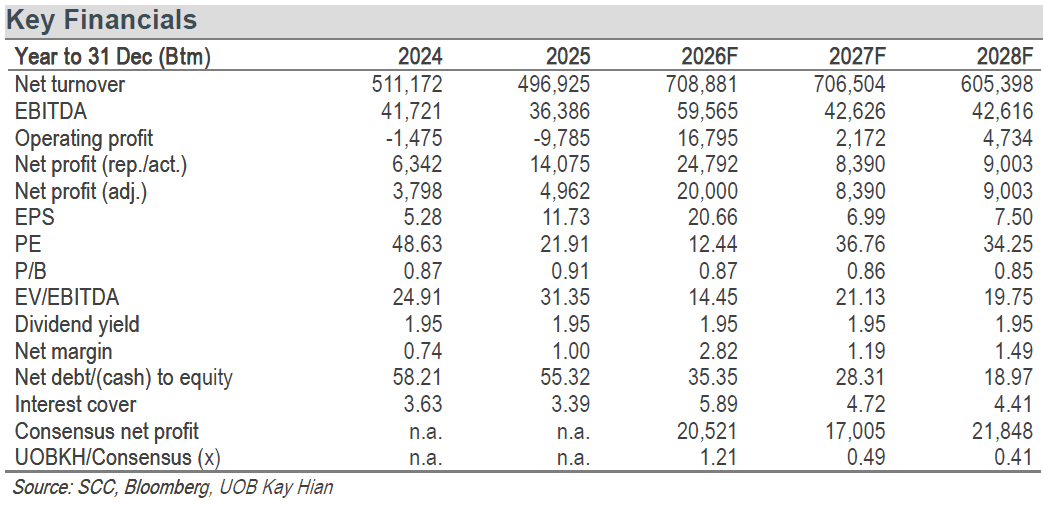
Highlights
- CBM EBITDA margin has improved significantly, driven by higher selling prices and effective cost optimisation, providing upside to our earnings forecasts.
- Its financial position has strengthened after using proceeds from the partial divestment of its CAP stake to repay debt, bringing both net debt-to-equity and net debt-to-EBITDA ratios back to healthy levels.
- Maintain BUY. Target price: Bt330.00 (previously Bt320.00).
Analysis
- The tone during our meeting with Siam Cement (SCC) was positive.
- CBM EBITDA margin improved significantly. We remain positive on the cement building material (CBM) business as its earnings recovery is being driven by both pricing and structural cost improvements. Besides gradual domestic price increases, CBM has benefitted from an organisational transformation implemented in mid-2Q26 to improve operational efficiency through centralisation of support functions, elimination of overlapping operations, and the introduction of a "One Face to Customer" strategy offering integrated housing and building solutions. As a result, CBM's EBITDA margin increased to 14% in 2Q26 (vs 10% in 1Q26 and 8% in 2Q25).
- Management expects the transformation to generate approximately Bt1.00b of fixed cost savings in 2H26 and increase EBITDA by around Bt3.0b by 2028. The restructuring is appropriate given the still-muted cement demand environment. Thailand's cement demand was broadly flat yoy in 2Q26, supported mainly by public infrastructure projects (40% of domestic sales), while the residential property sector remained weak. In contrast, overseas markets continued to outperform, with Indonesia's cement demand rising 15% yoy, supported by government stimulus measures and the property sector,
while Vietnam grew 4% yoy, driven by strong foreign direct investment (FDI) inflows.
- Low-carbon cement and cost optimisation remain key growth drivers. SCC continues to focus on expanding the production and sales of low-carbon cement in Thailand while accelerating exports from its Vietnam operations to premium overseas markets with stricter environmental standards, where both selling prices and profitability are more attractive. The company is also increasing the use of alternative fuels, including RDF and biomass, to reduce coal dependency. Investments in Chloride Bypass and External Combustion System technologies allow cement kilns to utilise a higher proportion of
alternative fuels without compromising product quality. SCC targets an alternative fuel utilisation rate of more than 50% by 2027, up from around 40% currently.
BUY (Maintained)
Current price:
Target price:
Upside:
Previous TP :
Bt257.00
Bt330.00
+28.40%
Bt320.00
Analyst
IMPORTANT NOTICE - DISCLOSURES AND DISCLAIMERS
This report is provided subject to, and must be read together with, the full Disclosures / Disclaimers available at the following link: https://research-api.uobkayhian.com/assets/disclaimer/df64a6ea-7980-447c-ae9e-fd19b93257dc, which are incorporated by reference into this report. In particular, this report is intended for general circulation and informational purposes only and does not constitute personal investment advice or a recommendation to buy or sell any investment product or security. You should independently evaluate the information and, where necessary, seek advice from a qualified financial adviser regarding the suitability of any investment. Analyst certifications required under applicable regulations, including SEC Regulation AC (where relevant), are included in this report. By accessing, receiving or using this report, you acknowledge that you have read, understood and agreed to be bound by the Disclosures / Disclaimers, as may be amended, supplemented or updated from time to time.
