

Company Coverage
Superior Prima Sukses (BLES IJ): Higher ASPs Drive Record Earnings
NOT RATED
Current price:
Target price:
Upside:
Rp202
n.a.
n.a.
Analyst
Highlights
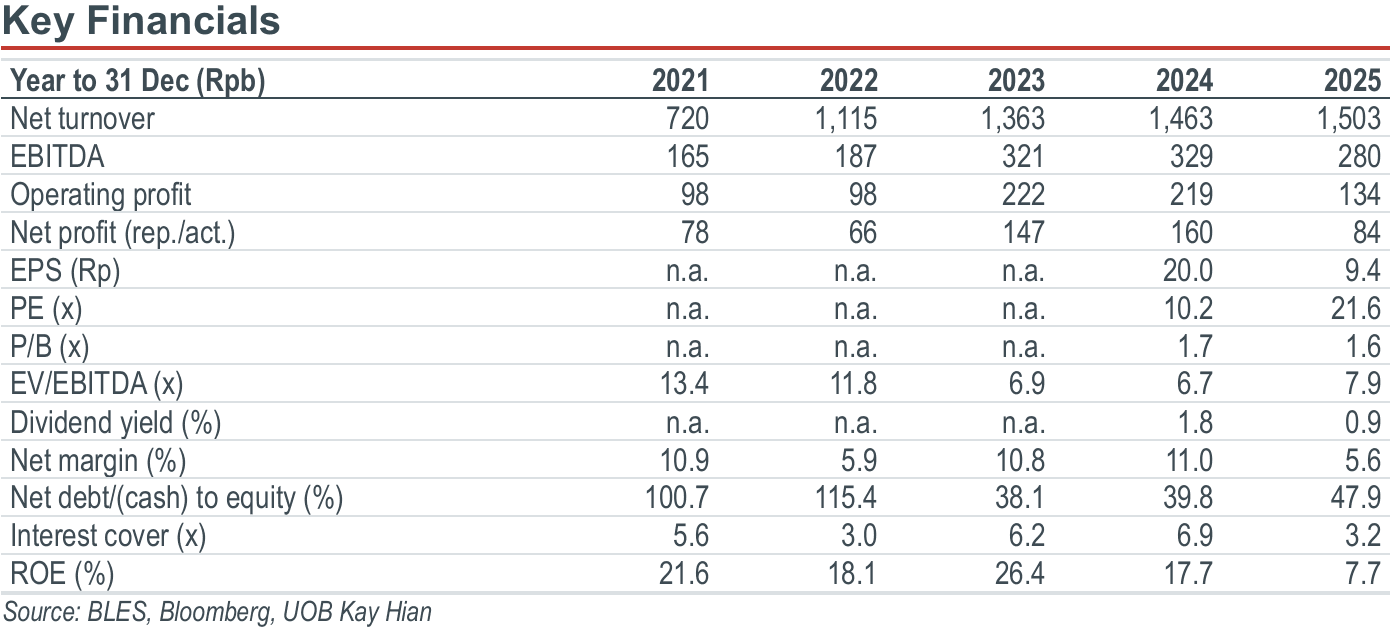
Margin recovery is underway. Gross margin rebounded from 25.9% in 2025 to 37.8% in 1H26, with 6M26 net profit already exceeding 2025 profit.
Heavy capex cycle is over. Capex fell from Rp327b in 2025 to Rp13b in 6M26, cutting net gearing from 0.49x to 0.25x in six months.
Long growth runway with support from Tanoko. AAC block adoption is growing exponentially nationwide, with tycoon Hermanto Tanoko (~18% ownership) looking to replicate his building-materials success through BLES.
Analysis
AAC blocks are structurally replacing traditional red bricks. Superior Prima Sukses (BLES) is Indonesia's leading Autoclaved Aerated Concrete (AAC) block manufacturer, known locally as bata ringan, with an estimated 20% national market share. AAC offers clear advantages over conventional red brick: It is about 70% lighter, installs roughly 3x faster, and cheaper to build with. National adoption remains concentrated in Java, where it has already reached 80-90% penetration in the more mature Jakarta/West Java market, versus around 40% in Central and East Java. Outside Java, demand is still largely confined to major cities such as Medan, Makassar, and Banjarmasin. This points to a clear runway ahead, positioning bata ringan for a continued, scalable growth into secondary cities and regions beyond Java.
The low-ASP, low-margin period is over. ASP fell from about Rp522,000/m³ in 2023 to around Rp402,000/m³ in 2025, a decline compounded by a period when the government shifted national priority away from infrastructure. Against this weaker backdrop, BLES aggressively lowered ASP to undercut competitors and gain market share, prioritising volume growth over profitability. Gross margin fell to 25.9% in 2025 from 32.1% in 2024, and ROE dropped to about 7.5%, the weakest year in recent history. As of 1H26, pricing has moved the other way, with ASPs up roughly 50% yoy, lifting gross margins to 37.8% (vs 1H25’s 21.4%) and ROE to 27.7% annualised during the period.
The heavy capex cycle is behind the company, for now. BLES recently established its new Banjarnegara plant, adding around 1.0m m³/year of capacity and bringing total installed capacity to about 5.6m m³/year across its six plants. Capex has since fallen sharply to Rp13b in 6M26, from Rp553b in 2024 and Rp327b in 2025. Plant utilisation currently sits at about 70%, with management noting that historically it can reach around 90%, leaving the company not needing additional plants for at least two years. That said, management also said it continuously monitors ex-Java markets for potentially new investments, so this is better read as a pause in heavy capex, not a multi-year commitment against further plant construction.
Highlights
Margin recovery is underway. Gross margin rebounded from 25.9% in 2025 to 37.8% in 1H26, with 6M26 net profit already exceeding 2025 profit.
Heavy capex cycle is over. Capex fell from Rp327b in 2025 to Rp13b in 6M26, cutting net gearing from 0.49x to 0.25x in six months.
Long growth runway with support from Tanoko. AAC block adoption is growing exponentially nationwide, with tycoon Hermanto Tanoko (~18% ownership) looking to replicate his building-materials success through BLES.
Analysis
AAC blocks are structurally replacing traditional red bricks. Superior Prima Sukses (BLES) is Indonesia's leading Autoclaved Aerated Concrete (AAC) block manufacturer, known locally as bata ringan, with an estimated 20% national market share. AAC offers clear advantages over conventional red brick: It is about 70% lighter, installs roughly 3x faster, and cheaper to build with. National adoption remains concentrated in Java, where it has already reached 80-90% penetration in the more mature Jakarta/West Java market, versus around 40% in Central and East Java. Outside Java, demand is still largely confined to major cities such as Medan, Makassar, and Banjarmasin. This points to a clear runway ahead, positioning bata ringan for a continued, scalable growth into secondary cities and regions beyond Java.
The low-ASP, low-margin period is over. ASP fell from about Rp522,000/m³ in 2023 to around Rp402,000/m³ in 2025, a decline compounded by a period when the government shifted national priority away from infrastructure. Against this weaker backdrop, BLES aggressively lowered ASP to undercut competitors and gain market share, prioritising volume growth over profitability. Gross margin fell to 25.9% in 2025 from 32.1% in 2024, and ROE dropped to about 7.5%, the weakest year in recent history. As of 1H26, pricing has moved the other way, with ASPs up roughly 50% yoy, lifting gross margins to 37.8% (vs 1H25’s 21.4%) and ROE to 27.7% annualised during the period.
The heavy capex cycle is behind the company, for now. BLES recently established its new Banjarnegara plant, adding around 1.0m m³/year of capacity and bringing total installed capacity to about 5.6m m³/year across its six plants. Capex has since fallen sharply to Rp13b in 6M26, from Rp553b in 2024 and Rp327b in 2025. Plant utilisation currently sits at about 70%, with management noting that historically it can reach around 90%, leaving the company not needing additional plants for at least two years. That said, management also said it continuously monitors ex-Java markets for potentially new investments, so this is better read as a pause in heavy capex, not a multi-year commitment against further plant construction.
NOT RATED
Current price:
Target price:
Upside:
Rp202
n.a.
n.a.
Analyst
IMPORTANT NOTICE - DISCLOSURES AND DISCLAIMERS
This report is provided subject to, and must be read together with, the full Disclosures / Disclaimers available at this link, which are incorporated by reference into this report. In particular, this report is intended for general circulation and informational purposes only and does not constitute personal investment advice or a recommendation to buy or sell any investment product or security. You should independently evaluate the information and, where necessary, seek advice from a qualified financial adviser regarding the suitability of any investment. Analyst certifications required under applicable regulations, including SEC Regulation AC (where relevant), are included in this report. By accessing, receiving or using this report, you acknowledge that you have read, understood and agreed to be bound by the Disclosures / Disclaimers, as may be amended, supplemented or updated from time to time.


