

Company Coverage
Automobile Weekly: Policy Raises The Bar As New-Model Debuts Turn Defensive
Highlights
- China ended its 11-year battery tax exemption – it will be implementing a 2% tax on lithium-ion cells from Sep 26, which will rise to 4% in 2027.
- MIIT has ordered production-consistency audits, tougher ADAS safety checks and an end to irrational competition, while Hainan will ban new ICE-car sales by 2030.
- Debuts have turned defensive: GWM cut Tank 300 hybrid prices and Li Auto
held the L6’s pricing. Meanwhile, XPeng's MONA L03 drew 20,000 orders.
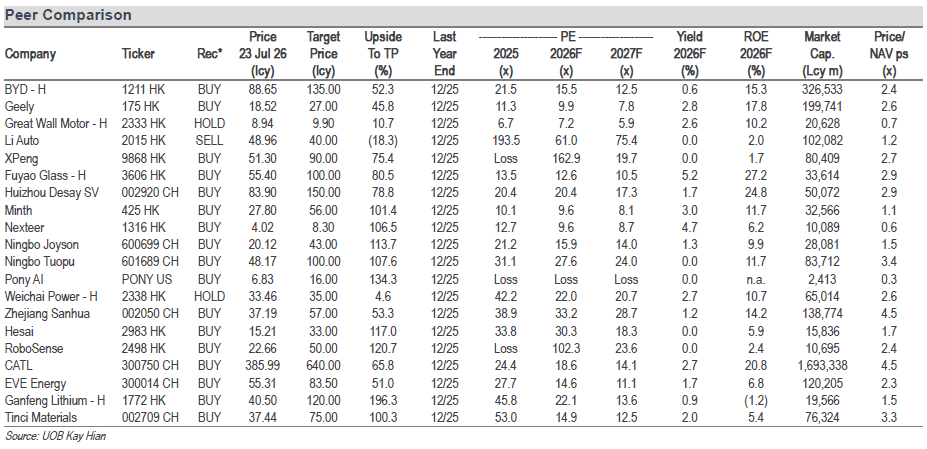
- Maintain MARKET WEIGHT. Top BUYs: CATL, BYD, Geely, Minth; SELL Li
Auto.
Analysis
- Policy: Three moves that have raised costs and compliance bar. Beijing has tightened the battery tax, and launched a system-wide safety and anti-price-war review of automakers. Meanwhile, Hainan has set the first provincial deadline to end ICE-car sales.
- Battery consumption tax ‒ an 11-year exemption ends. From 1 Sep 26, a 2% consumption tax will apply to lithium-ion batteries for EVs and energy storage, and this will rise to 4% in 2027, while sodium-ion and solid-state remain exempt through to 2028. This adds a cost line across the supply battery chain of electric vehicle (EV) and energy storage system (ESS). CATL should have stronger bargaining power to pass on the tax to auto OEMs, and BYD would be immune to the tax, as it makes batteries in-house. However, smaller battery manufacturers like EVE Energy and other auto OEMs would bear additional cost pressure. Geely produces one-third of the batteries it needs for EVs, and it will likely ramp up battery production going forward. Additionally, the tax will accelerate the development of sodium-ion batteries and solid-state batteries.
- Battery consumption tax ‒ an 11-year exemption ends. From 1 Sep 26, a 2% consumption tax will apply to lithium-ion batteries for EVs and energy storage, and this will rise to 4% in 2027, while sodium-ion and solid-state remain exempt through to 2028. This adds a cost line across the supply battery chain of electric vehicle (EV) and energy storage system (ESS). CATL should have stronger bargaining power to pass on the tax to auto OEMs, and BYD would be immune to the tax, as it makes batteries in-house. However, smaller battery manufacturers like EVE Energy and other auto OEMs would bear additional cost pressure. Geely produces one-third of the batteries it needs for EVs, and it will likely ramp up battery production going forward. Additionally, the tax will accelerate the development of sodium-ion batteries and solid-state batteries.
Highlights
- China ended its 11-year battery tax exemption – it will be implementing a 2% tax on lithium-ion cells from Sep 26, which will rise to 4% in 2027.
- MIIT has ordered production-consistency audits, tougher ADAS safety checks and an end to irrational competition, while Hainan will ban new ICE-car sales by 2030.
- Debuts have turned defensive: GWM cut Tank 300 hybrid prices and Li Auto
held the L6’s pricing. Meanwhile, XPeng's MONA L03 drew 20,000 orders.
- Maintain MARKET WEIGHT. Top BUYs: CATL, BYD, Geely, Minth; SELL Li
Auto.
Analysis
- Policy: Three moves that have raised costs and compliance bar. Beijing has tightened the battery tax, and launched a system-wide safety and anti-price-war review of automakers. Meanwhile, Hainan has set the first provincial deadline to end ICE-car sales.
- Battery consumption tax ‒ an 11-year exemption ends. From 1 Sep 26, a 2% consumption tax will apply to lithium-ion batteries for EVs and energy storage, and this will rise to 4% in 2027, while sodium-ion and solid-state remain exempt through to 2028. This adds a cost line across the supply battery chain of electric vehicle (EV) and energy storage system (ESS). CATL should have stronger bargaining power to pass on the tax to auto OEMs, and BYD would be immune to the tax, as it makes batteries in-house. However, smaller battery manufacturers like EVE Energy and other auto OEMs would bear additional cost pressure. Geely produces one-third of the batteries it needs for EVs, and it will likely ramp up battery production going forward. Additionally, the tax will accelerate the development of sodium-ion batteries and solid-state batteries.
- Battery consumption tax ‒ an 11-year exemption ends. From 1 Sep 26, a 2% consumption tax will apply to lithium-ion batteries for EVs and energy storage, and this will rise to 4% in 2027, while sodium-ion and solid-state remain exempt through to 2028. This adds a cost line across the supply battery chain of electric vehicle (EV) and energy storage system (ESS). CATL should have stronger bargaining power to pass on the tax to auto OEMs, and BYD would be immune to the tax, as it makes batteries in-house. However, smaller battery manufacturers like EVE Energy and other auto OEMs would bear additional cost pressure. Geely produces one-third of the batteries it needs for EVs, and it will likely ramp up battery production going forward. Additionally, the tax will accelerate the development of sodium-ion batteries and solid-state batteries.
IMPORTANT NOTICE - DISCLOSURES AND DISCLAIMERS
This report is provided subject to, and must be read together with, the full Disclosures / Disclaimers available at the following link: https://research-api.uobkayhian.com/assets/disclaimer/df64a6ea-7980-447c-ae9e-fd19b93257dc, which are incorporated by reference into this report. In particular, this report is intended for general circulation and informational purposes only and does not constitute personal investment advice or a recommendation to buy or sell any investment product or security. You should independently evaluate the information and, where necessary, seek advice from a qualified financial adviser regarding the suitability of any investment. Analyst certifications required under applicable regulations, including SEC Regulation AC (where relevant), are included in this report. By accessing, receiving or using this report, you acknowledge that you have read, understood and agreed to be bound by the Disclosures / Disclaimers, as may be amended, supplemented or updated from time to time.
Related articles

30 Sept 2026
China Property: First Central Mortgage Interest Subsidy From 1 Oct 26; Tier 1 Land Supply Up 12% mom In Sep 26

29 Sept 2026
Alibaba Group (9988 HK): APSARA Conference 2026 Key Takeaways

8 Oct 2026
Geely Auto (175 HK): Exports And New Technologies Offset Weak Domestic Sales
Our latest research
23 Oct 2026
TA: Lenovo Group (0992 HK) / WuXi Biologics (2269 HK)

23 Oct 2026
Han’s Laser (002008 CH): 3Q26: Strong Beat In IT Business

23 Oct 2026