

Analyst
Qi Wang, CFA
qi.wang@uobkh.comAnalyst
Elena Chen
elena.chen@uobkh.comAnalyst
In connection with UOBKH institutional research
Key China Market Indices
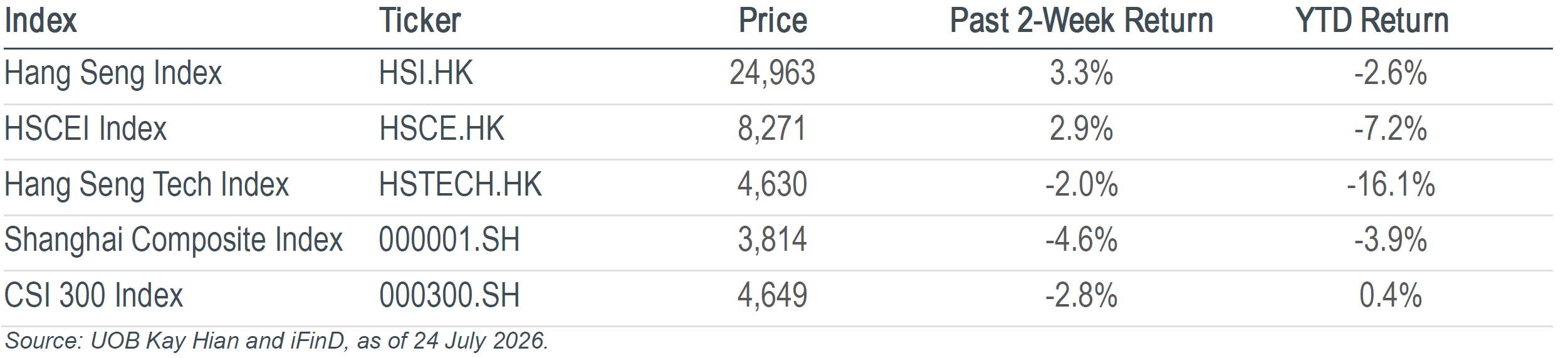
- A-shares: crowded trades meets a liquidity test. The Shanghai Composite and CSI 300 Indices fell 4.6% and 2.8% over the past two weeks, leaving them down 3.9% and up 0.4% YTD, respectively. The recent pullback was driven by caution ahead of large IPOs (e.g. CXMT) and profit-taking in crowded AI and semiconductor stocks, with a rotation into resources and banks. Because the selling was concentrated in prior growth winners rather than a broad-based correction, the movement appears more like a positioning reset than a macro capitulation.
- H-share resilience masks tech concerns. The Hang Seng Index and HSCEI gained 3.3% and 2.9%, respectively – supported by resources, financials and HKD 40 bn of Southbound net buying. In contrast, the Hang Seng Tech Index lost 2.0% as AI came under renewed scruinty over capex substantiality and monetization potential. All three indices remained below their end-2025 levels – down 2.6%, 7.2% and 16.1% YTD, respectively. This suggests a fragile recovery in Hong Kong still.
- AI narratives shifts from model capability to utilisation and returns. China's intelligent computing capacity reached 2,185 EFLOPS by end-June, +177% yoy, with rack utilisation at 71.4%. While capacity expansion and rapid model innovations continue to support AI’s long-term thesis, the ongoing weakness in the Hang Seng Information Technology suggests that benchmark performance and capacity growth alone are no longer sufficient. Investors are increasingly focused on utilisation, pricing power, customer willingness to pay and sustainable returns on AI capex.
- Policy expectations and IPO liquidity concerns. Markets expect the late-July Politburo meeting to priortise faster policy implementation and targeted support for domestic demand. Monetary conditions are expected to remain accommodative, with scope for rate cuts in 2H2026. CXMT (688825.SH) debuted 472% above its offer price today (27 Jul), generating RMB 122.1 bn in turnover by midday despite an initial free float of only 6.7%. Zhongji Innolight (3308.HK) is expected to list in Hong Kong on 30 July, with a final offer price of HK$980 per share and base proceeds of approximately HK$53.4 bn. While these IPOs may temporarily absorb market liquidity, particularly from smaller stocks, such effects are typically short-lived. We think fundamentals remain key, and macro pressures will continue to cap the Hong Kong market’s upside.
- Best-performing sectors: Materials (e.g. 2899.HK, 1378.HK, 2099.HK) +10.0%; Energy (e.g. 0883.HK, 0857.HK, 1088.HK) +8.6%; Financials (e.g. 0005.HK, 0939.HK, 1299.HK) +6.0%.
- Potential movers and shakers: Details inside.

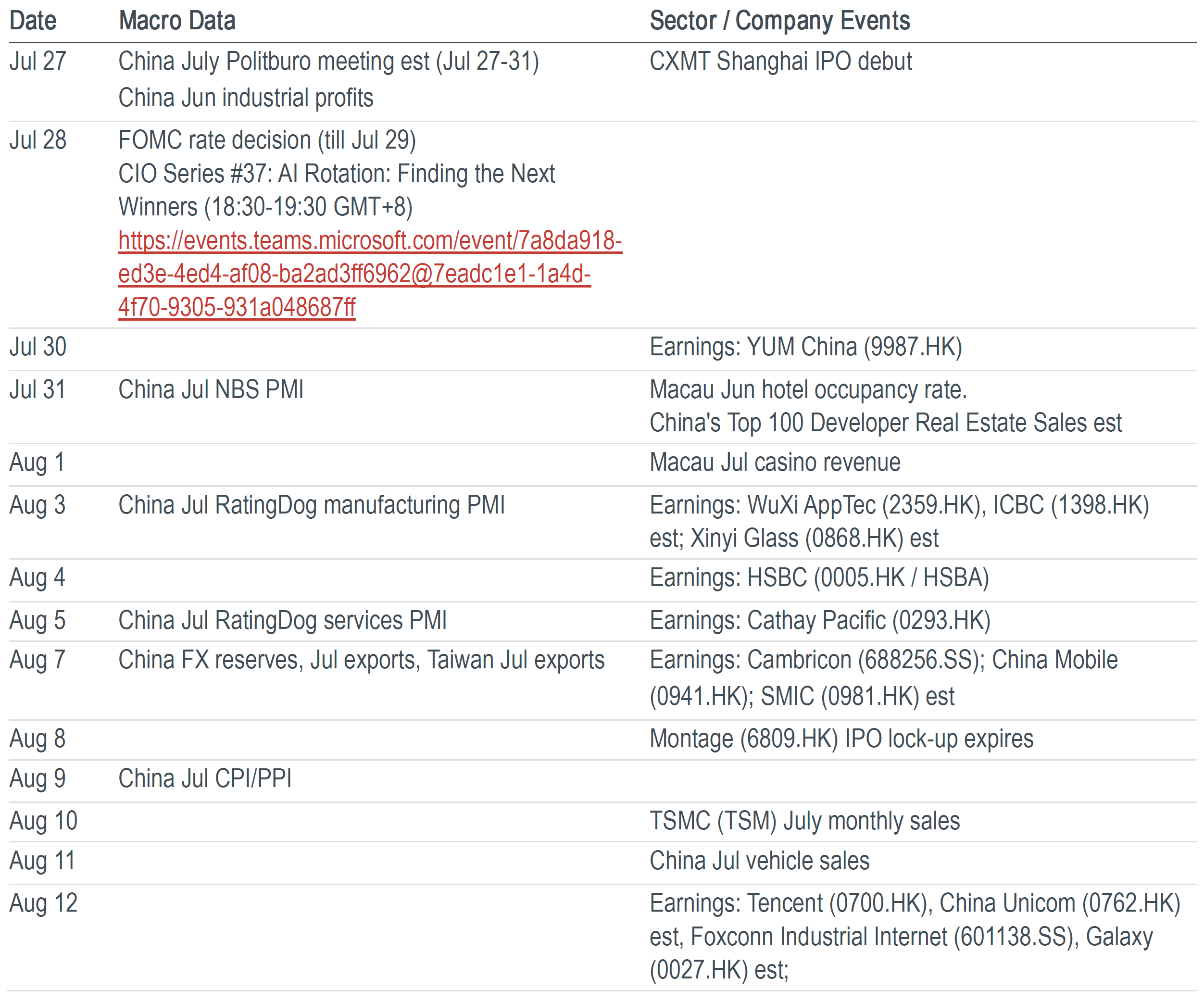
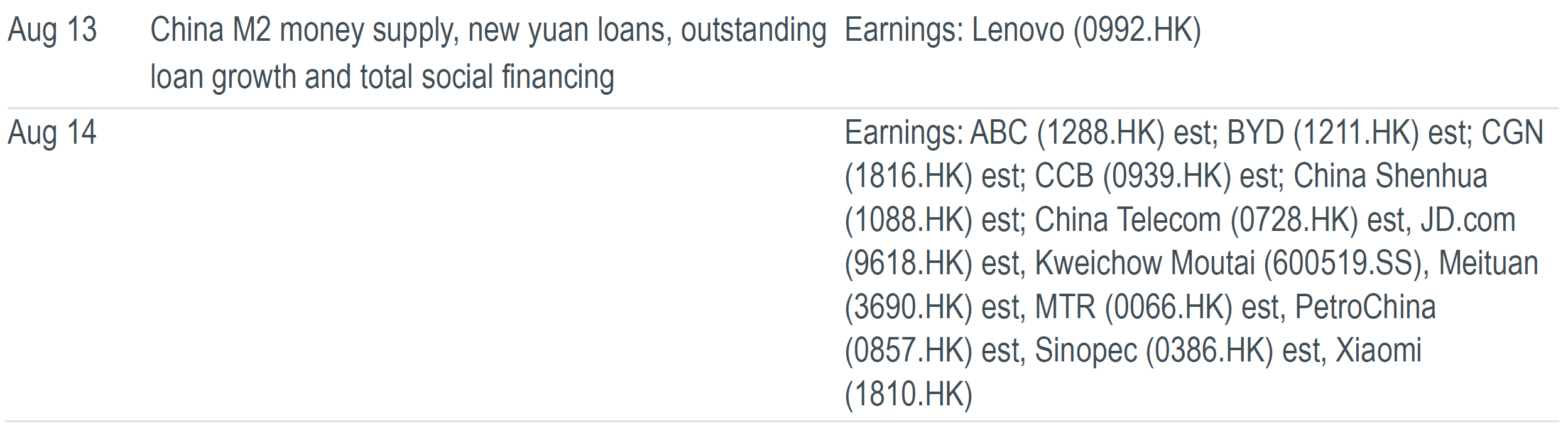
- Must-watch events: China July Politburo meeting est (Jul 27-31), China Jun industrial profits (Jul 27), FOMC Rate Decision (Jul 29-30), China Jul NBS PMI (Jul 31), Montage IPO lockup expires (Aug 8), China Jul CPI/PPI (Aug 9), TSMC July Monthly Sales (Aug 10). Earnings: HSBC (Aug 4), China Mobile (Aug 7), Tencent (Aug 12). PetroChina, ABC, Xiaomi & Kweichow Moutai (Aug 14). Details below.
Best 3 Hang Seng Sectors (Past 2 Weeks)
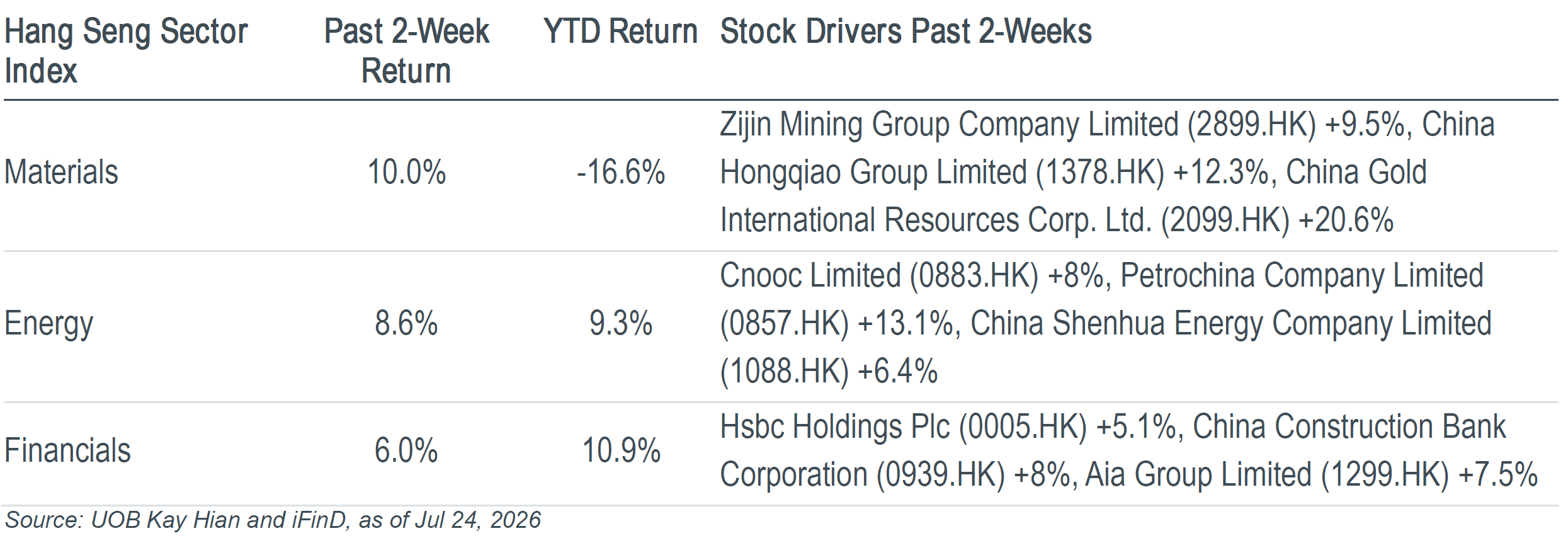
- Materials was the best-performing sector, rising 10.0% over the past two weeks. Safe-haven demand, global hunger for hard assets and renewed supply constraint concerns supported precious metals, copper and aluminum stocks. Despite the rebound, however, the sector remained down 16.6% YTD, suggesting a relief rally rather than a sustained recovery.
- Energy gained 8.6%, lifting its YTD return to 9.3%. Rising geopolitical tensions and shipping disruptions lifted crude oil's risk premium during the period, improving sentiment towards upstream energy producers such as CNNOC (0883.HK), PetroChina (0857.HK) and Shenhua (1088.HK).
- Financials rose 6.0% and remained the best-performing sector YTD with a 10.9% return. The advance reflected a rotation into relatively low-valuation, high-dividend banks and insurers, which is typical when the market lacks conviction in any growth themes.
Worst 3 Hang Seng Sectors (Past 2 Weeks)

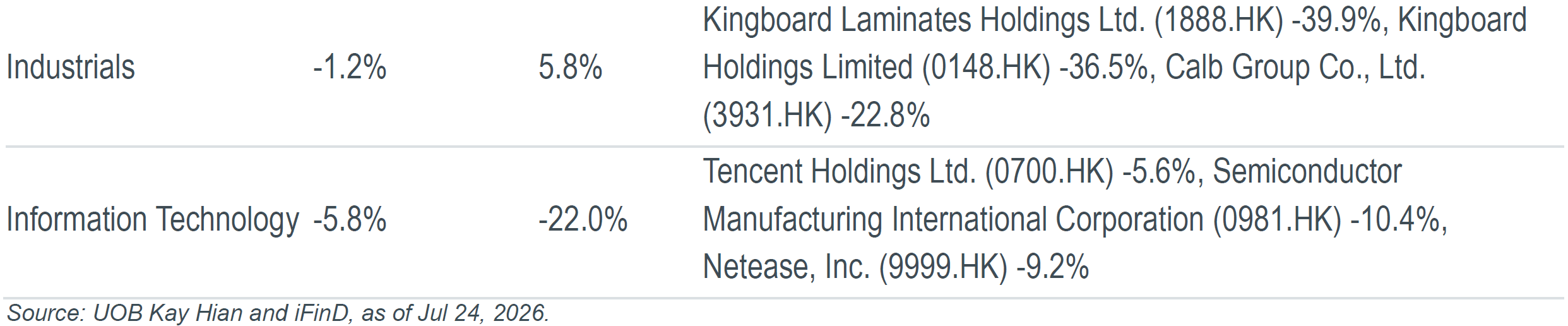
- Information Technology was the weakest sector, falling 5.8% and extending its YTD loss to 22.0%. The sell-off was concentrated in semiconductors and internet names following a crowded momentum rally. Profit-taking was exacerbated by renewed concerns over AI capex sustainability and monetization timing.
- Industrials declined 1.2%, with a sharp divergence beneath the surface. Kingboard Laminates (1888.HK) plunged 39.9%, parent Kingboard Holdings (0148.HK) fell 36.5%, and CALB (3931.HK) dropped 22.8%. The collapse reflected a sharp unwind in momentum across AI-driven PCB and battery supply chains. Despite the correction, the sector remained +5.8% YTD, highlighting continuing strong fundamentals.
- Consumer Discretionary gained 1.3% but still ranked as the third-weakest sector. Weakness in selected internet names capped the sector's advance: Baidu (9888.HK) fell 9.6%, Kuaishou (1024.HK) declined 2.2%, while Alibaba (9988.HK) was broadly flat. The mixed performance reflected continued softness in domestic consumption and concerns over Big Tech firms’ AI strategies.
Southbound Trading Summary (Past 2 Weeks)
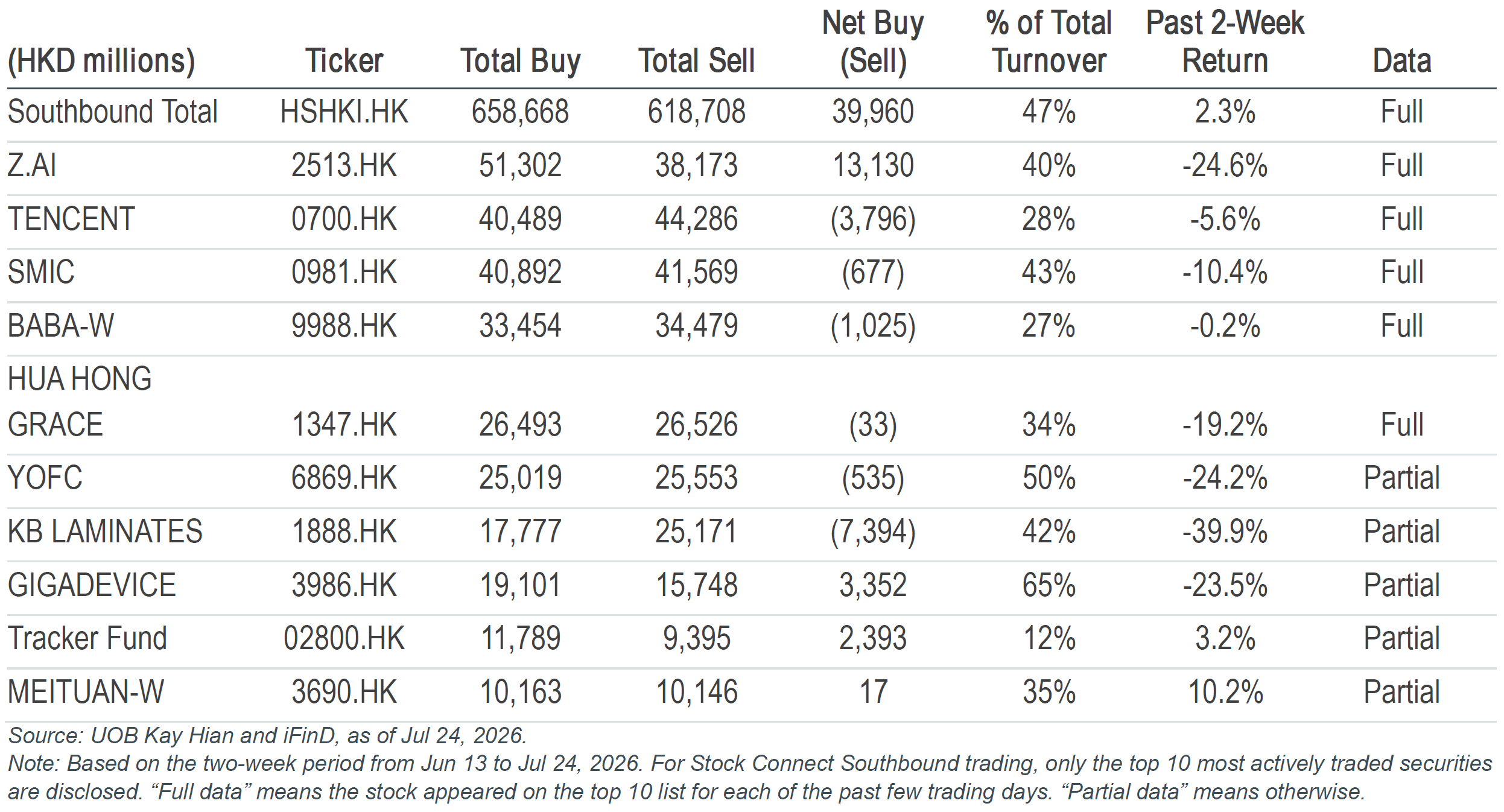
- Southbound trading recorded HKD 40.0 bn of net buying over the past two weeks. Gross purchases reached HKD 658.7 bn against gross sales of HKD 618.7 bn, with Southbound activity accounting for 47% of total market turnover. The inflow coincided with a 2.3% gain in the Hang Seng Stock Connect Hong Kong Index. However, the concentrated flows into a small number of stocks suggests this was not a broad-based risk-on move.
- AI-related names and selective dip-buying dominated inflows. Z.AI (2513.HK) attracted HKD 13.1 bn of net buying and GigaDevice (3986.HK) drew HKD 3.4 bn, despite share price declines of 24.6% and 23.5%, respectively. The Tracker Fund (2800.HK) also recorded HKD 2.4 bn of net inflows and rose 3.2%. The divergence between strong buying and weak share performance suggests investors were selectively accumulating AI names on weakness.
- Outflows centred on former momentum leaders and internet platforms. Kingboard Laminates recorded HKD 7.4 bn of net selling and fell 39.9%. Tencent (0700.HK) saw HKD 3.8 bn of net outflows, while Alibaba (9988.HK) recorded HKD 1.0 bn of net selling. SMIC (0981.HK), Hua Hong Semiconductor (1347.HK) and YOFC (6869.HK) also experienced net outflows, although their share-price declines were significantly larger than the flow data alone could explain.
Stocks: Potential Movers and Shakers
- ChangXin Memory Technology (CXMT) debuted on the Shanghai STAR Market. Its share price surge more than 500% with the market capitalisation briefly exceeding RMB 3.4 tn – astounding but still within the expected valuation range of RMB 3-5 tn.
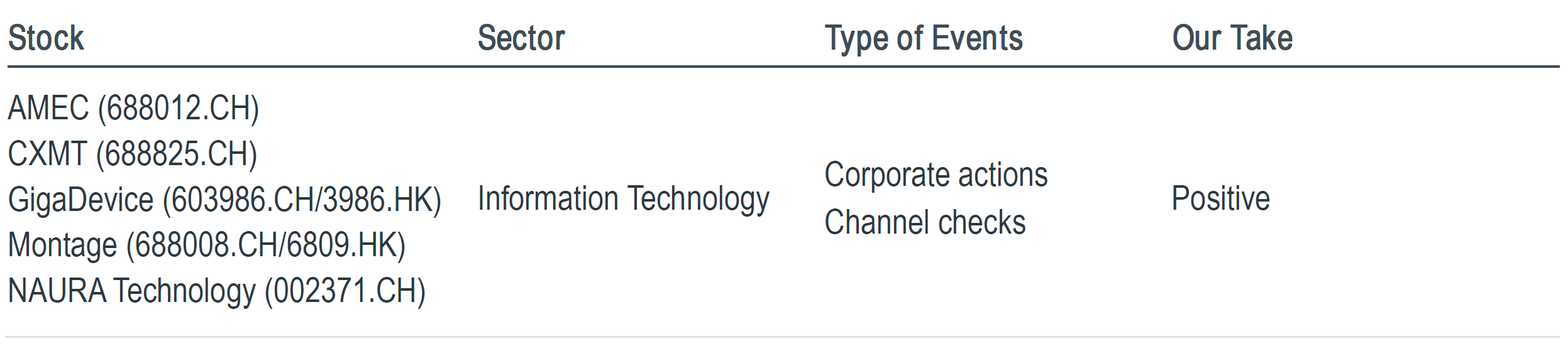
- We saw meaningful outflows from Chinese technology stocks, particularly those viewed as "CXMT proxies". We believe this reflects: (a) profit-taking in CXMT-related names after a strong two-month rally; and (b) capital being redeployed to the CXMT IPO itself, where the implied market valuation was more than 6x the IPO valuation.
- Valuations have become more attractive. The recent correction has created an opportunity to accumulate high-quality Chinese semiconductor names. Our preferred order is Montage (688008.CH / 6809.HK) > NAURA (002371.CH) > AMEC (688012.CH).
- We favour Montage for its dominant position in global memory interface chip market. We also like equipment makers NAURA and AMEC, which are well positioned to benefit from China's multi-year buildout of advanced logic and memory fabs, as well as the continued import substitution. (Johnny Yum)

- Anta brand outperformed full-year guidance in 1H2026. The Anta brand recorded low single-digit retail sales growth in 2Q2026 (vs high single-digit in 1Q2026). Retail sales grew at a mid-single-digit pace in 1H2026, ahead of the company's low single-digit full-year guidance. Offline sales for both Anta Core and Anta Kids recorded low single-digit growth, while online sales expanded at a low-teens rate.
- Fila remained on track. Fila recorded low single-digit retail sales growth in 2Q2026 (vs low-teens in 1Q2026). 1H2026 retail sales grew at a mid-single-digit pace, in line with the company's full-year guidance.
- Other brands maintained strong momentum. Retail sales for the group's other brands (excluding Jack Wolfskin) grew 25-30% in 2Q2026, with Descente, Kolon and Maia Active growing around 20%, more than 40% and more than 25%, respectively. For 1H2026, the segment delivered 35-40% growth, well ahead of the company's more than 20% full-year guidance.
- Management remains cautiously optimistic on 2H2026. Management maintained a conservative outlook despite expected tailwinds in 3Q2026, including a low base and the Mid-Autumn Festival falling within the quarter. Weather conditions and consumer confidence remain key swing factors. Nevertheless, management is confident of meeting its full-year retail sales guidance of low single-digit growth for the Anta brand, mid-single-digit growth for Fila and more than 20% growth for the other brands, which we view as conservative.
- Our View: Maintain BUY and raise the target price by 8% to HKD 107.90, as we increase 2026/27 earnings forecasts by 2%/4%, respectively. Our DCF-based target price implies 18.6x 2026F PE and 17.4x 2027F PE. (Stella Guo/Ejann Hiew)

- BYD's flagship model rollout gathered pace. The Da Tang EV, the Dynasty series' first D-segment SUV, reached its 10,000th delivery on 23 July, about one month after its launch on 17 June after receiving more than 150,000 pre-orders. Fang Cheng Bao's Tai 7 surpassed 200,000 cumulative sales in around 10 months (June: 23,710 units, +29.7% mom). BYD also unveiled the first design sketches of the Da Han flagship sedan, offering a 1,008-km range ahead of its public debut at the Chengdu Auto Show on 21 August.
- Overseas expansion remained strong. Chinese brands captured a record 34% of Europe's June plug-in hybrid electric vehicle (PHEV) deliveries and 11% of total new-car sales, according to Dataforce. BYD also launched the Denza brand in Europe and the UK with the Z9 GT, while its Brazil plant produced its 100,000th new energy vehicle (NEV). Growing contributions from premium models and overseas markets should support BYD’s average selling prices (ASP) and margins despite continued domestic price competition.
- Our View: We expect BYD's monthly sales to increase from more than 400,000 units in June to more than 500,000 units from September, with yoy growth accelerating to 25-30% from July as the Great Tang, Great Han and Seal 08 ramp up. Maintain BUY with a target price of HKD 135, pegged to 20x 2027F PE. (Ken Lee)

- Property sales continued to recover, while margin pressure eased. Contracted sales returned to growth in 1H2026, supported by higher average sales prices (ASP) and resilient demand in Tier-1 cities. We expect sales momentum to strengthen further in Jul-Aug 2026. Meanwhile, blended gross margin is expected to be around 16% in 1H2026, reflecting a slower yoy decline as higher-margin projects acquired during the market trough are progressively recognised. Land acquisitions remained conservative in 1H2026 due to limited supply and intense competition, but we expect investment activity to pick up in 2H2026.
- Investment property revaluation to weigh on earnings. Continued weakness in mainland office rents is likely to result in investment property revaluation losses in 1H2026. Excluding this non-cash impact, we expect core net profit to decline by low teens yoy, mainly due to lower property settlement revenue and margin compression. Strong contracted sales and disciplined land acquisitions should further reduce net gearing from the already low 34.3% as of Dec 2025.
- Our View: Maintain BUY with a target price of HKD 19.88. We cut our 2026/27/28 core net profit forecasts by 8.2%, 6.1% and 2.4%, respectively, reflecting a more conservative gross margin assumption for property development while maintaining our 13-15% development gross margin outlook. COLI remains our top pick, having outperformed the HSI in the month following results announcements in eight of the past 10 reporting seasons. (Damon Shen, Liu Jieqi)

- 2Q2026 results ahead of expectations despite weak VIP win rates. Sands China reported 2Q2026 adjusted property EBITDA of USD 430 mn (-32% qoq, -24% yoy). Adjusting for a normalised VIP win rate, property EBITDA would have been USD 517 mn (-16% qoq, -8% yoy) or 2% above market consensus. The normalised EBITDA margin fell to 26.7% (-2.9 ppt qoq, -4.6 ppt yoy), mainly due to higher operating costs from extended gaming hours, sales network expansion and service upgrades. Although exceptionally weak VIP luck led to a reduced gross gaming revenue (GGR) market share to 23.5% (-2.2 ppt qoq), gaming volumes grew across all segments.
- The Venetian renovation on track. Refurbishment of The Venetian's 2,900 rooms and suites, which began in March, remains on track for completion by Chinese New Year 2028. Sands China will also introduce new premium gaming salons and related amenities. Around 400 rooms were unavailable during 2Q2026, with management expecting 400-500 rooms to remain out of inventory each quarter through 2027
- Our View: Maintain BUY, while lowering the target price by 2% to HKD 20.30. We cut our 2026/27 EBITDA forecasts by 1%/3%, while maintaining our 2026 target EV/EBITDA multiple of 12.0x. (Stella Guo/Ejann Hiew)

- Development property (DP) remains a key drag. We expect DP settlement revenue and gross margin to decline further in 1H2026 due to weak industry-wide deliveries, lower-margin project settlements and higher impairment provisions. We estimate impairment charges to exceed RMB 2.0 bn in 1H2026. Recurring businesses, however, remain resilient, supported by double-digit tenant sales growth and a gain of more than RMB 5.0 bn from the Chengwan disposal.
- Preview for 1H2026 results. We expect 1H2026 net profit to remain broadly flat yoy, as resilient recurring income and the Chengwan disposal gain largely offset weakness in the DP business. Group gross margin should edge higher on an improved earnings mix, while net gearing and interim DPS are expected to remain broadly stable. We forecast FY2026 core earnings to decline by about 13% yoy.
- Our View: We cut our 2026/27/28 core net profit forecasts by 25.7%, 24.1% and 22.9%, respectively, to reflect a more conservative 12.0% DP gross margin assumption for 2026. We have lowered our SOTP-based target price to HKD 39.60 but maintain BUY, supported by resilient recurring earnings and an attractive 3.5% dividend yield. (Damon Shen, Liu Jieqi)

- 2Q2026 retail sell-through softened. Li Ning recorded a low single-digit yoy decline in retail sell-through in 2Q2026 (excluding Li Ning Young), which was below management's expectations due to weaker consumer demand and unfavourable weather. Including Li Ning Young, which recorded low-teen growth, total retail sell-through was broadly flat yoy.
- Higher pressure expected in 2H2026. Despite softer retail sell-through in 2Q2026 and subdued momentum in July, management maintained its full-year guidance of high single-digit revenue growth and a high single-digit net margin. Nevertheless, pressure is expected to increase in 2H2026 amid weaker gross margins and higher branding and sports-related investments, including the Asian Games, Stephen Curry partnership and the Xian Marathon.
- Our View: Maintain BUY but lower the target price by 6% to HKD 23.30. We cut our 2026/27 earnings forecasts by 3%/4%, respectively. Our DCF-based target price implies 18.3x 2026F PE and 17.0x 2027F PE. (Stella Guo/Ejann Hiew)

- Broadly breakeven bottom line in 1H2026. We expect recurring business revenue to grow by around 3% yoy, supported by resilient mall operations. Mall rental income is expected to rise about 9% yoy, tenant sales by around 16% yoy, while occupancy remains above 97%. Property management is also expected to return to low-single-digit growth after a weak 2025. However, this should be largely offset by continued weakness in the property development business, where booked gross margin is expected to deteriorate to around -10% in 1H2026 (vs -6.9% in 2025), reflecting weak contracted sales and a higher proportion of low-margin settlements.
- Debt reduction remains on track. Interest-bearing debt is expected to decline by more than RMB 5 bn in 1H2026, with funding costs falling below 3.5% as operating property loans replace shorter-dated bonds. Of the RMB 7.2 bn of debt maturing in 2026, RMB 2.6 bn has already been repaid. The remaining maturities are fully covered by refinancing, investment property loans and operating cash flow, suggesting manageable refinancing risk.
- Our View: Maintain BUY but lower the SOTP-based target price to HKD 10.12. We have cut our 2026/27/28 core net profit forecasts to RMB -3.0 bn, RMB 194 mn and RMB 1.4 bn (from RMB -1.5 bn/RMB 4.8 bn/RMB 5.2 bn) to reflect weaker property development gross margins due to softer contracted sales and larger booking losses. We also expect margin pressure to intensify in 2H2026 as settlement volumes rise and year-end destocking accelerates. Accordingly, we lower our SOTP-based target price by 7.6% to HKD 10.12, while maintaining BUY. (Damon Shen, Liu Jieqi)
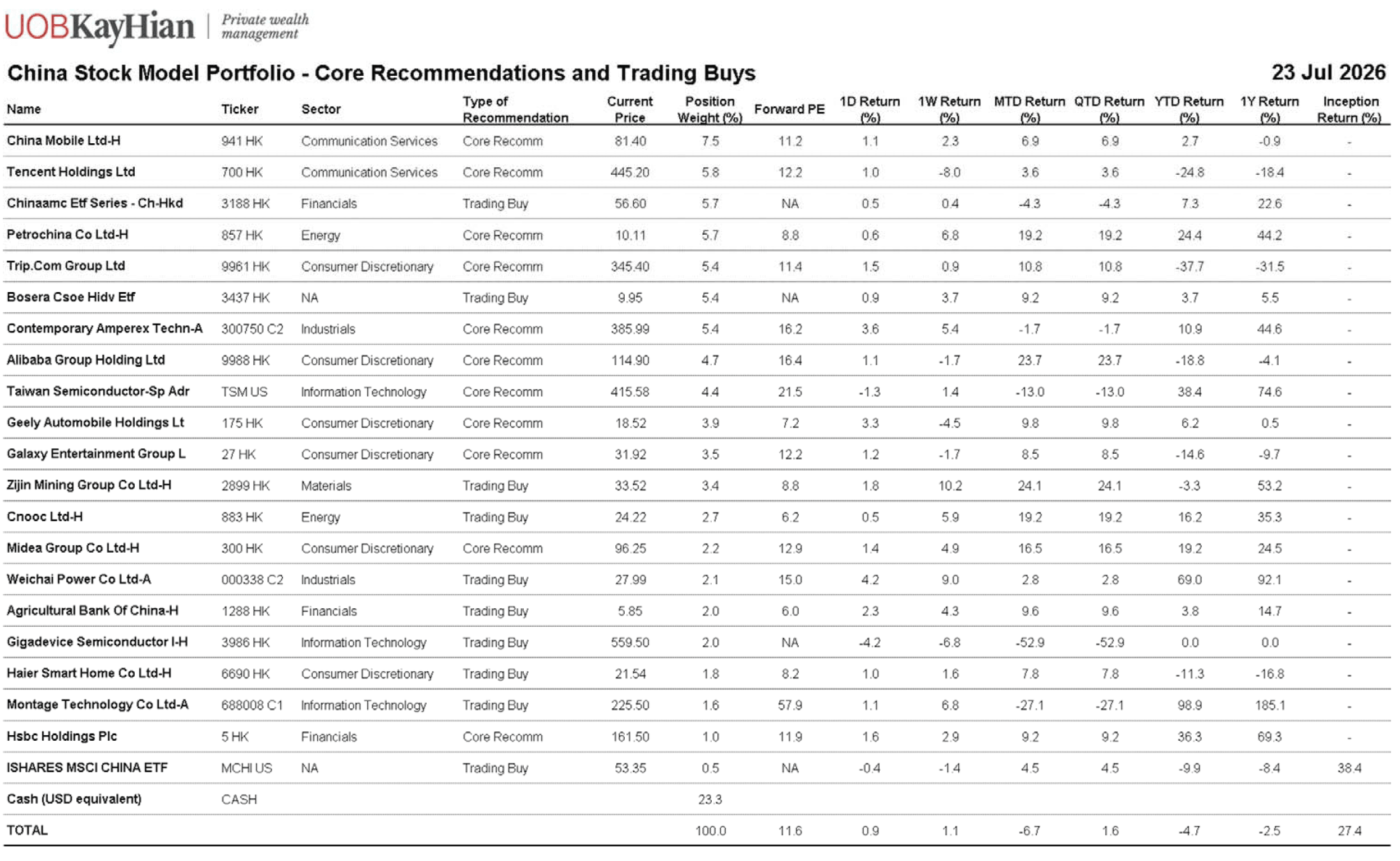
Appendix – China Stock Model Portfolio
Key China Market Indices
- A-shares: crowded trades meets a liquidity test. The Shanghai Composite and CSI 300 Indices fell 4.6% and 2.8% over the past two weeks, leaving them down 3.9% and up 0.4% YTD, respectively. The recent pullback was driven by caution ahead of large IPOs (e.g. CXMT) and profit-taking in crowded AI and semiconductor stocks, with a rotation into resources and banks. Because the selling was concentrated in prior growth winners rather than a broad-based correction, the movement appears more like a positioning reset than a macro capitulation.
- H-share resilience masks tech concerns. The Hang Seng Index and HSCEI gained 3.3% and 2.9%, respectively – supported by resources, financials and HKD 40 bn of Southbound net buying. In contrast, the Hang Seng Tech Index lost 2.0% as AI came under renewed scruinty over capex substantiality and monetization potential. All three indices remained below their end-2025 levels – down 2.6%, 7.2% and 16.1% YTD, respectively. This suggests a fragile recovery in Hong Kong still.
- AI narratives shifts from model capability to utilisation and returns. China's intelligent computing capacity reached 2,185 EFLOPS by end-June, +177% yoy, with rack utilisation at 71.4%. While capacity expansion and rapid model innovations continue to support AI’s long-term thesis, the ongoing weakness in the Hang Seng Information Technology suggests that benchmark performance and capacity growth alone are no longer sufficient. Investors are increasingly focused on utilisation, pricing power, customer willingness to pay and sustainable returns on AI capex.
- Policy expectations and IPO liquidity concerns. Markets expect the late-July Politburo meeting to priortise faster policy implementation and targeted support for domestic demand. Monetary conditions are expected to remain accommodative, with scope for rate cuts in 2H2026. CXMT (688825.SH) debuted 472% above its offer price today (27 Jul), generating RMB 122.1 bn in turnover by midday despite an initial free float of only 6.7%. Zhongji Innolight (3308.HK) is expected to list in Hong Kong on 30 July, with a final offer price of HK$980 per share and base proceeds of approximately HK$53.4 bn. While these IPOs may temporarily absorb market liquidity, particularly from smaller stocks, such effects are typically short-lived. We think fundamentals remain key, and macro pressures will continue to cap the Hong Kong market’s upside.
- Best-performing sectors: Materials (e.g. 2899.HK, 1378.HK, 2099.HK) +10.0%; Energy (e.g. 0883.HK, 0857.HK, 1088.HK) +8.6%; Financials (e.g. 0005.HK, 0939.HK, 1299.HK) +6.0%.
- Potential movers and shakers: Details inside.
- Must-watch events: China July Politburo meeting est (Jul 27-31), China Jun industrial profits (Jul 27), FOMC Rate Decision (Jul 29-30), China Jul NBS PMI (Jul 31), Montage IPO lockup expires (Aug 8), China Jul CPI/PPI (Aug 9), TSMC July Monthly Sales (Aug 10). Earnings: HSBC (Aug 4), China Mobile (Aug 7), Tencent (Aug 12). PetroChina, ABC, Xiaomi & Kweichow Moutai (Aug 14). Details below.
Best 3 Hang Seng Sectors (Past 2 Weeks)
- Materials was the best-performing sector, rising 10.0% over the past two weeks. Safe-haven demand, global hunger for hard assets and renewed supply constraint concerns supported precious metals, copper and aluminum stocks. Despite the rebound, however, the sector remained down 16.6% YTD, suggesting a relief rally rather than a sustained recovery.
- Energy gained 8.6%, lifting its YTD return to 9.3%. Rising geopolitical tensions and shipping disruptions lifted crude oil's risk premium during the period, improving sentiment towards upstream energy producers such as CNNOC (0883.HK), PetroChina (0857.HK) and Shenhua (1088.HK).
- Financials rose 6.0% and remained the best-performing sector YTD with a 10.9% return. The advance reflected a rotation into relatively low-valuation, high-dividend banks and insurers, which is typical when the market lacks conviction in any growth themes.
Worst 3 Hang Seng Sectors (Past 2 Weeks)
- Information Technology was the weakest sector, falling 5.8% and extending its YTD loss to 22.0%. The sell-off was concentrated in semiconductors and internet names following a crowded momentum rally. Profit-taking was exacerbated by renewed concerns over AI capex sustainability and monetization timing.
- Industrials declined 1.2%, with a sharp divergence beneath the surface. Kingboard Laminates (1888.HK) plunged 39.9%, parent Kingboard Holdings (0148.HK) fell 36.5%, and CALB (3931.HK) dropped 22.8%. The collapse reflected a sharp unwind in momentum across AI-driven PCB and battery supply chains. Despite the correction, the sector remained +5.8% YTD, highlighting continuing strong fundamentals.
- Consumer Discretionary gained 1.3% but still ranked as the third-weakest sector. Weakness in selected internet names capped the sector's advance: Baidu (9888.HK) fell 9.6%, Kuaishou (1024.HK) declined 2.2%, while Alibaba (9988.HK) was broadly flat. The mixed performance reflected continued softness in domestic consumption and concerns over Big Tech firms’ AI strategies.
Southbound Trading Summary (Past 2 Weeks)
- Southbound trading recorded HKD 40.0 bn of net buying over the past two weeks. Gross purchases reached HKD 658.7 bn against gross sales of HKD 618.7 bn, with Southbound activity accounting for 47% of total market turnover. The inflow coincided with a 2.3% gain in the Hang Seng Stock Connect Hong Kong Index. However, the concentrated flows into a small number of stocks suggests this was not a broad-based risk-on move.
- AI-related names and selective dip-buying dominated inflows. Z.AI (2513.HK) attracted HKD 13.1 bn of net buying and GigaDevice (3986.HK) drew HKD 3.4 bn, despite share price declines of 24.6% and 23.5%, respectively. The Tracker Fund (2800.HK) also recorded HKD 2.4 bn of net inflows and rose 3.2%. The divergence between strong buying and weak share performance suggests investors were selectively accumulating AI names on weakness.
- Outflows centred on former momentum leaders and internet platforms. Kingboard Laminates recorded HKD 7.4 bn of net selling and fell 39.9%. Tencent (0700.HK) saw HKD 3.8 bn of net outflows, while Alibaba (9988.HK) recorded HKD 1.0 bn of net selling. SMIC (0981.HK), Hua Hong Semiconductor (1347.HK) and YOFC (6869.HK) also experienced net outflows, although their share-price declines were significantly larger than the flow data alone could explain.
Stocks: Potential Movers and Shakers
- ChangXin Memory Technology (CXMT) debuted on the Shanghai STAR Market. Its share price surge more than 500% with the market capitalisation briefly exceeding RMB 3.4 tn – astounding but still within the expected valuation range of RMB 3-5 tn.
- We saw meaningful outflows from Chinese technology stocks, particularly those viewed as "CXMT proxies". We believe this reflects: (a) profit-taking in CXMT-related names after a strong two-month rally; and (b) capital being redeployed to the CXMT IPO itself, where the implied market valuation was more than 6x the IPO valuation.
- Valuations have become more attractive. The recent correction has created an opportunity to accumulate high-quality Chinese semiconductor names. Our preferred order is Montage (688008.CH / 6809.HK) > NAURA (002371.CH) > AMEC (688012.CH).
- We favour Montage for its dominant position in global memory interface chip market. We also like equipment makers NAURA and AMEC, which are well positioned to benefit from China's multi-year buildout of advanced logic and memory fabs, as well as the continued import substitution. (Johnny Yum)
- Anta brand outperformed full-year guidance in 1H2026. The Anta brand recorded low single-digit retail sales growth in 2Q2026 (vs high single-digit in 1Q2026). Retail sales grew at a mid-single-digit pace in 1H2026, ahead of the company's low single-digit full-year guidance. Offline sales for both Anta Core and Anta Kids recorded low single-digit growth, while online sales expanded at a low-teens rate.
- Fila remained on track. Fila recorded low single-digit retail sales growth in 2Q2026 (vs low-teens in 1Q2026). 1H2026 retail sales grew at a mid-single-digit pace, in line with the company's full-year guidance.
- Other brands maintained strong momentum. Retail sales for the group's other brands (excluding Jack Wolfskin) grew 25-30% in 2Q2026, with Descente, Kolon and Maia Active growing around 20%, more than 40% and more than 25%, respectively. For 1H2026, the segment delivered 35-40% growth, well ahead of the company's more than 20% full-year guidance.
- Management remains cautiously optimistic on 2H2026. Management maintained a conservative outlook despite expected tailwinds in 3Q2026, including a low base and the Mid-Autumn Festival falling within the quarter. Weather conditions and consumer confidence remain key swing factors. Nevertheless, management is confident of meeting its full-year retail sales guidance of low single-digit growth for the Anta brand, mid-single-digit growth for Fila and more than 20% growth for the other brands, which we view as conservative.
- Our View: Maintain BUY and raise the target price by 8% to HKD 107.90, as we increase 2026/27 earnings forecasts by 2%/4%, respectively. Our DCF-based target price implies 18.6x 2026F PE and 17.4x 2027F PE. (Stella Guo/Ejann Hiew)
- BYD's flagship model rollout gathered pace. The Da Tang EV, the Dynasty series' first D-segment SUV, reached its 10,000th delivery on 23 July, about one month after its launch on 17 June after receiving more than 150,000 pre-orders. Fang Cheng Bao's Tai 7 surpassed 200,000 cumulative sales in around 10 months (June: 23,710 units, +29.7% mom). BYD also unveiled the first design sketches of the Da Han flagship sedan, offering a 1,008-km range ahead of its public debut at the Chengdu Auto Show on 21 August.
- Overseas expansion remained strong. Chinese brands captured a record 34% of Europe's June plug-in hybrid electric vehicle (PHEV) deliveries and 11% of total new-car sales, according to Dataforce. BYD also launched the Denza brand in Europe and the UK with the Z9 GT, while its Brazil plant produced its 100,000th new energy vehicle (NEV). Growing contributions from premium models and overseas markets should support BYD’s average selling prices (ASP) and margins despite continued domestic price competition.
- Our View: We expect BYD's monthly sales to increase from more than 400,000 units in June to more than 500,000 units from September, with yoy growth accelerating to 25-30% from July as the Great Tang, Great Han and Seal 08 ramp up. Maintain BUY with a target price of HKD 135, pegged to 20x 2027F PE. (Ken Lee)
- Property sales continued to recover, while margin pressure eased. Contracted sales returned to growth in 1H2026, supported by higher average sales prices (ASP) and resilient demand in Tier-1 cities. We expect sales momentum to strengthen further in Jul-Aug 2026. Meanwhile, blended gross margin is expected to be around 16% in 1H2026, reflecting a slower yoy decline as higher-margin projects acquired during the market trough are progressively recognised. Land acquisitions remained conservative in 1H2026 due to limited supply and intense competition, but we expect investment activity to pick up in 2H2026.
- Investment property revaluation to weigh on earnings. Continued weakness in mainland office rents is likely to result in investment property revaluation losses in 1H2026. Excluding this non-cash impact, we expect core net profit to decline by low teens yoy, mainly due to lower property settlement revenue and margin compression. Strong contracted sales and disciplined land acquisitions should further reduce net gearing from the already low 34.3% as of Dec 2025.
- Our View: Maintain BUY with a target price of HKD 19.88. We cut our 2026/27/28 core net profit forecasts by 8.2%, 6.1% and 2.4%, respectively, reflecting a more conservative gross margin assumption for property development while maintaining our 13-15% development gross margin outlook. COLI remains our top pick, having outperformed the HSI in the month following results announcements in eight of the past 10 reporting seasons. (Damon Shen, Liu Jieqi)
- 2Q2026 results ahead of expectations despite weak VIP win rates. Sands China reported 2Q2026 adjusted property EBITDA of USD 430 mn (-32% qoq, -24% yoy). Adjusting for a normalised VIP win rate, property EBITDA would have been USD 517 mn (-16% qoq, -8% yoy) or 2% above market consensus. The normalised EBITDA margin fell to 26.7% (-2.9 ppt qoq, -4.6 ppt yoy), mainly due to higher operating costs from extended gaming hours, sales network expansion and service upgrades. Although exceptionally weak VIP luck led to a reduced gross gaming revenue (GGR) market share to 23.5% (-2.2 ppt qoq), gaming volumes grew across all segments.
- The Venetian renovation on track. Refurbishment of The Venetian's 2,900 rooms and suites, which began in March, remains on track for completion by Chinese New Year 2028. Sands China will also introduce new premium gaming salons and related amenities. Around 400 rooms were unavailable during 2Q2026, with management expecting 400-500 rooms to remain out of inventory each quarter through 2027
- Our View: Maintain BUY, while lowering the target price by 2% to HKD 20.30. We cut our 2026/27 EBITDA forecasts by 1%/3%, while maintaining our 2026 target EV/EBITDA multiple of 12.0x. (Stella Guo/Ejann Hiew)
- Development property (DP) remains a key drag. We expect DP settlement revenue and gross margin to decline further in 1H2026 due to weak industry-wide deliveries, lower-margin project settlements and higher impairment provisions. We estimate impairment charges to exceed RMB 2.0 bn in 1H2026. Recurring businesses, however, remain resilient, supported by double-digit tenant sales growth and a gain of more than RMB 5.0 bn from the Chengwan disposal.
- Preview for 1H2026 results. We expect 1H2026 net profit to remain broadly flat yoy, as resilient recurring income and the Chengwan disposal gain largely offset weakness in the DP business. Group gross margin should edge higher on an improved earnings mix, while net gearing and interim DPS are expected to remain broadly stable. We forecast FY2026 core earnings to decline by about 13% yoy.
- Our View: We cut our 2026/27/28 core net profit forecasts by 25.7%, 24.1% and 22.9%, respectively, to reflect a more conservative 12.0% DP gross margin assumption for 2026. We have lowered our SOTP-based target price to HKD 39.60 but maintain BUY, supported by resilient recurring earnings and an attractive 3.5% dividend yield. (Damon Shen, Liu Jieqi)
- 2Q2026 retail sell-through softened. Li Ning recorded a low single-digit yoy decline in retail sell-through in 2Q2026 (excluding Li Ning Young), which was below management's expectations due to weaker consumer demand and unfavourable weather. Including Li Ning Young, which recorded low-teen growth, total retail sell-through was broadly flat yoy.
- Higher pressure expected in 2H2026. Despite softer retail sell-through in 2Q2026 and subdued momentum in July, management maintained its full-year guidance of high single-digit revenue growth and a high single-digit net margin. Nevertheless, pressure is expected to increase in 2H2026 amid weaker gross margins and higher branding and sports-related investments, including the Asian Games, Stephen Curry partnership and the Xian Marathon.
- Our View: Maintain BUY but lower the target price by 6% to HKD 23.30. We cut our 2026/27 earnings forecasts by 3%/4%, respectively. Our DCF-based target price implies 18.3x 2026F PE and 17.0x 2027F PE. (Stella Guo/Ejann Hiew)
- Broadly breakeven bottom line in 1H2026. We expect recurring business revenue to grow by around 3% yoy, supported by resilient mall operations. Mall rental income is expected to rise about 9% yoy, tenant sales by around 16% yoy, while occupancy remains above 97%. Property management is also expected to return to low-single-digit growth after a weak 2025. However, this should be largely offset by continued weakness in the property development business, where booked gross margin is expected to deteriorate to around -10% in 1H2026 (vs -6.9% in 2025), reflecting weak contracted sales and a higher proportion of low-margin settlements.
- Debt reduction remains on track. Interest-bearing debt is expected to decline by more than RMB 5 bn in 1H2026, with funding costs falling below 3.5% as operating property loans replace shorter-dated bonds. Of the RMB 7.2 bn of debt maturing in 2026, RMB 2.6 bn has already been repaid. The remaining maturities are fully covered by refinancing, investment property loans and operating cash flow, suggesting manageable refinancing risk.
- Our View: Maintain BUY but lower the SOTP-based target price to HKD 10.12. We have cut our 2026/27/28 core net profit forecasts to RMB -3.0 bn, RMB 194 mn and RMB 1.4 bn (from RMB -1.5 bn/RMB 4.8 bn/RMB 5.2 bn) to reflect weaker property development gross margins due to softer contracted sales and larger booking losses. We also expect margin pressure to intensify in 2H2026 as settlement volumes rise and year-end destocking accelerates. Accordingly, we lower our SOTP-based target price by 7.6% to HKD 10.12, while maintaining BUY. (Damon Shen, Liu Jieqi)
Appendix – China Stock Model Portfolio
Analyst
Qi Wang, CFA
qi.wang@uobkh.comAnalyst
Elena Chen
elena.chen@uobkh.comAnalyst
In connection with UOBKH institutional research
Disclosures and disclaimers
This report is provided subject to, and must be read together with, the full Disclosures / Disclaimers available at the following link: https://research-api.uobkayhian.com/assets/disclaimer/b2112181-0bf2-4c07-af37-3d7129735e61, which are incorporated by reference into this report. In particular, this report is intended for general circulation and informational purposes only and does not constitute personal investment advice or a recommendation to buy or sell any investment product or security. You should independently evaluate the information and, where necessary, seek advice from a qualified financial adviser regarding the suitability of any investment. Analyst certifications required under applicable regulations, including SEC Regulation AC (where relevant), are included in this report. By accessing, receiving or using this report, you acknowledge that you have read, understood and agreed to be bound by the Disclosures / Disclaimers, as may be amended, supplemented or updated from time to time.


