

China Bi-Weekly
Selectivity Remains Key in a Challenging Macro Environment
Analyst
Elena Chen
elena.chen@uobkh.comAnalyst
Qi Wang, CFA
qi.wang@uobkh.comAnalyst
In collaboration with UOBKH Institutional Research
Key China Market Indices
Index | Price | Past 2-Week Return | YTD Return |
Hang Seng Index | 23,972 | -3.1% | -6.5% |
HSCEI Index | 8,031 | -2.4% | -9.9% |
Hang Seng Tech Index | 4,158 | -5.6% | -24.6% |
Shanghai Composite Index | 3,842 | -1.8% | -3.2% |
CSI 300 Index | 4,358 | -3.3% | -5.9% |
Source: UOB Kay Hian and iFinD, as of Oct 2, 2026
China’s Growing Pains continue amid limited policy support. Top 100 real estate developer sales (new home sales) declined 9.2% yoy in September and dropped 11.8% in January-September 2026 (source: CRIC). This marks the sixth consecutive down year since 2021, and does not bode well for the macro data due later this month, especially retail sales and fixed asset investment. Meanwhile, China’s stimulus remains limited. The recent mortgage subsidies could help, but amount to just RMB 833 (USD 116) in monthly savings for eligible households. Investors are right to be disappointed, in other words.
Higher US interest rates are also hitting Hong Kong. Fed rate hikes and rising long-term bond yields are also weighing on the Hong Kong market, largely because HKD is pegged to USD. The impact has been most pronounced in Financials and Materials, which fell 4.6% and 8.4%, respectively, in the last two weeks (see below).
Domestic challenges and external headwinds call for greater selectivity. A near-term easing of both internal and external pressures appears unlikely. This means investors cannot count on a broad-based recovery to lift all boards, making stock selection more important than ever. We continue to favor high-quality companies under our China Export Shock 2.0 and China Maxxing themes. Watch the replay of our latest CIO Series to learn more.
Investors are overly bearish on Big Tech. The Hang Seng Tech Index declined 5.6% over the past two weeks and lost nearly one quarter of its value YTD. Fundamentals remain solid for Chinese platform leaders, while valuations are at historical lows. For companies such as Tencent (0700.HK), we see increasingly attractive long-term investment opportunities at current valuations (13x forward PE). We view Tencent as a leading AI practitioner (similar to Meta), not an AI laggard. This remains our Core Recommendation.
Best-performing sectors: Health Care +2.4% (e.g. 9926.HK, 2269.HK); Real Estate 0.0% (e.g. 1109.HK, 0688.HK); Utilities -0.5% (e.g. 0902.HK, 0836.HK).
Potential movers and shakers: Details inside.
Positive | CATL (300750 CH), Geely (175 HK), COLI (0688.HK), CR Mixc (1209.HK) |
Neutral | GGalaxy Entertainment (27 HK), Sands China (1928 HK), COLI (0688.HK), CR Land (1109.HK), Longfor (0960.HK) |
Negative | N/A |
Must Watch Events: Details below.
Date | Macro Data | Sector / Company Events |
Oct 7 | Foreign Reserves |
|
Oct 9-15 | Money Supply M2, M1, M0 |
|
Oct 8 |
| TSMC September sales |
Oct 14 | China Sep exports/imports and CPI/PPI; US Sep CPI |
|
Oct 15 |
| TSMC 3Q2026 results |
Oct 19 | GDP, retail sales, industrial production |
|
Best 3 Hang Seng Sectors (Past 2 Weeks)
Hang Seng Sector Index | Past 2-Week Return | YTD Return | Stock Drivers Past 2-Weeks |
Health Care | 2.4% | 6.5% | Akeso, Inc. (9926.HK) +18%, WuXi Biologics (Cayman) Inc. (2269.HK) +8.3%, CSPC Pharmaceutical Group Limited (1093.HK) +11.2% |
Real Estate | 0.0% | -3.4% | China Resources Land Ltd. (1109.HK) +2.7%, China Overseas Land & Investment Ltd. (0688.HK) +4.8%, C&D International Investment Group Limited (1908.HK) +8.7% |
Utilities | -0.5% | -1.7% | Huaneng Power International, Inc. (0902.HK) +6.7%, China Resources Power Holdings Co. Ltd. (0836.HK) +2.9%, CGN Power Co.,Ltd. (1816.HK) +2.2% |
Source: UOB Kay Hian and iFinD, as of Oct 2, 2026
Health Care led with a 2.4% two-week gain, lifting its YTD return to +6.5%. Akeso surged 18.0%, WuXi Biologics rose 8.3% and CSPC Pharmaceutical gained 11.2%. On Sep 28, AstraZeneca announced a USD 2bn investment in Akeso’s partner, Summit Therapeutics, to co-develop Ivonescimab combinations. We view the deal as a catalyst for faster global development of Akeso-originated Ivonescimab, even though the investment amount goes to Summit, not Akeso.
Real Estate was flat over two weeks, leaving its YTD decline at 3.4%. China Resources Land +2.7%, China Overseas Land & Investment +4.8% and C&D International +8.7%. China announced targeted mortgage interest subsidies on Sep 29, providing relief to eligible homeowners and serving while offering a modest demand catalyst. China likely needs a bigger stimulus to revive its struggling property market.
Utilities fell 0.5% over two weeks, outperforming the market yet extending its YTD decline to 1.7%. Huaneng Power +6.7%, China Resources Power +2.9% and CGN Power +2.2%. Regulated or contracted cash flows offer relative shelter during the recent sell-off, but generation mix determines earnings risk. Coal-fired operators are sensitive to fuel costs and tariffs, while nuclear operators depend more on utilization and project execution. Rising interest rates are also unfavorable for utility stocks as dividend plays.
Worst 3 Hang Seng Sectors (Past 2 Weeks)
Hang Seng Sector Index | Past 2-Week Return | YTD Return | Stock Drivers Past 2-Weeks |
Consumer Discretionary | -4.3% | -26.6% | Alibaba Group Holding Limited (9988.HK) -4.5%, BYD Company Limited (1211.HK) -9.3%, Meituan (3690.HK) -4.1% |
Financials | -4.6% | 8.2% | HSBC Holdings Plc (0005.HK) -7.5%, AIA Group Limited (1299.HK) -9.8%, Hong Kong Exchanges And Clearing Ltd. (0388.HK) -3.1% |
Materials | -8.4% | -18.4% | Zijin Mining Group Company Limited (2899.HK) -7.1%, China Gold International Resources Corp. Ltd. (2099.HK) -13.5%, Zijin Gold International Company Limited (2259.HK) -10.2% |
Source: UOB Kay Hian and iFinD, as of Oct 2, 2026
Consumer Discretionary fell 4.3% over two weeks, extending its YTD decline to 26.6%. BYD lost 9.3% and Meituan dropped 4.1%, while Alibaba was also among the losers despite its robust cloud compute business. As discussed earlier, China’s stimulus remains limited in scale and is unlikely to provide a meaningful boost to consumption.
Financials fell 4.6% over two weeks, lowering its YTD gain to 8.2%. HSBC lost 7.5%, AIA dropped 9.8% and HKEX declined 3.1%. September’s official survey showed expansion in monetary financial services and insurance, while capital-market services remained in contraction.
Materials was the worst-performing sector, down 8.4% over two weeks and down 18.4% YTD. Zijin Mining lost 7.1%, China Gold International dropped 13.5% and Zijin Gold International declined 10.2%. Higher US real yields and a stronger dollar weighed on gold, raising the short-term opportunity cost of holding gold and pressuring spot prices. However, gold remains a long-term beneficiary of de-dollarization and persistent geopolitical risk. We continue to like gold as our Core Recommend mention and favor Zijin as a Trading Buy.
Southbound Trading Summary (Past 2 Weeks)
(HKD millions) | Ticker | Total Buy | Total Sell | Net Buy (Sell) | % of Total Turnover | Past 2-Week Return | Data |
Southbound Total | HSHKI.HK | 290,451 | 267,015 | 23,436 | 34% | -3.1% | Full |
TENCENT | 0700.HK | 20,020 | 17,921 | 2,099 | 23% | 0.5% | Full |
Z.AI | 2513.HK | 14,015 | 13,217 | 798 | 41% | -19.7% | Full |
YOFC | 6869.HK | 11,339 | 11,437 | (99) | 44% | -4.3% | Partial |
BABA-W | 9988.HK | 9,504 | 8,749 | 754 | 20% | -4.5% | Partial |
KB LAMINATES | 1888.HK | 8,194 | 9,225 | (1,031) | 37% | 4.9% | Partial |
SMIC | 0981.HK | 5,965 | 9,250 | (3,286) | 41% | -7.5% | Full |
MINIMAX-W | 0100.HK | 6,097 | 5,648 | 448 | 40% | -19.9% | Partial |
Tracker Fund | 02800.HK | 3,977 | 2,185 | 1,791 | 10% | -3.2% | Partial |
XIAOMI-W | 1810.HK | 2,987 | 2,612 | 375 | 23% | -8.2% | Partial |
CNOOC | 0883.HK | 3,162 | 2,436 | 726 | 51% | -0.3% | Partial |
Source: UOB Kay Hian and iFinD, as of Oct 2, 2026.
Note: Based on the two-week period from Sep 21 to Oct 2, 2026. For Stock Connect Southbound trading, only the top 10 most actively traded securities are disclosed. “Full data” means the stock appeared on the top 10 list for each of the past few trading days. “Partial data” means otherwise.
Southbound investors increased Hong Kong exposure amid correction. Southbound turnover totaled HKD 557.47bn, comprising HKD 290.45bn of purchases and HKD 267.02bn of sales, resulting in a net buying of HKD 23.44bn. Mainland Chinese investors have been buying on dips as the Hang Seng Index undergoes correction.
Buying spanned resilient platforms, AI stocks and broad market exposure. Tencent attracted HKD 2.10bn of net buying and gained 0.5%, supported by Chinese investors. Z.AI and MiniMax saw net inflows of HKD 0.80bn and HKD 0.45bn, respectively, but each fell nearly 20%, suggesting immense selling pressures still. Tracker Fund attracted HKD 1.79bn and CNOOC received HKD 0.73bn, showing that purchases are extending to the broad market and energy.
- Hardware outflows accompanied both falling and rising share prices. SMIC recorded HKD 3.29bn of net selling and fell 7.5%, while YOFC saw HKD 0.10bn of net outflows and declined 4.3%. Kingboard Laminates, by contrast, gained 4.9% despite HKD 1.03bn of net selling. All three stocks are AI-driven, yet the divergence in performance highlights increasing selectivity within technology.
Stocks: Potential Movers and Shakers
Stock | Sector | Type of Events | Our Take |
CATL (300750 CH) | New Energy | Corporate Action, Sales / Products | Positive |
CATL’s Hungarian plant moved into cell trial production. On Aug 25, authorities suspended work in three areas of CATL’s Debrecen cell plant in Hungary after elevated nickel levels were detected among nine employees. After meeting the required permit conditions, CATL began trial operations with its first two cell production lines on Sep 22. The completed first unit reportedly has annual capacity of around 40GWh, versus 100GWh planned across all three phases. However, neither figure represents the current output. On Oct 1, management said capacity was booked by automakers for years ahead and its recruitment continued, although further expansion remains under discussion with the government.
Local cell manufacturing strengthens CATL’s European supply capability. Debrecen extends CATL’s European operations from module assembly into cell manufacturing, bringing production closer to automotive customers. Local cell supply can shorten delivery lead times, support local procurement by customers and deepen CATL’s integration into the European automotive supply chain. That said, trial production does not warrant earnings contribution. We are watching for a compliant ramp-up that can convert local capacity into reliable deliveries and profitable growth
Overseas growth supports our long-term positive view. CATL remains a beneficiary of China Export Shock 2.0, with European demand offering scope to offset domestic pricing pressure. Its battery reliability, customer qualification and financial strength raise the switching cost, reinforcing its competitive advantage beyond pricing.. CATL remains our Core Recommendation. (Elena Chen)
Stock | Sector | Type of Events | Our Take |
Geely (175 HK) | Consumer Discretionary | Corporate Action, Sales / Products | Positive |
- Geely expanded its charging and battery-swapping business this week.
- NIO Power investment broadens network access. On Sep 27, Geely agreed to buy 30% of NIO Power, valued at about RMB 16b, paid by offering Yiyi, its commercial-fleet battery-swapping unit, and RMB 640m cash. The stake could fall to 20% if performance conditions are not met, or increase to 34% through an additional RMB 640m investment within two years. NIO China will also acquire 10% of Haohan Energy, Geely’s charging unit.
Faster charging complements strong initial orders. On Sep 23, Geely launched a 2,250kW charging station. Its tests achieved a 10–70% charge in 4 minutes 30 seconds, reportedly 30 seconds faster than BYD’s flash charging. Separately, Lynk & Co 20 secured 14,663 firm orders within an hour of the Sep 29 launch, equivalent to 86% of the brand’s August sales of 17,027 units (down 37.4% yoy).
Both developments are positive. The NIO Power deal provides exposure to a 4,126-station swapping network through an asset contribution and modest initial cash outlay, while faster charging strengthens Geely’s EV offering. Our 2026-28 forecasts remain unchanged. Maintain BUY with a target price of HK$29, based on 10x 2027F PE. Geely is our Core Recommendation.(Ken Lee)
Stock | Sector | Type of Events | Our Take |
Galaxy Entertainment (27 HK) Sands China (1928 HK) | Consumer Discretionary | Macro / Industry Data | Neutral |
September GGR missed consensus by 3%. Macau’s Sep 2026 gross gaming revenue (GGR) reached MOP 18.1b, down 1% yoy and down 17% mom – recovering to 82% of 2019’s level (vs a recovery of 90% in Aug). Sep GGR missed market consensus by 3%. For 9M26, GGR rose only 3% yoy to MOP 187.1b.
Macau’s August visitation was up 6% yoy and 24% vs 2019. In Aug, Macau’s total visitation reached 4.5m, +6% yoy and +26% mom, or 24% above 2019’s level. Of the total, Mainland Chinese visitors amounted to 3.6m (80%), +9% yoy and +32% mom, while same-day visitors totaled 2.9m, +12% yoy and +35% mom. The average length of stay remained unchanged mom at 1.7 days. For 8M26, cumulative visitation increased 8% yoy to 29.0m, 6% above 2019’s level. Growth was driven by same-day visitors, which hiked 14% yoy, while overnight visitors fell 1% yoy.
Daily visitors exceeded MGTO’s forecast and last year’s level during the first four days of the National Day holiday. During the Mid-Autumn Festival (Sep 25-27), Macau recorded approximately 415,000 visitor arrivals, bringing the daily average to around 138,300. This represented a 3% yoy decline from the 143,050 average during last year’s eight-day combined Mid-Autumn Festival and National Day holidays, which was affected by Typhoon Matmo. For the first four days of this year’s National Day holidays, Macau welcomed approximately 750,000 visitors, averaging 187,500 arrivals per day. This exceeded the Macao Government Tourism Office’s earlier forecast of 150,000 arrivals and also the 167,900 average during the same period last year, representing 12% growth yoy.
Maintain OVERWEIGHT; Galaxy remains our top pick. We maintain Galaxy’s target price at HKD 47.00, based on a 12.0x target 2026 EV/EBITDA ratio. Galaxy is also our Core Recommendation. (Stella Guo/Ejann Hiew)
Stock | Sector | Type of Events | Our Take |
COLI (0688.HK) | Real Estate | Sales / Products | Neutral |
Top 100 developers' sales remain about 15% below last year. Gross sales of top 100 developers totalled RMB 2,127b in 9m26, down 14.7% yoy (or down 11.8% according to CRIC). Sales area fell 17.9% yoy to 100.1m sqm, faster than the decline in sales value. The entry bar fell as well: sales of the 100th-ranked developer declined 18.7% yoy to RMB 3.9b, and the number of developers with sales above RMB10b fell by 18 to 39.
Sales are concentrated in top developers, in favor of COLI and CR Land. The top 10 accounted for 52.4% of top-100 sales in 9M26, up 3.9ppt yoy. Only 15 of the 82 developers grew sales yoy, including COLI (+6.2%yoy to RMB 181.0bn), CR Land (+6.6% to RMB 164.6bn) and Jinmao (+4.9% to RMB 84.6bn), while Vanke (-48.6% to RMB 51.6bn), Longfor (-54.3% to RMB 23.2bn) and Greentown (-24.3% to RMB 81.7bn) plunged. September was weaker for the leaders, with COLI and CR Land sales down 22.9%/11.9% yoy, both to RMB 15.5bn.
Maintain UNDERWEIGHT on China's property sector. Cumulative sales declined at the same pace as in 1-8M26. New mortgage subsidies (see below), which took effect on Oct 1, are expected to marginally lift sales. Considering overall weak fundamental, we prefer developers with low reliance on presale proceeds and strong Tier 1 exposure. Top picks include COLI. (Liu Jieqi/ Damon Shen)
Stock | Sector | Type of Events | Our Take |
COLI (0688.HK) | Real Estate | Legal / Regulatory | Positive |
Central government announces its first nationwide mortgage interest subsidy. On Sep 29, the Ministry of Finance, PBOC and NFRA jointly announced a one-year programme, effective Oct 1, to subsidise 1% mortgage interest for new first-home buyers for up to five years, on loans up to RMB 1mn. Eligibility requires (a) a new loan, not a refinancing; (b) a home of no more than 120 sqm; and (c) a purchase price of no more than RMB 1.5m. The maximum saving is RMB 10,000 a year, or RMB 50,000 over five years. The 100bp subsidy is at the upper end of the market's 40-100bp expectation, but eligibility is narrower than expected. For example, homes priced below RMB 1.5m accounted for 34.4% of Guangzhou's primary and secondary transactions in 2025, yet 61% of Chongqing's new-home sales in 1H2026. Therefore, we expect the new policy to mainly benefit second-hand transactions, suburban Tier 1/2 areas and lower-tier cities with home prices are cheaper.
Beijing and Shanghai set reference rules for the Aug 28 presale reform. For land sold from Aug 28 Aug, both cities allow presales only after topping-out of the main structure and disburse mortgages only after completion filing. After receiving at least 50% of the land premium within 30 days, Beijing allows the balance in interest-free instalments over two years, while Shanghai requires payment within one year, extendable by a further year on approval. Tier 1 land supply rose to 17 sites with a RMB 61.8bn reserve price in Sep 2026, up 12% mom and 3.5x yoy, with the premium on settled lots at 12.9% (+1.5ppt mom). We expect more cities to publish new local rules.
More policy support may be on the way, as urged by top Party leaders. On Sep 28, Premier Li Qiang called for further measures to stabilise the property market, and we expect more easing to come. Recent mortgage subsidies, albeit small in scale, are expected to support property sales in the coming quarter. More importantly, we see an increasingly supportive policy tone recently, which could boost sentiment. We prefer developers with low reliance on presale proceeds and strong Tier 1 exposure. Our top picks remain COLI and CR Mixc. (Liu Jieqi/ Damon Shen)
Type of Events | Explanation |
Channel Checks | Industry-wide or supply chain news with implications to a particular sector or company |
Corporate Action | Dividends, special dividends, stock splits, share buybacks, equity / bond financing, M&As, spin-offs and restructuring etc. |
Earnings | Quarterly earnings for US-listed companies. Semi-annual earnings for Hong Kong-listed companies |
Insider Dealing | Company insiders’ buying / selling of stocks and derivatives of the company |
Investor Action | Lead investor buying / selling including activist investor actions |
Investor Roadshow | Deal and non-deal roadshows, reverse roadshows (analyst days), and company meetings at investment conferences |
Legal / Regulatory | Lawsuits, legislature/regulation changes, other regulatory events |
Macro / Industry Data | Regular economic or industry data related to the sector or stock |
Sales / Products | Sales or product related news, such as monthly sales or new product launches |
Public Event | Public speeches and appearances by companies in the media or industry conferences |
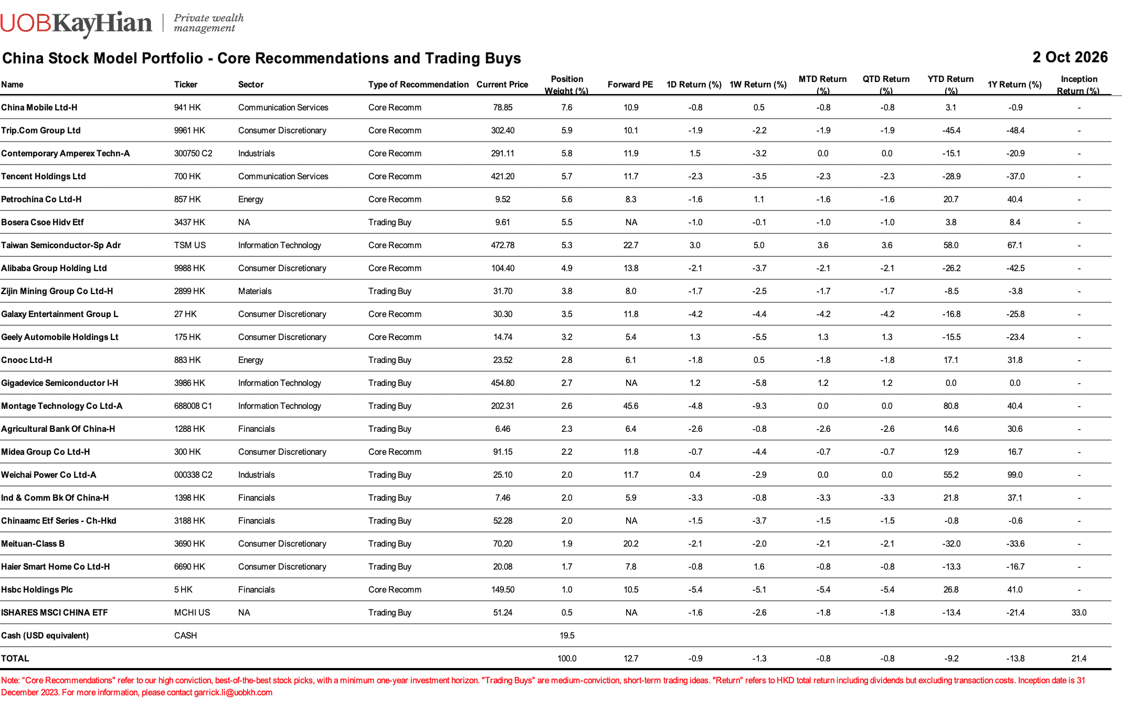
Appendix - China Stock Model Portfolio
Key China Market Indices
Index | Price | Past 2-Week Return | YTD Return |
Hang Seng Index | 23,972 | -3.1% | -6.5% |
HSCEI Index | 8,031 | -2.4% | -9.9% |
Hang Seng Tech Index | 4,158 | -5.6% | -24.6% |
Shanghai Composite Index | 3,842 | -1.8% | -3.2% |
CSI 300 Index | 4,358 | -3.3% | -5.9% |
Source: UOB Kay Hian and iFinD, as of Oct 2, 2026
China’s Growing Pains continue amid limited policy support. Top 100 real estate developer sales (new home sales) declined 9.2% yoy in September and dropped 11.8% in January-September 2026 (source: CRIC). This marks the sixth consecutive down year since 2021, and does not bode well for the macro data due later this month, especially retail sales and fixed asset investment. Meanwhile, China’s stimulus remains limited. The recent mortgage subsidies could help, but amount to just RMB 833 (USD 116) in monthly savings for eligible households. Investors are right to be disappointed, in other words.
Higher US interest rates are also hitting Hong Kong. Fed rate hikes and rising long-term bond yields are also weighing on the Hong Kong market, largely because HKD is pegged to USD. The impact has been most pronounced in Financials and Materials, which fell 4.6% and 8.4%, respectively, in the last two weeks (see below).
Domestic challenges and external headwinds call for greater selectivity. A near-term easing of both internal and external pressures appears unlikely. This means investors cannot count on a broad-based recovery to lift all boards, making stock selection more important than ever. We continue to favor high-quality companies under our China Export Shock 2.0 and China Maxxing themes. Watch the replay of our latest CIO Series to learn more.
Investors are overly bearish on Big Tech. The Hang Seng Tech Index declined 5.6% over the past two weeks and lost nearly one quarter of its value YTD. Fundamentals remain solid for Chinese platform leaders, while valuations are at historical lows. For companies such as Tencent (0700.HK), we see increasingly attractive long-term investment opportunities at current valuations (13x forward PE). We view Tencent as a leading AI practitioner (similar to Meta), not an AI laggard. This remains our Core Recommendation.
Best-performing sectors: Health Care +2.4% (e.g. 9926.HK, 2269.HK); Real Estate 0.0% (e.g. 1109.HK, 0688.HK); Utilities -0.5% (e.g. 0902.HK, 0836.HK).
Potential movers and shakers: Details inside.
Positive | CATL (300750 CH), Geely (175 HK), COLI (0688.HK), CR Mixc (1209.HK) |
Neutral | GGalaxy Entertainment (27 HK), Sands China (1928 HK), COLI (0688.HK), CR Land (1109.HK), Longfor (0960.HK) |
Negative | N/A |
Must Watch Events: Details below.
Date | Macro Data | Sector / Company Events |
Oct 7 | Foreign Reserves |
|
Oct 9-15 | Money Supply M2, M1, M0 |
|
Oct 8 |
| TSMC September sales |
Oct 14 | China Sep exports/imports and CPI/PPI; US Sep CPI |
|
Oct 15 |
| TSMC 3Q2026 results |
Oct 19 | GDP, retail sales, industrial production |
|
Best 3 Hang Seng Sectors (Past 2 Weeks)
Hang Seng Sector Index | Past 2-Week Return | YTD Return | Stock Drivers Past 2-Weeks |
Health Care | 2.4% | 6.5% | Akeso, Inc. (9926.HK) +18%, WuXi Biologics (Cayman) Inc. (2269.HK) +8.3%, CSPC Pharmaceutical Group Limited (1093.HK) +11.2% |
Real Estate | 0.0% | -3.4% | China Resources Land Ltd. (1109.HK) +2.7%, China Overseas Land & Investment Ltd. (0688.HK) +4.8%, C&D International Investment Group Limited (1908.HK) +8.7% |
Utilities | -0.5% | -1.7% | Huaneng Power International, Inc. (0902.HK) +6.7%, China Resources Power Holdings Co. Ltd. (0836.HK) +2.9%, CGN Power Co.,Ltd. (1816.HK) +2.2% |
Source: UOB Kay Hian and iFinD, as of Oct 2, 2026
Health Care led with a 2.4% two-week gain, lifting its YTD return to +6.5%. Akeso surged 18.0%, WuXi Biologics rose 8.3% and CSPC Pharmaceutical gained 11.2%. On Sep 28, AstraZeneca announced a USD 2bn investment in Akeso’s partner, Summit Therapeutics, to co-develop Ivonescimab combinations. We view the deal as a catalyst for faster global development of Akeso-originated Ivonescimab, even though the investment amount goes to Summit, not Akeso.
Real Estate was flat over two weeks, leaving its YTD decline at 3.4%. China Resources Land +2.7%, China Overseas Land & Investment +4.8% and C&D International +8.7%. China announced targeted mortgage interest subsidies on Sep 29, providing relief to eligible homeowners and serving while offering a modest demand catalyst. China likely needs a bigger stimulus to revive its struggling property market.
Utilities fell 0.5% over two weeks, outperforming the market yet extending its YTD decline to 1.7%. Huaneng Power +6.7%, China Resources Power +2.9% and CGN Power +2.2%. Regulated or contracted cash flows offer relative shelter during the recent sell-off, but generation mix determines earnings risk. Coal-fired operators are sensitive to fuel costs and tariffs, while nuclear operators depend more on utilization and project execution. Rising interest rates are also unfavorable for utility stocks as dividend plays.
Worst 3 Hang Seng Sectors (Past 2 Weeks)
Hang Seng Sector Index | Past 2-Week Return | YTD Return | Stock Drivers Past 2-Weeks |
Consumer Discretionary | -4.3% | -26.6% | Alibaba Group Holding Limited (9988.HK) -4.5%, BYD Company Limited (1211.HK) -9.3%, Meituan (3690.HK) -4.1% |
Financials | -4.6% | 8.2% | HSBC Holdings Plc (0005.HK) -7.5%, AIA Group Limited (1299.HK) -9.8%, Hong Kong Exchanges And Clearing Ltd. (0388.HK) -3.1% |
Materials | -8.4% | -18.4% | Zijin Mining Group Company Limited (2899.HK) -7.1%, China Gold International Resources Corp. Ltd. (2099.HK) -13.5%, Zijin Gold International Company Limited (2259.HK) -10.2% |
Source: UOB Kay Hian and iFinD, as of Oct 2, 2026
Consumer Discretionary fell 4.3% over two weeks, extending its YTD decline to 26.6%. BYD lost 9.3% and Meituan dropped 4.1%, while Alibaba was also among the losers despite its robust cloud compute business. As discussed earlier, China’s stimulus remains limited in scale and is unlikely to provide a meaningful boost to consumption.
Financials fell 4.6% over two weeks, lowering its YTD gain to 8.2%. HSBC lost 7.5%, AIA dropped 9.8% and HKEX declined 3.1%. September’s official survey showed expansion in monetary financial services and insurance, while capital-market services remained in contraction.
Materials was the worst-performing sector, down 8.4% over two weeks and down 18.4% YTD. Zijin Mining lost 7.1%, China Gold International dropped 13.5% and Zijin Gold International declined 10.2%. Higher US real yields and a stronger dollar weighed on gold, raising the short-term opportunity cost of holding gold and pressuring spot prices. However, gold remains a long-term beneficiary of de-dollarization and persistent geopolitical risk. We continue to like gold as our Core Recommend mention and favor Zijin as a Trading Buy.
Southbound Trading Summary (Past 2 Weeks)
(HKD millions) | Ticker | Total Buy | Total Sell | Net Buy (Sell) | % of Total Turnover | Past 2-Week Return | Data |
Southbound Total | HSHKI.HK | 290,451 | 267,015 | 23,436 | 34% | -3.1% | Full |
TENCENT | 0700.HK | 20,020 | 17,921 | 2,099 | 23% | 0.5% | Full |
Z.AI | 2513.HK | 14,015 | 13,217 | 798 | 41% | -19.7% | Full |
YOFC | 6869.HK | 11,339 | 11,437 | (99) | 44% | -4.3% | Partial |
BABA-W | 9988.HK | 9,504 | 8,749 | 754 | 20% | -4.5% | Partial |
KB LAMINATES | 1888.HK | 8,194 | 9,225 | (1,031) | 37% | 4.9% | Partial |
SMIC | 0981.HK | 5,965 | 9,250 | (3,286) | 41% | -7.5% | Full |
MINIMAX-W | 0100.HK | 6,097 | 5,648 | 448 | 40% | -19.9% | Partial |
Tracker Fund | 02800.HK | 3,977 | 2,185 | 1,791 | 10% | -3.2% | Partial |
XIAOMI-W | 1810.HK | 2,987 | 2,612 | 375 | 23% | -8.2% | Partial |
CNOOC | 0883.HK | 3,162 | 2,436 | 726 | 51% | -0.3% | Partial |
Source: UOB Kay Hian and iFinD, as of Oct 2, 2026.
Note: Based on the two-week period from Sep 21 to Oct 2, 2026. For Stock Connect Southbound trading, only the top 10 most actively traded securities are disclosed. “Full data” means the stock appeared on the top 10 list for each of the past few trading days. “Partial data” means otherwise.
Southbound investors increased Hong Kong exposure amid correction. Southbound turnover totaled HKD 557.47bn, comprising HKD 290.45bn of purchases and HKD 267.02bn of sales, resulting in a net buying of HKD 23.44bn. Mainland Chinese investors have been buying on dips as the Hang Seng Index undergoes correction.
Buying spanned resilient platforms, AI stocks and broad market exposure. Tencent attracted HKD 2.10bn of net buying and gained 0.5%, supported by Chinese investors. Z.AI and MiniMax saw net inflows of HKD 0.80bn and HKD 0.45bn, respectively, but each fell nearly 20%, suggesting immense selling pressures still. Tracker Fund attracted HKD 1.79bn and CNOOC received HKD 0.73bn, showing that purchases are extending to the broad market and energy.
- Hardware outflows accompanied both falling and rising share prices. SMIC recorded HKD 3.29bn of net selling and fell 7.5%, while YOFC saw HKD 0.10bn of net outflows and declined 4.3%. Kingboard Laminates, by contrast, gained 4.9% despite HKD 1.03bn of net selling. All three stocks are AI-driven, yet the divergence in performance highlights increasing selectivity within technology.
Stocks: Potential Movers and Shakers
Stock | Sector | Type of Events | Our Take |
CATL (300750 CH) | New Energy | Corporate Action, Sales / Products | Positive |
CATL’s Hungarian plant moved into cell trial production. On Aug 25, authorities suspended work in three areas of CATL’s Debrecen cell plant in Hungary after elevated nickel levels were detected among nine employees. After meeting the required permit conditions, CATL began trial operations with its first two cell production lines on Sep 22. The completed first unit reportedly has annual capacity of around 40GWh, versus 100GWh planned across all three phases. However, neither figure represents the current output. On Oct 1, management said capacity was booked by automakers for years ahead and its recruitment continued, although further expansion remains under discussion with the government.
Local cell manufacturing strengthens CATL’s European supply capability. Debrecen extends CATL’s European operations from module assembly into cell manufacturing, bringing production closer to automotive customers. Local cell supply can shorten delivery lead times, support local procurement by customers and deepen CATL’s integration into the European automotive supply chain. That said, trial production does not warrant earnings contribution. We are watching for a compliant ramp-up that can convert local capacity into reliable deliveries and profitable growth
Overseas growth supports our long-term positive view. CATL remains a beneficiary of China Export Shock 2.0, with European demand offering scope to offset domestic pricing pressure. Its battery reliability, customer qualification and financial strength raise the switching cost, reinforcing its competitive advantage beyond pricing.. CATL remains our Core Recommendation. (Elena Chen)
Stock | Sector | Type of Events | Our Take |
Geely (175 HK) | Consumer Discretionary | Corporate Action, Sales / Products | Positive |
- Geely expanded its charging and battery-swapping business this week.
- NIO Power investment broadens network access. On Sep 27, Geely agreed to buy 30% of NIO Power, valued at about RMB 16b, paid by offering Yiyi, its commercial-fleet battery-swapping unit, and RMB 640m cash. The stake could fall to 20% if performance conditions are not met, or increase to 34% through an additional RMB 640m investment within two years. NIO China will also acquire 10% of Haohan Energy, Geely’s charging unit.
Faster charging complements strong initial orders. On Sep 23, Geely launched a 2,250kW charging station. Its tests achieved a 10–70% charge in 4 minutes 30 seconds, reportedly 30 seconds faster than BYD’s flash charging. Separately, Lynk & Co 20 secured 14,663 firm orders within an hour of the Sep 29 launch, equivalent to 86% of the brand’s August sales of 17,027 units (down 37.4% yoy).
Both developments are positive. The NIO Power deal provides exposure to a 4,126-station swapping network through an asset contribution and modest initial cash outlay, while faster charging strengthens Geely’s EV offering. Our 2026-28 forecasts remain unchanged. Maintain BUY with a target price of HK$29, based on 10x 2027F PE. Geely is our Core Recommendation.(Ken Lee)
Stock | Sector | Type of Events | Our Take |
Galaxy Entertainment (27 HK) Sands China (1928 HK) | Consumer Discretionary | Macro / Industry Data | Neutral |
September GGR missed consensus by 3%. Macau’s Sep 2026 gross gaming revenue (GGR) reached MOP 18.1b, down 1% yoy and down 17% mom – recovering to 82% of 2019’s level (vs a recovery of 90% in Aug). Sep GGR missed market consensus by 3%. For 9M26, GGR rose only 3% yoy to MOP 187.1b.
Macau’s August visitation was up 6% yoy and 24% vs 2019. In Aug, Macau’s total visitation reached 4.5m, +6% yoy and +26% mom, or 24% above 2019’s level. Of the total, Mainland Chinese visitors amounted to 3.6m (80%), +9% yoy and +32% mom, while same-day visitors totaled 2.9m, +12% yoy and +35% mom. The average length of stay remained unchanged mom at 1.7 days. For 8M26, cumulative visitation increased 8% yoy to 29.0m, 6% above 2019’s level. Growth was driven by same-day visitors, which hiked 14% yoy, while overnight visitors fell 1% yoy.
Daily visitors exceeded MGTO’s forecast and last year’s level during the first four days of the National Day holiday. During the Mid-Autumn Festival (Sep 25-27), Macau recorded approximately 415,000 visitor arrivals, bringing the daily average to around 138,300. This represented a 3% yoy decline from the 143,050 average during last year’s eight-day combined Mid-Autumn Festival and National Day holidays, which was affected by Typhoon Matmo. For the first four days of this year’s National Day holidays, Macau welcomed approximately 750,000 visitors, averaging 187,500 arrivals per day. This exceeded the Macao Government Tourism Office’s earlier forecast of 150,000 arrivals and also the 167,900 average during the same period last year, representing 12% growth yoy.
Maintain OVERWEIGHT; Galaxy remains our top pick. We maintain Galaxy’s target price at HKD 47.00, based on a 12.0x target 2026 EV/EBITDA ratio. Galaxy is also our Core Recommendation. (Stella Guo/Ejann Hiew)
Stock | Sector | Type of Events | Our Take |
COLI (0688.HK) | Real Estate | Sales / Products | Neutral |
Top 100 developers' sales remain about 15% below last year. Gross sales of top 100 developers totalled RMB 2,127b in 9m26, down 14.7% yoy (or down 11.8% according to CRIC). Sales area fell 17.9% yoy to 100.1m sqm, faster than the decline in sales value. The entry bar fell as well: sales of the 100th-ranked developer declined 18.7% yoy to RMB 3.9b, and the number of developers with sales above RMB10b fell by 18 to 39.
Sales are concentrated in top developers, in favor of COLI and CR Land. The top 10 accounted for 52.4% of top-100 sales in 9M26, up 3.9ppt yoy. Only 15 of the 82 developers grew sales yoy, including COLI (+6.2%yoy to RMB 181.0bn), CR Land (+6.6% to RMB 164.6bn) and Jinmao (+4.9% to RMB 84.6bn), while Vanke (-48.6% to RMB 51.6bn), Longfor (-54.3% to RMB 23.2bn) and Greentown (-24.3% to RMB 81.7bn) plunged. September was weaker for the leaders, with COLI and CR Land sales down 22.9%/11.9% yoy, both to RMB 15.5bn.
Maintain UNDERWEIGHT on China's property sector. Cumulative sales declined at the same pace as in 1-8M26. New mortgage subsidies (see below), which took effect on Oct 1, are expected to marginally lift sales. Considering overall weak fundamental, we prefer developers with low reliance on presale proceeds and strong Tier 1 exposure. Top picks include COLI. (Liu Jieqi/ Damon Shen)
Stock | Sector | Type of Events | Our Take |
COLI (0688.HK) | Real Estate | Legal / Regulatory | Positive |
Central government announces its first nationwide mortgage interest subsidy. On Sep 29, the Ministry of Finance, PBOC and NFRA jointly announced a one-year programme, effective Oct 1, to subsidise 1% mortgage interest for new first-home buyers for up to five years, on loans up to RMB 1mn. Eligibility requires (a) a new loan, not a refinancing; (b) a home of no more than 120 sqm; and (c) a purchase price of no more than RMB 1.5m. The maximum saving is RMB 10,000 a year, or RMB 50,000 over five years. The 100bp subsidy is at the upper end of the market's 40-100bp expectation, but eligibility is narrower than expected. For example, homes priced below RMB 1.5m accounted for 34.4% of Guangzhou's primary and secondary transactions in 2025, yet 61% of Chongqing's new-home sales in 1H2026. Therefore, we expect the new policy to mainly benefit second-hand transactions, suburban Tier 1/2 areas and lower-tier cities with home prices are cheaper.
Beijing and Shanghai set reference rules for the Aug 28 presale reform. For land sold from Aug 28 Aug, both cities allow presales only after topping-out of the main structure and disburse mortgages only after completion filing. After receiving at least 50% of the land premium within 30 days, Beijing allows the balance in interest-free instalments over two years, while Shanghai requires payment within one year, extendable by a further year on approval. Tier 1 land supply rose to 17 sites with a RMB 61.8bn reserve price in Sep 2026, up 12% mom and 3.5x yoy, with the premium on settled lots at 12.9% (+1.5ppt mom). We expect more cities to publish new local rules.
More policy support may be on the way, as urged by top Party leaders. On Sep 28, Premier Li Qiang called for further measures to stabilise the property market, and we expect more easing to come. Recent mortgage subsidies, albeit small in scale, are expected to support property sales in the coming quarter. More importantly, we see an increasingly supportive policy tone recently, which could boost sentiment. We prefer developers with low reliance on presale proceeds and strong Tier 1 exposure. Our top picks remain COLI and CR Mixc. (Liu Jieqi/ Damon Shen)
Type of Events | Explanation |
Channel Checks | Industry-wide or supply chain news with implications to a particular sector or company |
Corporate Action | Dividends, special dividends, stock splits, share buybacks, equity / bond financing, M&As, spin-offs and restructuring etc. |
Earnings | Quarterly earnings for US-listed companies. Semi-annual earnings for Hong Kong-listed companies |
Insider Dealing | Company insiders’ buying / selling of stocks and derivatives of the company |
Investor Action | Lead investor buying / selling including activist investor actions |
Investor Roadshow | Deal and non-deal roadshows, reverse roadshows (analyst days), and company meetings at investment conferences |
Legal / Regulatory | Lawsuits, legislature/regulation changes, other regulatory events |
Macro / Industry Data | Regular economic or industry data related to the sector or stock |
Sales / Products | Sales or product related news, such as monthly sales or new product launches |
Public Event | Public speeches and appearances by companies in the media or industry conferences |
Appendix - China Stock Model Portfolio
Analyst
Elena Chen
elena.chen@uobkh.comAnalyst
Qi Wang, CFA
qi.wang@uobkh.comAnalyst
In collaboration with UOBKH Institutional Research
Disclosures and disclaimers
This report is provided subject to, and must be read together with, the full Disclosures / Disclaimers available at this link, which are incorporated by reference into this report. In particular, this report is intended for general circulation and informational purposes only and does not constitute personal investment advice or a recommendation to buy or sell any investment product or security. You should independently evaluate the information and, where necessary, seek advice from a qualified financial adviser regarding the suitability of any investment. Analyst certifications required under applicable regulations, including SEC Regulation AC (where relevant), are included in this report. By accessing, receiving or using this report, you acknowledge that you have read, understood and agreed to be bound by the Disclosures / Disclaimers, as may be amended, supplemented or updated from time to time.


